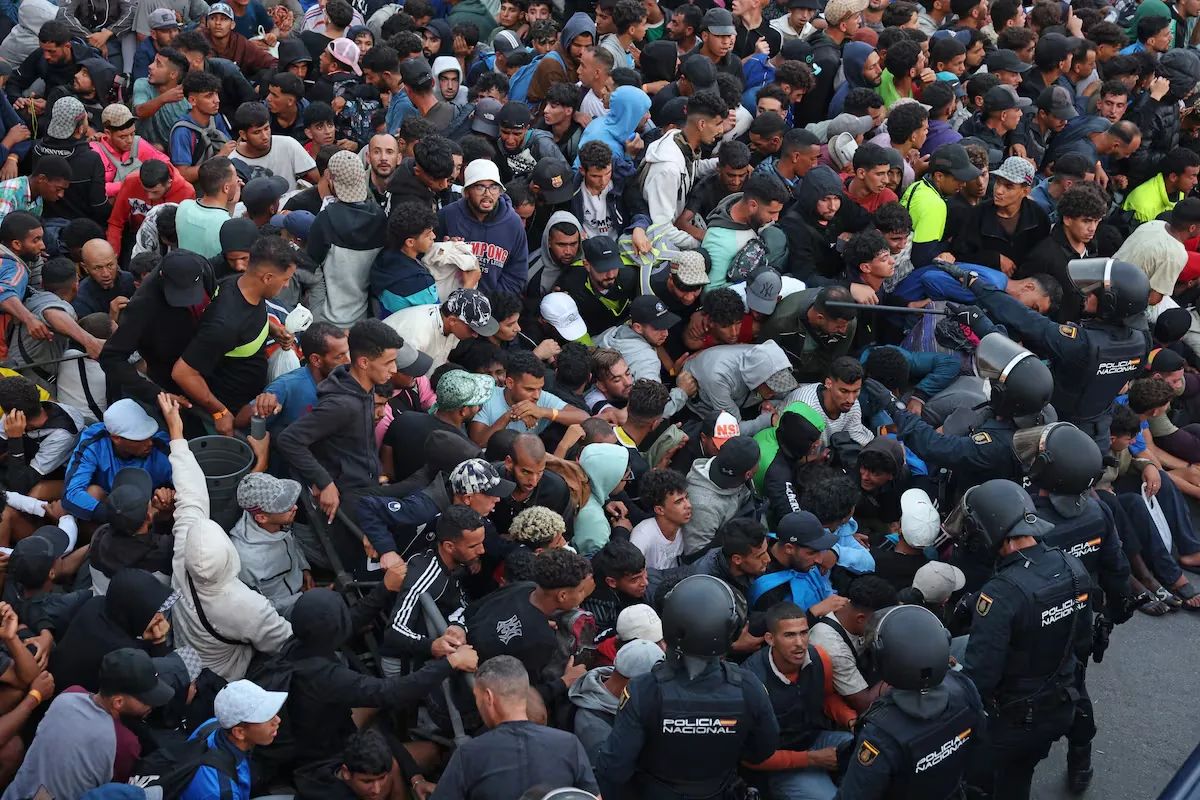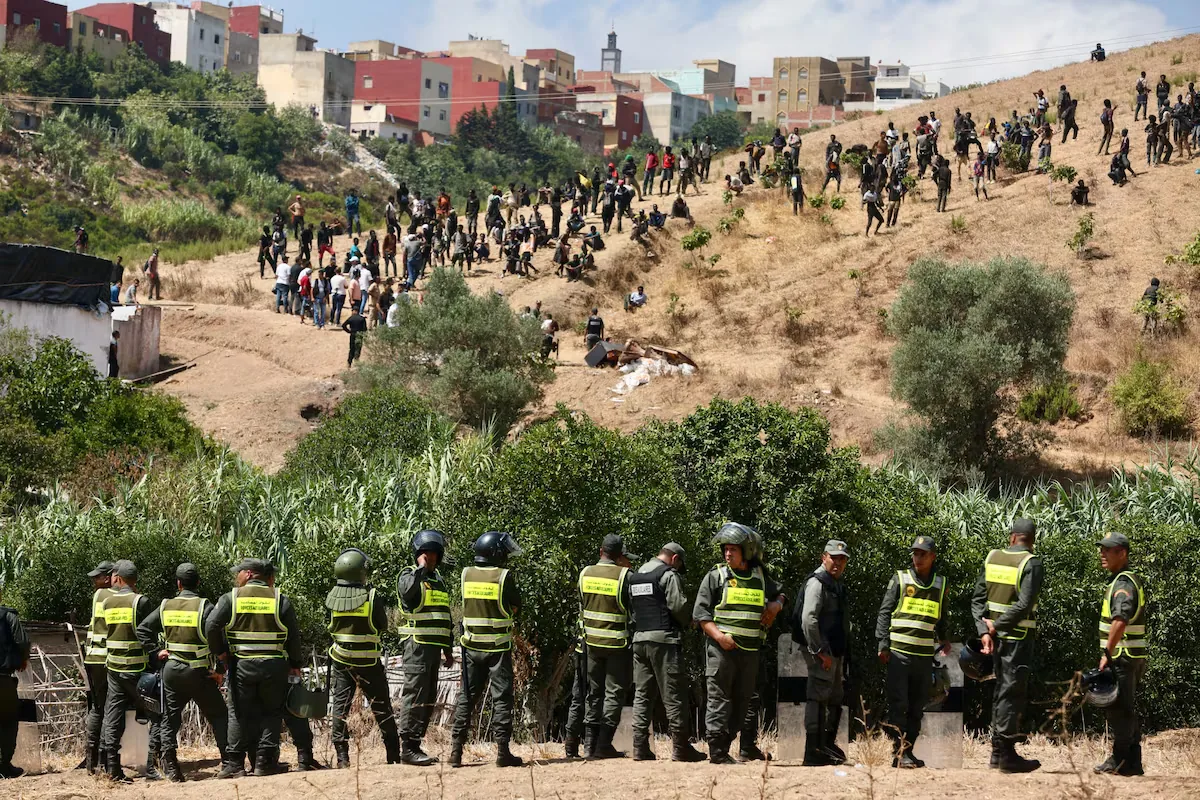
Riot units of the Moroccan security forces are blocking the passage this Saturday of some hundreds of sub-Saharan migrants who are trying to approach the border in the El Tarajal area, in Ceuta. The police have charged against them and have them cornered about three kilometers from the border on the outskirts of Castillejos. Attempts to cross into Ceuta began around six in the morning, but the reinforcements deployed by Morocco have prevented them from succeeding. There are no groups of Moroccan migrants in the area, unlike what happened on July 30 and 31, when about 80,000 crossed into Ceuta. There is a strong operation deployed near the border crossing with many more security forces than on previous days, stationed at all nearby points and marking a security perimeter. In Melilla, the border is experiencing the last hours calmly and without incidents, although with a greater police deployment than usual. Both Spanish and Moroccan authorities have reinforced both sides of the border in response to the call through social networks for a new massive entry of migrants this Saturday in Ceuta. Two weeks after the entry of more than 70,000 people into Ceuta from Morocco, the city has not returned to normal and has about 5,000 irregular migrants on its streets whom it cannot accommodate.
Read more The keys to the trial for the murder of Tupac Shakur, 30 years after his death
EL PAÍS offers the latest on the migration crisis for free. If you want to support our journalism, subscribe.

The police control migrants in Castillejos from a helicopter
The Moroccan security forces control the movements of hundreds of sub-Saharan migrants on the outskirts of Castillejos with a helicopter. The black Africans remain impassive under a scorching sun on a hillside bordering the forests of the border with Ceuta.

Ayuso calls Sánchez “irresponsible and traitor” for “letting Spain be invaded by terrorists”
The President of the Community of Madrid, Isabel Díaz Ayuso, has called the Prime Minister, Pedro Sánchez, “irresponsible and traitor,” whom she holds responsible for the massive entry of migrants into Ceuta at the end of July. “The Government has let Spain be invaded by terrorists it does not want to identify,” she wrote in a message on X.
Ayuso has spoken in these terms about the arrival of nearly 80,000 migrants to the autonomous city on July 30 and 31. Most returned to Morocco within the first 24 hours and about 5,000 remain in Ceuta, many of them unaccompanied minors who are being identified to return to their families, according to the Government.
Moroccan police charge against hundreds of migrants in Castillejos, on the border with Ceuta
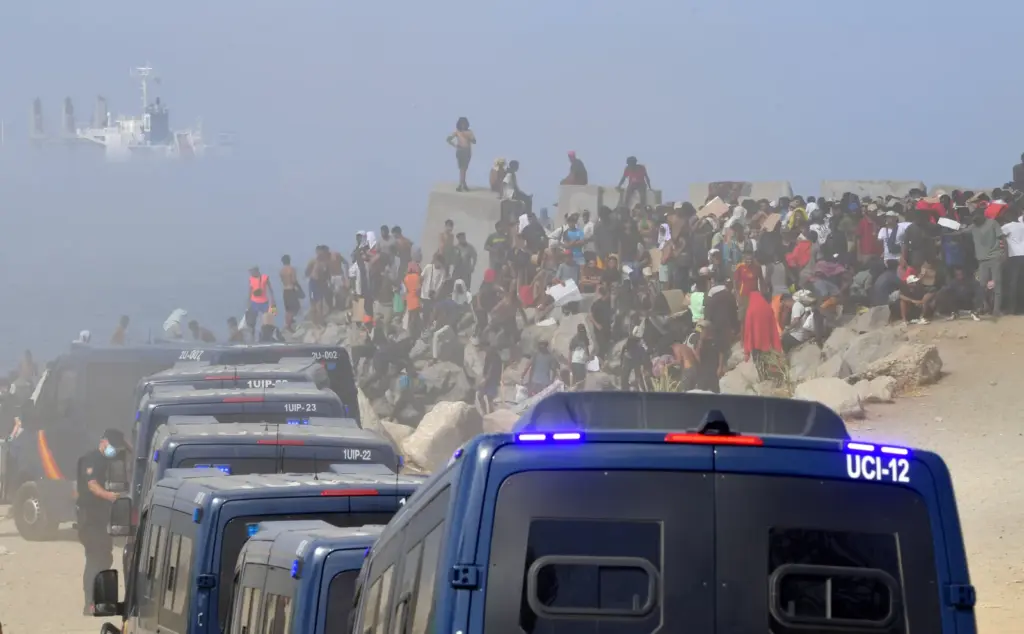
Moroccan police have charged against hundreds of sub-Saharan migrants on the outskirts of Castillejos and are beginning to detain several groups in isolated areas. The mass of sub-Saharan migrants remains concentrated in a hollow in the Cerámica neighborhood, the closest to the border.
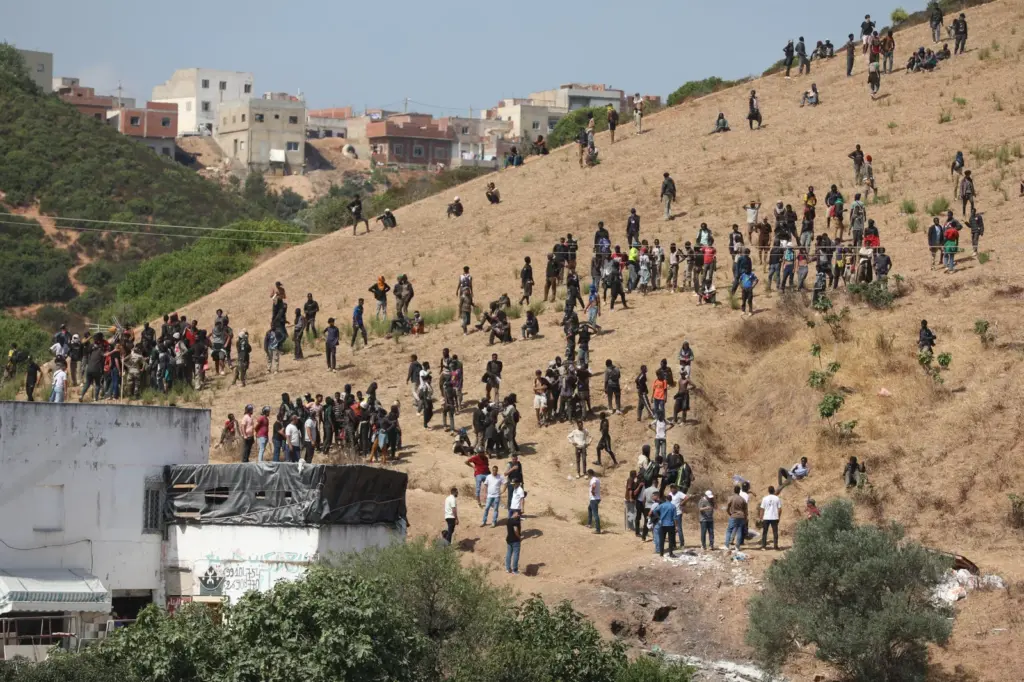
Moroccan police disperse hundreds of sub-Saharan migrants concentrated on the outskirts of Castillejos, three kilometers from the Ceuta border. / FADWA AL NASSER
Morocco blocks the passage to Ceuta of hundreds of sub-Saharan migrants
Riot units of the Moroccan security forces are blocking the passage of some hundreds of sub-Saharan migrants who are trying to approach the border in the El Tarajal area. The police have them cornered about three kilometers from the border on the outskirts of Castillejos. Attempts to cross into Ceuta began around six in the morning, but the reinforcements deployed by Morocco have prevented them from succeeding. There are no groups of Moroccan migrants in the area, unlike what happened on July 30 and 31, when about 80,000 crossed into Ceuta. Most returned within 24 hours.
Moroccan security forces concentrate at the border with Spain
On the avenue leading to the Spanish border of Beni Ansar, there is a large presence of Moroccan forces, including the Army, Police, and auxiliary forces. During the morning, more personnel continue to arrive by road, and about ten blue vans, white vehicles of the Auxiliary Forces, and military deployed in support roles are observed. At one point, there are between 60 and 70 personnel gathered, according to a visual estimate, some in camouflage uniforms and others dressed in black with caps. Part of the contingent spent the night there and is still resting under four jaimas (two with camouflage fabric). On the ground, numerous semicircular shields and helmets with protective mesh are neatly stacked. This morning, the group remains formed while receiving instructions. The Auxiliary Forces participate in the control and containment of gatherings, while the Army performs support functions.
Italian Foreign Minister on the Ceuta crisis: “Spain should worry about Morocco, not Italy”
Italian Foreign Minister Antonio Tajani believes that, regarding the Ceuta migration crisis, Spain should worry about Morocco and not Italy, since it is the country “where the problems originate.”
“Instead of worrying about us, Spain should worry about Morocco: that is where the problems originate, not in our controls, which serve the purpose of everyone to prevent illegal immigrants and, worse, potential terrorists, from reaching Europe,” the Italian far-right minister said in an interview with the newspaper Corriere della Sera.
Relations between Italy and Spain are tense due to the Ceuta migration crisis, as Giorgia Meloni’s government decided to temporarily suspend the Schengen agreement with Spain and apply controls at ports and airports on travelers coming from the Iberian country for a “security issue” in response to the massive entry of irregular immigrants.
Spain, after unsuccessfully demanding Rome lift these controls, responded with the same measure, suspending Schengen with Italy and reinstating controls on travel from Italian territory.
Asked whether Italy will maintain the suspension of the community free movement agreement, Tajani says in the interview that they have to see “if the alert is justified” and then they will decide, apparently referring to the possibility of a new massive entry of irregular migrants in Ceuta this weekend. (Efe)
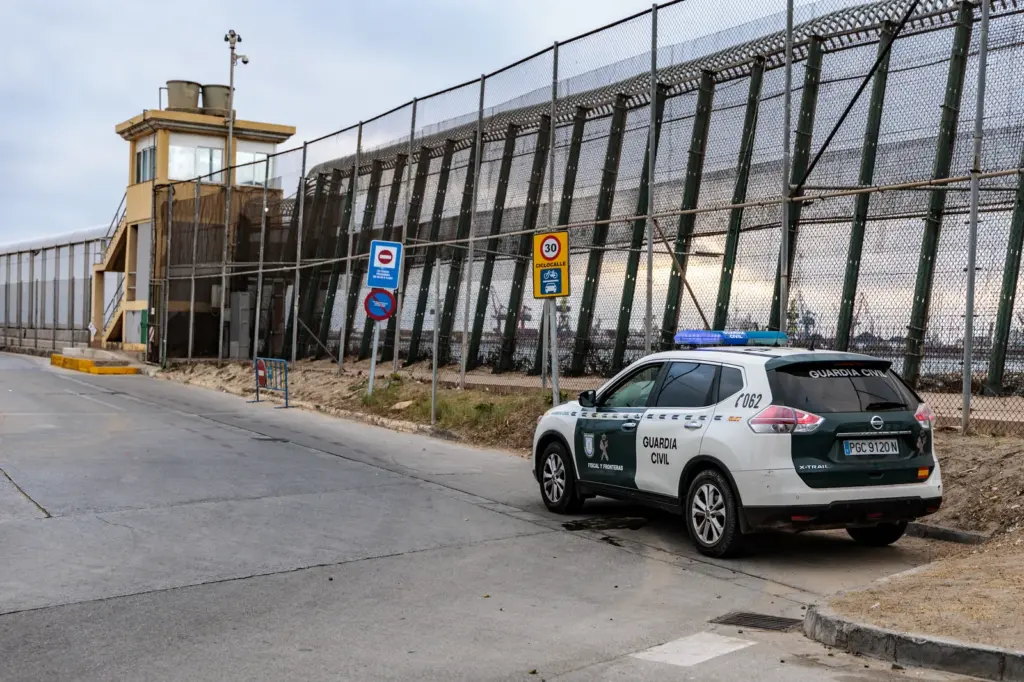
A Civil Guard vehicle at the Melilla fence, this Saturday. / José Manuel Giner
The Beni Ansar crossing (border with Melilla), completely empty: “People know the alert is there”
The Beni Ansar border crossing presents an almost absolute calm image this Saturday. The passport control room on the Spanish side is completely empty. “It is unusual,” says the only police officer in the room while checking a passport. “People know the alert is there,” which explains the situation these days, when many citizens have given up crossing into Morocco. Among the few travelers passing this control is Islam, a woman in her twenties from Málaga who crosses the border to her country of origin with her family to attend a wedding in Nador. She complains that Moroccan agents unnecessarily delay the passport checks and says that during the wait, she has seen them watching TikTok.
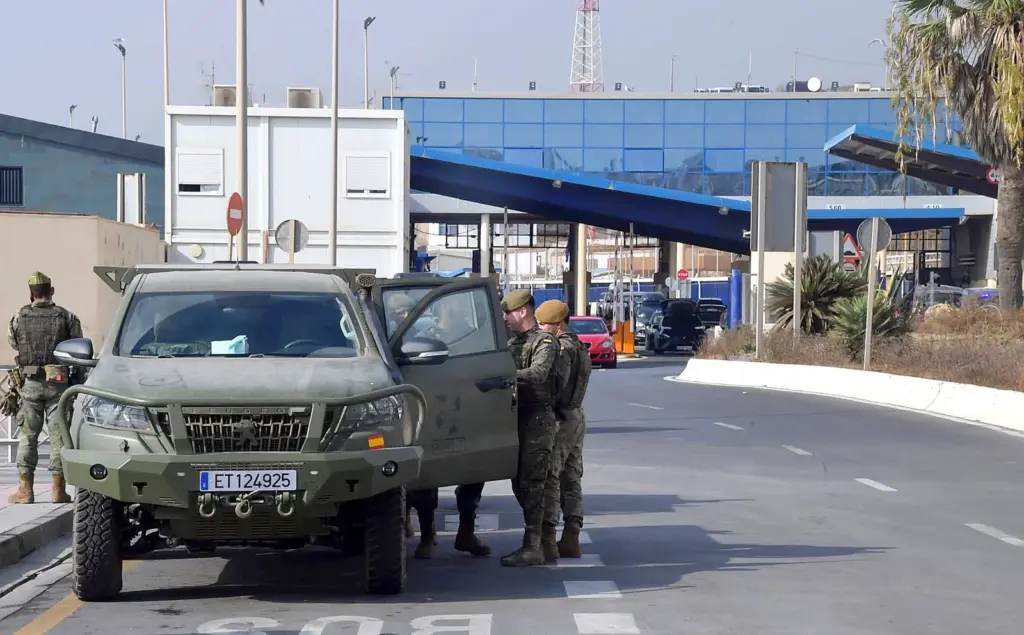
Military personnel at the El Tarajal border, this Saturday. / Joaquín Sánchez
Calm at the Melilla border, with greater police deployment than usual
The Melilla border is experiencing the last hours calmly and without incidents, despite calls spread on social networks in Morocco to try to enter irregularly this Saturday, although with a greater police deployment than usual.
Sources from the Government Delegation in Melilla have reported that the day is proceeding “normally, without news and without incidents.”
According to the Efe agency, the comings and goings of Civil Guard, National Police, and Local Police patrols are constant on the south pier, one of the hotspots of the migration crisis that began on July 30, although the area is calm.
Additionally, in recent days, the final stretch of the pier has also been reinforced with the installation of a fence, where previously there was only a breakwater, and a floating barrier.
Likewise, there is a notable police deployment in the urban area of Melilla, although calm predominates in the early hours of this Saturday in the city.

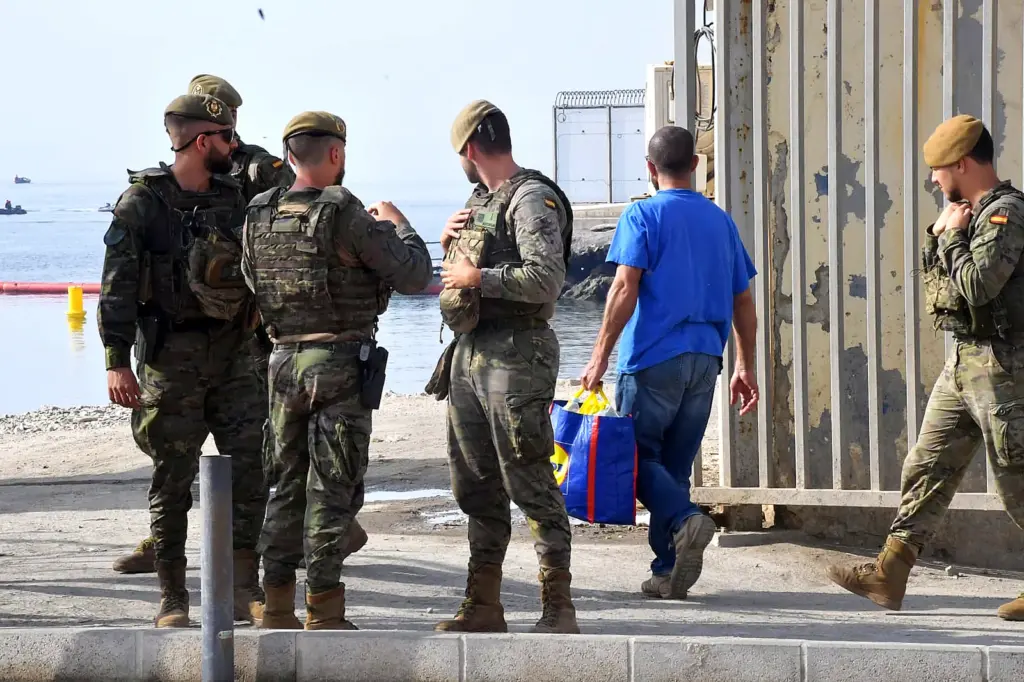
Spanish soldiers at the El Tarajal border this Saturday. / Joaquín Sánchez
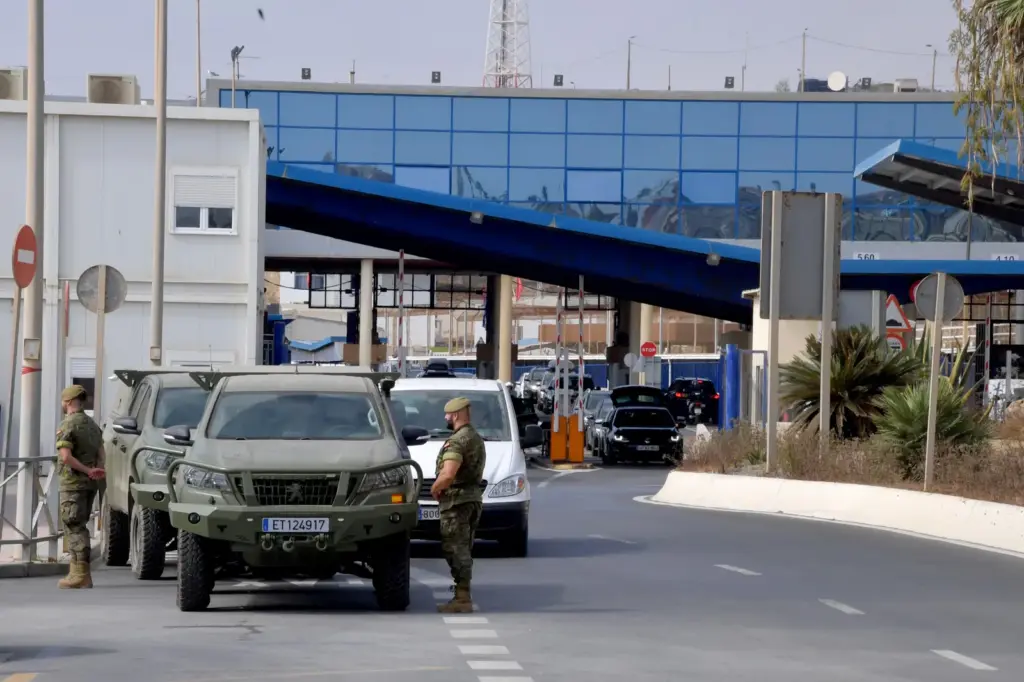
Police, Civil Guard, and military shield the surroundings of the El Tarajal crossing against the 15-A call
Ceuta woke up enveloped in taró (the typical August mist in the autonomous city). And amid uncertainty about whether the call for a new massive entry would materialize, after messages went viral on social networks in Morocco inviting people to join crossing into Spanish soil.
Until eleven this morning, however, the situation remains calm in El Tarajal. The strong operation deployed near the border crossing with many more security forces than on previous days is unusual, stationed at all nearby points and marking a security perimeter around ten in the morning.
At the El Tarajal fence, at that time, about ten soldiers from the Army, also legionnaires, and civil guards watch the entrance of the pier. The shielding of the pier is ten times stronger than the previous day, the eve of 15-A. And not only at the gate; dozens of National Police officers occupy the nearby bridge and the hill right in front and have perimetered the entire area.
Morocco says it has thwarted a new attempt by hundreds of immigrants to reach Ceuta
Moroccan security forces say they have thwarted a new attempt to irregularly cross into the Spanish city of Ceuta by hundreds of migrants who had hidden on the outskirts of the border city of Castillejos.
Moroccan security sources indicate that the incident occurred in a mountainous area on the outskirts of Castillejos and southwest of Ceuta.
Thousands of personnel participate in the security deployment organized by Rabat to prevent the crossing into Ceuta that had been called for this Saturday through social networks after the massive entry at the end of July. (Efe)
MIGRATION CRISIS
Dozens of civil guards and soldiers disembark in Ceuta ahead of 15-A: “The alert is there, but it is not a real threat”
Social networks, the media, politicians, Spaniards—and especially the people of Ceuta—have been looking at this point in recent hours. A small beach of about 200 meters between pier and pier, between fence and fence, Spanish territory, where 15 days ago thousands of people crossed massively and irregularly from Morocco to Ceuta. Since then, tense calm has settled at the El Tarajal crossing that divides Europe and the Alawite kingdom. But this August 15, uncertainty is even greater due to the supposed call for a new crossing from the neighboring country. The day before, four Civil Guard agents guard the piece of land and geostrategic powder keg as they do every day. From time to time, Army trucks also arrive to control the area. Next to the 500-meter red buoy, the deployment is not special for this Saturday, but dozens of civil guards and Army soldiers have traveled in recent hours to the city of Ceuta in anticipation of what may happen, either as reinforcements or interrupting their vacations, filling the ships arriving at the port.
Read the full information here.
MIGRATION CRISIS
Unprecedented police deployment in Ceuta amid fear of a new massive entry: keys to the border crisis
Never before, until July 30, had Ceuta faced a migration crisis of this magnitude. The swimming entry through the El Tarajal pier of 80,000 people from Morocco, according to the latest government estimates, brought this city of just over 83,000 inhabitants to the brink of collapse. More than two weeks later, the situation is still far from normalized, as Interior Minister Fernando Grande-Marlaska acknowledged on Thursday, and at least 5,000 of the irregular migrants who crossed the border that day—about half of whom are minors—are still waiting for their situation to be resolved with the threat of expulsion. In the background, the risk, as this Saturday, of new massive jumps encouraged through social networks, as happened then. These are the four keys to understanding the current situation of the Ceuta border.
Read the full information here.
Good morning. Here begins the live narration of the situation in Ceuta and Melilla this Saturday, August 15, in response to the call through social networks for a new massive entry of migrants.
Read more Peruvians trapped in the Russia war after a job promise: “They take us like cannon fodder”