







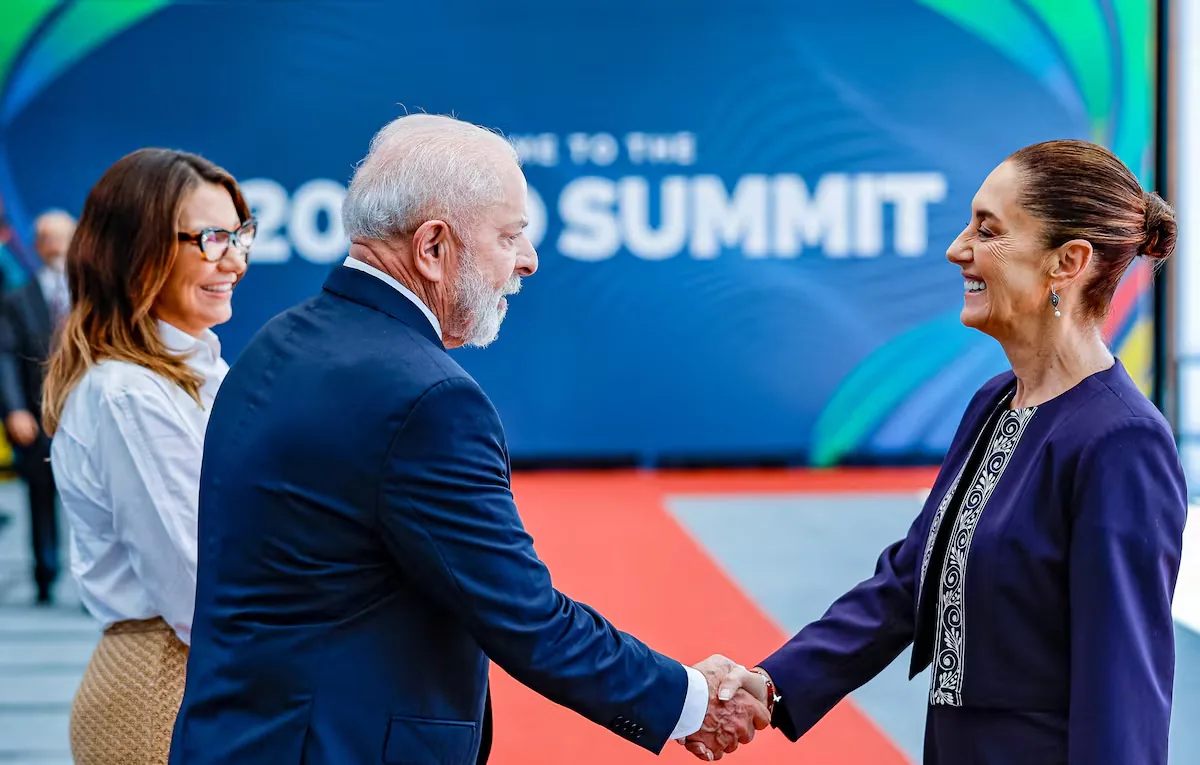
Contacts between presidents Luiz Inácio Lula da Silva, 80, and Claudia Sheinbaum, 64, are becoming increasingly frequent as the United States pursues, at a rapid pace and without scruples, to establish its dominance in the Americas. Both leaders, heads of the two Latin American giants, the only significant countries governed by the left in the region, spoke again this Thursday via videoconference. While the Mexican highlighted in a tweet that Brazil and Mexico “continue building an increasingly solid bilateral relationship,” the Brazilian emphasized “the strategic importance of bilateral collaboration.” The two largest Latin American economies are strengthening commercial and diplomatic ties as their leaders harden their rhetoric. Lula and Sheinbaum resist the Trumpist onslaught and the reactionary wave advancing across the continent.
Read more The delicate global financial balance
Lula, the Bolsonaros, and Brazil are preparing for crucial elections in October, with the election of president, governors, and Congress. A pivotal vote also for the right-wing international led by Donald Trump, emboldened by the seven victories won in Latin America since the Republican returned to power in January 2025.
Brazil is big game. The left-right/Lula-Flávio Bolsonaro duel looks formidable according to polls. The latest, from Friday, gives the leftist 43% against the ultra’s 40%. “For democrats in the region, much is at stake,” says a Brazilian diplomatic source.
Michael Shifter, former president of the Inter-American Dialogue and one of Washington’s most influential hemispheric policy analysts, stresses that “these are not just any two countries. They represent more than half of Latin America’s GDP and population. They have greater capacity to resist Washington’s pressures.”
The researcher points out the limits of each: while Brazil has more leeway due to its commercial autonomy and ties with China, Mexico’s relationship with its northern neighbor is one of constant asymmetry and wear: “With Trump, it seems that whatever Sheinbaum does to try to satisfy him is never enough. Trump always asks for more.” Shifter maintains that “there is no intention to pick a fight with the Trump Administration, but there are incentives to set certain limits.” A dispute, by the way, that they did not start.
When the world was predictable, Lula liked to preach peace and love as an unbeatable formula to achieve progress. The Brazilian now seeks a fourth term amid open interference from Washington and surrounded by right-wing governments with which he tries to maintain a fluid relationship to preserve Brazil’s central role in the region, avoid isolation, and because he firmly believes in the power of dialogue and negotiation, which are in his country’s DNA. “He was never sectarian, had a good relationship with Bush Jr., Uribe, Sarkozy…,” emphasizes the cited diplomatic source, recalling his meetings with the leaders of Bolivia, Chile, Ecuador, Panama, Paraguay…
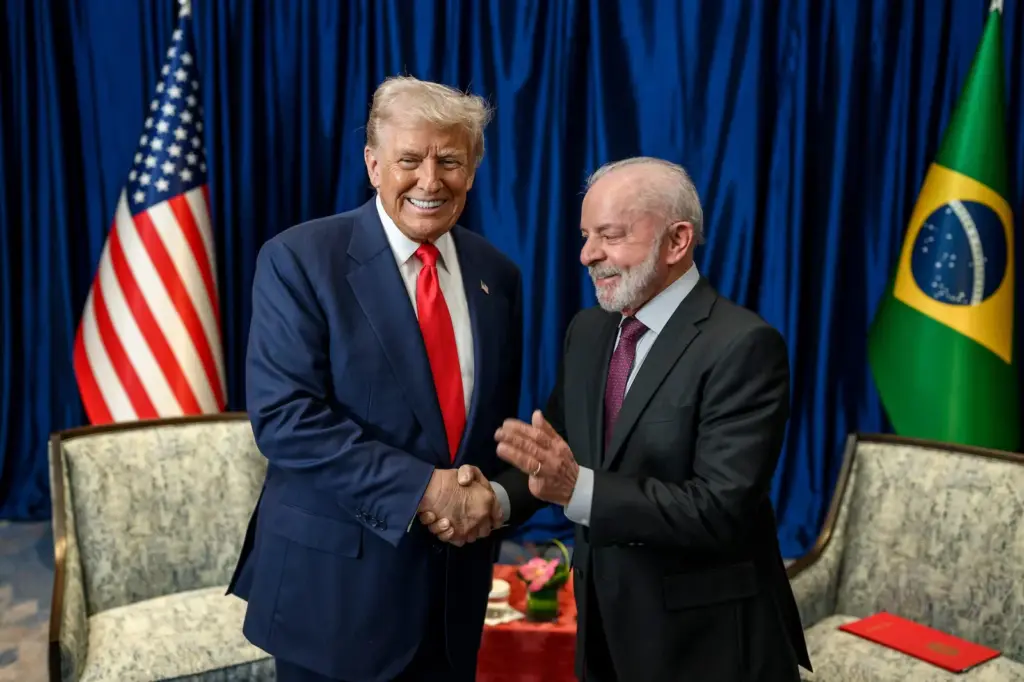
The rapport between the octogenarians Lula and Trump displayed is water under the bridge. The Brazilian government considers that the magnate has already chosen a candidate in the Brazilian elections: Flávio Bolsonaro, son of the former president and convicted coup plotter Jair Bolsonaro, whom Lula accuses of betraying the homeland by instigating a series of US attacks against Brazil.
Washington has used the same manual to pressure Lula and Sheinbaum: commercial blackmail, visa obstacles — to the Brazilian ambassador, the son of former Mexican president Andrés Manuel López Obrador and Morena’s organization secretary, a governor — and declaring cartels and criminal groups as terrorists.
The fear is that this last measure is a pretext for a possible US military attack on their territories. Stephen Miller, Trump’s deputy chief of staff, went as far as to say that drug cartels are “the ISIS and Al Qaeda of the Western Hemisphere and must be treated with the same brutality and ruthlessness.”
Wrapped in the flag, Lula presents himself as the great defender of Brazilian sovereignty against attacks and a scenario that not long ago would have seemed implausible. “We need to invest in defense. I want to be prepared so that no one invades this country and kidnaps the president, as they did,” he proclaimed at a recent rally referring to Venezuela. He also intends for Brazil to start manufacturing drones. “How are we going to control 16,000 kilometers of border? On foot? Without drones, you don’t control it.”
With the United States in full offensive to consolidate its dominance in the region, whether with a summit with military allies in Panama and instructive videos about the Donroe doctrine, the tutelage of Venezuela, tariff punishments, or joint military operations in Ecuador or Colombia, Lula’s Brazil rules out appeasement. It has just activated the machinery to respond to Washington with tariffs.
Governing Mexico in the times of Trump’s second term has become for President Sheinbaum a true exercise in juggling before a White House willing to blow up the bridges of bilateral trade with the persistent threat of punitive tariffs, while sliding the most aggressive rhetoric in decades: possible direct intervention on national territory to combat criminal organizations. The equation is complicated for a government forced to contain the impact on an economy deeply coupled with that of its northern neighbor.
“Poor Mexico, so far from God and so close to the United States!” It is the maxim attributed to Porfirio Díaz that harshly defines this historic and tense neighborhood. The daily battle is no longer just to contain the demands of an unpredictable leader but to demonstrate that Mexico can cooperate in security and trade on reciprocal terms, as the Mexican government argues.
Faced with the economic blackmail that the revision of the Mexico-US trade framework entails, Sheinbaum keeps institutional diplomacy channels open and avoids the visceral confrontation that the New York magnate profits so much from. However, the room for maneuver narrows when Washington’s rhetoric touches sovereignty, which for the president is non-negotiable. For Mexico, the discretionary withdrawal of visas is a tool of political coercion, interference ahead of the 2027 federal elections.
Mexico and Brazil recognize the current rapport between presidents Lula and Sheinbaum but, always jealous of sovereignty, cherish their autonomy. Plans for a visit by President Sheinbaum to Brazil have not materialized and, given the calendar, would only be after the elections.
For Carolina Moehlecke, from the School of International Relations at the Getúlio Vargas Foundation, “the challenge is enormous because Brazil functions better in stable scenarios.” Especially serious is the deterioration of relations with Argentina, the main destination of Brazilian industrial exports, and with the United States, the top direct investor. “In an extremely polarized scenario like the current one, external attacks no longer unite countries, they divide them along internal ideological lines,” she explained this week at a seminar on the elections. And with the added problem, she said, that “it fuels the incentives of those contesting an election to mobilize certain messages.” And that becomes a vicious circle.
The leftist Lula, at the head of a country of 210 million inhabitants, the fourth most populous democracy in the world, promises not to bow to Washington or its allies: “We will firmly oppose any attempt to subordinate Brazil to foreign interests or to a position of geopolitical dependence,” he states in his electoral program.
Brazilian Foreign Minister Mauro Vieira, a veteran diplomat, recently criticized in an article the attempts to “impose again in the world a logic of the law of the jungle.” He also warned that “Itamaraty [as the foreign ministry is known] will not stop reacting, always professionally, to disinformation maneuvers and the rudeness of aspiring predators and their local supporters [referring to the Bolsonaros].” Brazilian diplomacy keeps a cool head and its commitment to react proportionally. To the unprecedented and rude insults from Argentine Javier Milei against Lula, it responded by withdrawing the ambassador.
Analyst Shifter, from the Inter-American Dialogue, explains that the complex current scenario reflects a broader structural transformation throughout the region. He argues that the White House’s actions have drastically altered the bilateral relationship with Mexico: “Human rights and democracy have disappeared from the agenda. The entire focus on strengthening institutions and protecting and defending human rights has at least lost much importance,” he explains.
For Shifter, this retreat alters the regional balance: “Washington has basically given a green light to any authoritarian project that a leader in Latin America might have,” he warns. “Today ideology matters less. There is quite an open field for right-wing or left-wing regimes to eliminate checks and balances and weaken, if not destroy, the rule of law,” he points out.