Frustrated by a stalled and boring war against Iran, and eager to punish the allies, the President of the United States, Donald Trump, is increasingly looking back to what he considers the moment of glory of his foreign policy during his first term: the —failed— nuclear negotiations with the North Korean leader, Kim Jong-un. Angry with a South Korean government he accuses of not helping to resolve the blockade in the Strait of Hormuz, he now threatens a new rapprochement with the authoritarian regime in Pyongyang that could shake the delicate geopolitical balances in the Asia-Pacific and, with them, those of the world.
Read more A coalition sues the Trump Government for limiting the duration of foreign student visas
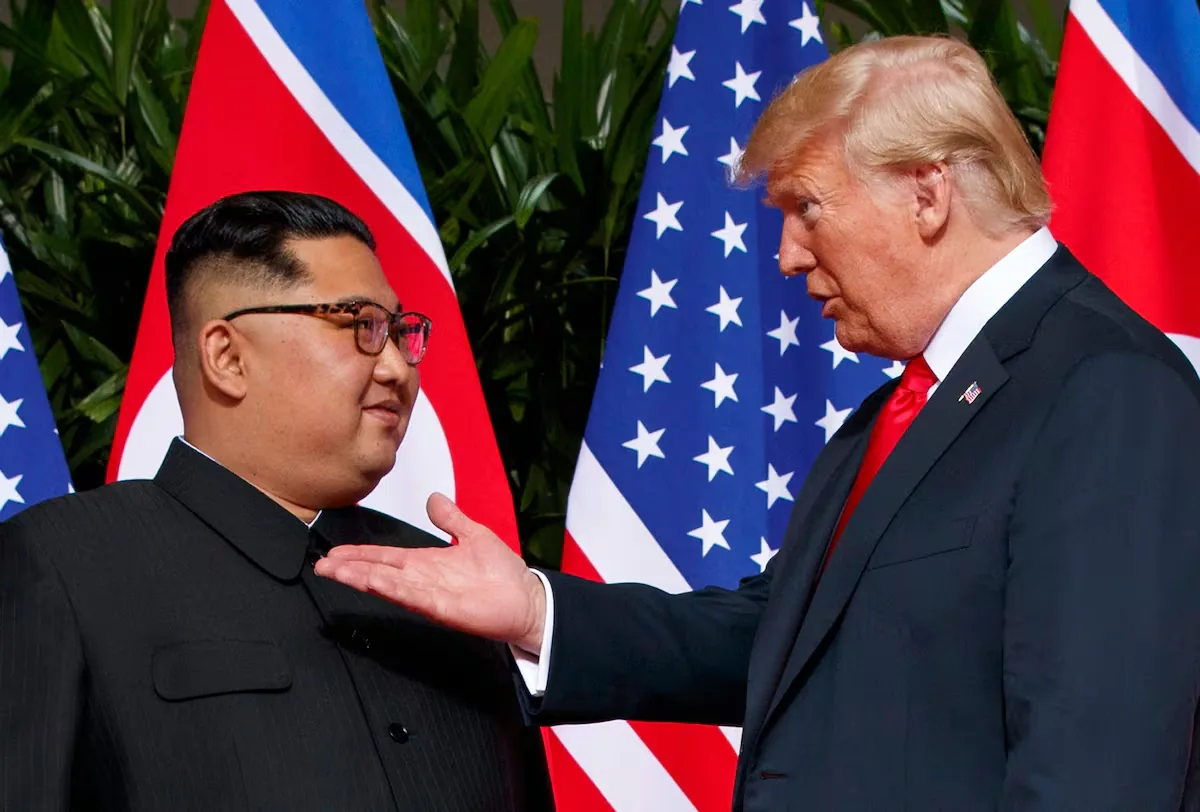
That first Trump campaign to achieve the denuclearization of North Korea included three meetings between the Republican and the scion of the Kim dynasty between 2018 and 2019. The only ones in history between a U.S. president and a North Korean supreme leader. They yielded no results Washington could boast about, beyond some vague promises. On the contrary. Pyongyang became more convinced that its nuclear program is the lifeline that protects it from enemy attacks and has multiplied its production of these weapons: experts estimate that today it has about 60, three or four times more than a decade ago, and possesses enough material to reach 90.
But the Republican leader nostalgically recalls the pomp and media attention surrounding those summits, that feeling of making history that increasingly seems unlikely to be repeated in the war against Iran. In the corridors of the presidential residence, it is possible to see the photo of his handshake with Kim in Singapore in 2018, but it does not seem likely that there will ever be a similar one with the spiritual leader in Tehran, Mojtaba Khamenei, hanging in the Oval Office.
Trump brought up the possibility of a new rapprochement with Kim last Sunday, when he announced his desire to cut the annual military maneuvers with South Korea, which will end abruptly this Friday, six days earlier than planned. The president spoke in glowing terms of his “friendship” with the leader he almost ten years ago nicknamed “rocket man,” due to the constant North Korean missile tests. He has also cited dissatisfaction with Seoul for not supporting him enough in the war in Iran. Now, according to The Wall Street Journal, he is considering holding a new summit with “the brilliant comrade” when he travels to Asia this fall.
One possibility is that the face-to-face meeting will take place in November, taking advantage of the Asia-Pacific Economic Cooperation (APEC) leaders’ summit to be held in the Chinese city of Shenzhen. Although officially there is no plan underway for a meeting with Kim — North Korea is not a member of APEC — Trump’s desire for it to happen “points to the president desperately seeking an achievement to boast about in foreign policy, given that victory in Iran remains elusive,” the Journal notes. It also recalls that “most U.S. presidents have refused to meet Kim without preconditions.”
This is not the first time in this term that Trump has expressed interest in a new rapprochement with the North Korean autocrat. Last year, during another tour of Asia, he urged the press accompanying him aboard Air Force One to “spread” his hopes for a new summit. It came to nothing: the president himself later commented that such a meeting would have overshadowed the one already scheduled — and was fundamental to straighten out the key bilateral relationship between Washington and Beijing — with Chinese President Xi Jinping in South Korea.
North Korea has made no comments on Trump’s renewed interest in relaunching a relationship in which, according to the U.S. president, Kim wrote him “beautiful letters.” “We fell in love,” said the Republican. In statements from the Oval Office on Monday, the president said the North Korean leader has indeed responded to messages and that exchanges between the two are “very positive.” He provided no further details.
“It is very clear that he is again communicating his desire to meet with Kim, to develop contact with North Korea. But this time it is different, because he has said he will reduce military maneuvers with South Korea, which are perceived as extremely important,” Andrew Yeo of the Catholic University of America in Washington pointed out on Monday in a talk organized by the think tank CSIS. The president returned to this issue on Monday in the Oval Office: he recalled that the United States protects South Korea against its northern neighbor and asked why his ally did not want to help him in what he called a “very simple military operation.”
The order to cut the maneuvers has caused enormous surprise. North Korea, which since the failure of negotiations with the United States has moved closer and closer to its great sponsor, China, and to Russia, has sent soldiers to the war in Ukraine, where it has learned new tactics and gained access to new technology. The joint military exercises were seen as key to coordination between South Korean and U.S. forces in light of the new North Korean military reality.
Pressure on Seoul
“President Trump’s message adds pressure on several pending issues related to the South Korean government,” South Korean Foreign Minister Cho Hyun said Wednesday before a parliamentary committee. The diplomat believes the order pursues three objectives: to force Seoul to address Washington’s demands, send a signal to Pyongyang, and help the United States break the deadlock in the Iranian conflict.
Trump said there are 39,000 U.S. troops deployed in South Korea, although the official figure is around 28,500. He also did not specify what kind of participation he had requested from his South Korean counterpart, Lee Jae-myung. The South Korean presidency maintains, however, that it has participated in international efforts to reach a ceasefire and restore free navigation in the Strait of Hormuz and states that it is negotiating with Washington possible practical and military contributions.
Adding to this friction is South Korea’s commitment to invest $350 billion (300 billion euros) in the United States as part of the trade agreement signed last year. Of that total, $150 billion will be allocated to cooperation in the shipbuilding industry, but both governments continue to negotiate how to execute the remaining $200 billion, according to the South Korean agency Yonhap. Cho has defended the delay due to the need to study the commercial viability of the investments, complete legal procedures, and resolve unforeseen issues he has not specified. South Korean Finance Minister Koo Yun-cheol has denied that his country is deliberately delaying the process.
The military exercises, which began on August 17 and were to last until the 27th, will finally end on the 21st. It is the first time that joint maneuvers of this magnitude have been shortened at the request of the United States once started, Yonhap reports. The allies will complete only the defensive phase, in which they will rehearse how to respond to a North Korean attack, but will leave out the part focused on a counteroffensive. Seoul and Washington are still negotiating what to do with the 14 joint exercises planned on the ground, but the Pentagon maintains that these changes will not affect their training objectives.
The North Korean regime systematically condemns these maneuvers, which have been held under different names and formats since 1976. The North Korean regime considers them rehearsals for an invasion, while the United States and South Korea insist on their defensive nature. In a commentary released Wednesday by the North Korean state agency KCNA, North Korea calls both countries “warmongers” and assures it will continue to exercise its right to “self-defense” as long as the military threat persists.
While Pyongyang plays hard to get — and analyzes what advantages it can gain from Trump’s desire for an approach — and South Korea tries to temper the situation, the rest of the powers in Asia watch the situation with interest. A Japan already concerned about Trump’s erratic policy in the region seeks to reconfigure its alliances and strengthen its military ties with Australia.
China moves its pieces: the announcement of the reduction of the maneuvers coincides with the arrival in Seoul of Chinese Foreign Minister Wang Yi, on his first bilateral visit to South Korea in five years. Wang met Wednesday with his counterpart Cho and will be received Thursday by President Lee, as well as by his National Security Advisor, Wi Aung-lac. The situation on the peninsula will be among the main topics of the talks.
Beijing, the main economic partner and traditional ally of North Korea, retains great influence over any attempt to reactivate regional dialogue. The tightening of the military alliance with Russia, to which Pyongyang has sent troops and weapons for the war in Ukraine, has also expanded Kim’s room for maneuver.