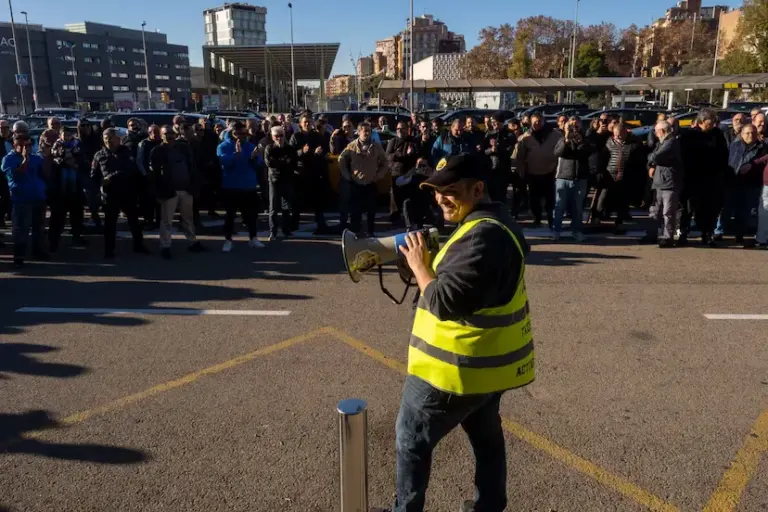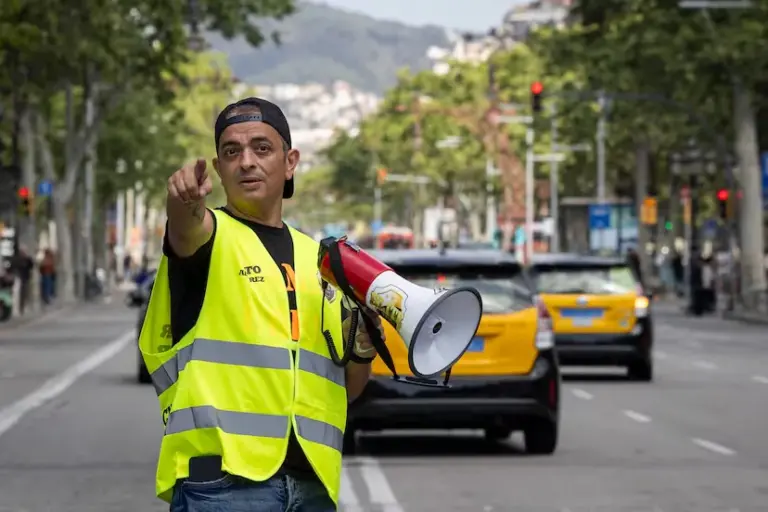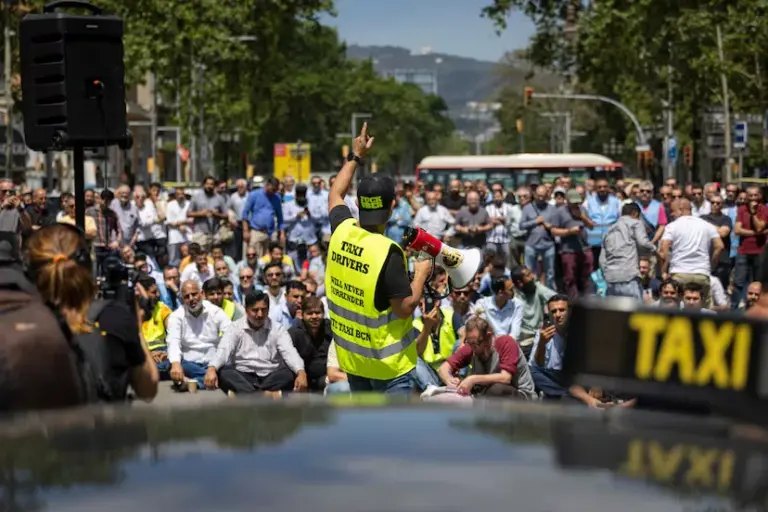
Walking with him along the Gran Via, that hot July of 2018, was the worker version of accompanying a Hollywood star through the streets of Cannes. Among the rows of taxis parked on one of the main arteries in downtown Barcelona, on asphalt that was burning and with the sun reflecting off the car bodies, everyone wanted to take pictures with him. Alberto Tito Álvarez had only been a taxi driver for five years at that time, but in a short time he had become a union leader capable of uniting the traditionally fragmented sector against the rise of mobility platforms competing with them, such as Uber and Cabify. “I am Tito, a rank-and-file taxi driver,” he said then.
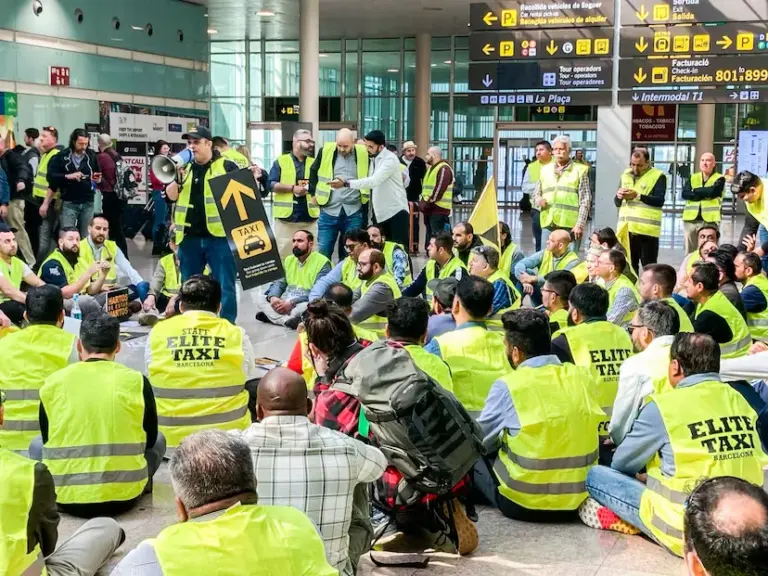
The protests of July 2018, which lasted several days, were repeated six months later, in January 2019, and there were also protests in other Spanish cities such as Madrid. It was a cycle of mobilizations in the taxi sector that put the Government on the ropes — its interlocutor was then Minister of Development, José Luis Ábalos, now in prison — and the Generalitat — the Territorial Councilor at that time was Damià Calvet — who kept passing the ball on how to regulate the mobility platforms that used VTC licenses. The result of those protests was twofold: on the one hand, a series of decrees and regulations that did not fully solve the problem but set certain limits on the new platforms; and on the other, a certain cohesion was achieved for the first time in the sector, in which lifelong taxi drivers, license owners, and salaried drivers, as well as new drivers from Pakistan or Morocco, seemed to unite, carried by the wave of Álvarez and his union, Élite Taxi, which imposed more aggressive and confrontational methods, resulting in some episodes of violence.
Álvarez now spends most of the year on Isla Margarita, a Caribbean paradise that belongs to Venezuela, where he went on vacation for three months in June last year to rest from the stress of taxi driving. He liked it so much that he returned that Christmas. And then the love struck. He fell in love with a girl from the island, proposed to her in a shopping center, and moved there, where he has since spent most of his time. He refers to that episode as an inevitable lightning bolt of fate — “that which happened to me,” he calls it — a prophecy already fulfilled that will lead him to retire there permanently — “here all year round we are between 26 and 35 degrees, it’s eternal summer,” he explains by phone — when he finishes what he is doing: pushing the taxi law that must finally regulate the sector once and for all.

Since the strikes of 2018 and 2019 “many things have changed,” Álvarez explains: “Part of the sector has evolved positively, and another part terribly, it is rotten and dedicated to scamming tourists.” Álvarez believes that the law being processed in the Parliament is the result of those protests, and that the regulation will protect and modernize the sector. But he also states that this law “touches many personal interests and bad practices not only in VTCs but also in taxis,” and this has led to suddenly “everyone being against Élite Taxi.” Among other things, the proposed law foresees that all vehicles, taxis and VTCs, carry a black box to control practices; that a B2 level of Catalan is required from all drivers, which has put foreign-born drivers on the warpath; and proposes a formula, the “exchange,” so that half of the 4,000 VTC licenses become taxi licenses throughout Catalonia, and the other half remain traditional VTCs.
Read more Has the time come to abolish prostitution?
“Everyone is against it, but they don’t propose alternatives. But it is a measure that solves the problem and the administration regains control of the licenses. In the PP and Vox communities they liberalize and deregulate, but here we can prove that regulation is possible,” Álvarez explains. He has gone from being a leader acclaimed by all to being considered a “traitor or sellout” by some. “I am God or the devil, there is no middle ground, but those who attack me are those whose gravy train is ending, those who engage in bad practices,” he points out. Faced with accusations of having sold out, Álvarez is blunt: “They have tried to buy me four times, and the last time there was a lot of money on the table. I told them no, I can’t fight against what I am, it’s impossible for me to sell out.”

Born in the Nou Barris district in 1976, he has explained several times that before starting to work as a salaried taxi driver in 2013, he worked as a waiter, welder, crane operator, and suffered hard episodes such as having to sleep on the street for a month and a half. At first, he was reproached for his alleged links to the FC Barcelona ultra group Boixos Nois, but that has not prevented him from sitting down to negotiate with politicians of all colors, that several parties have sought his support, and that he has ended up building more and more a profile of a serious unionist, although his street vein often slips out. “Since the protests I have matured, I have hardened. I have learned that you must not leave the streets, but also that in the offices you cannot be carried away by pressure. And now it’s not about the streets, it’s about the offices, getting this law passed, because if not, it will get out of hand for everyone,” he points out.
In 2019 he left the wheel to become a full-time union representative, and explains that now he lives from this and from the license he bought with Taxi Ecològic, which works double shifts. “This requires full dedication,” he points out, although he admits it has taken a toll on him several times. “They have done everything to me, they have gone after me hard, but the nail that sticks out the most is the one that gets hammered the most,” he says. Over the years, he has resigned and threatened to leave everything, but he has always returned, as evidenced by the thousands of messages on his communication channels. “It has affected my mental health a lot, I didn’t sleep, I was agitated, so I decided to ease off. But with the law I am at 200%. I have had phases of giving up, but it’s inside me,” he says. If the law passes, he will make a decision about his future, but Tito increasingly sees himself in Venezuela, where he has recently been involved in earthquake relief. “Here, the little they have they share, that’s what has made me fall in love,” he explains.
Read more Half a year into the war, the United States still has not strangled Iran’s economy