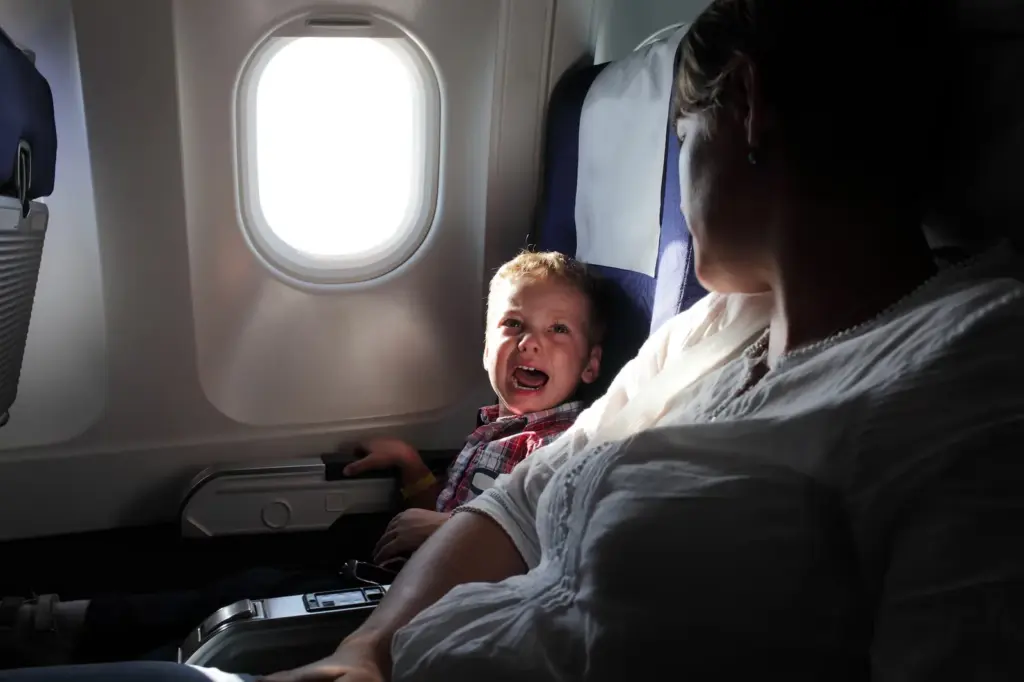
When a child cries on a plane, runs through a restaurant, splashes in a pool, or has a tantrum in a supermarket, the diagnosis is usually immediate: they are badly behaved. Almost simultaneously, a second judgment appears: their parents do not know how to raise them. The association is so common that it is hardly questioned. When a minor behaves in a way that bothers those around them, it is often interpreted that there has been a failure in the education received. However, that seemingly obvious relationship deserves to be reviewed.
Education influences, and a lot. Limits, emotional support, rules, and the example of adults play a decisive role in development. There are families that find it difficult to set limits and also situations in which adults give up exercising their educational responsibility. It is evident.
But neurodevelopment plays a fundamental role in child behavior. Waiting your turn, controlling impulses, tolerating frustration, or sitting still for long periods are not skills that appear when an adult teaches them. They are abilities that are progressively built as the brain matures and the child accumulates learning experiences. Many of them depend on executive functions — the set of cognitive processes that allow us to plan, inhibit impulses, regulate behavior, and adapt our behavior to environmental demands — whose development continues throughout childhood and adolescence and does not reach maturity until well into adulthood.
Developmental psychology and neuroscience have been showing for decades that these skills do not depend exclusively on the educational style of families. However, much of the public debate still relies on a much simpler explanation: if a child bothers, someone has done their job poorly. This way of interpreting child behavior reflects a profound lack of understanding of development, unrealistic expectations about what it means to be a child, and little tolerance for behaviors typical of childhood.
The adult world places enormous value on control, order, and efficiency. Also on the possibility of controlling what happens around and enjoying experiences free of interruptions, noise, or unforeseen events. These are perfectly legitimate aspirations that simultaneously show that individual well-being occupies a central place and, with it, the expectation that nothing disturbs one’s own comfort. From this logic, it is easy to forget that childhood represents precisely the opposite: a stage marked by impulsivity, movement, and exploration.
Regulating emotions, respecting coexistence rules, and minimizing the impact of one’s own behavior on others are necessary skills for civic coexistence in any society. However, expecting a minor to master them at the same level as an adult is simply a mistake.
A three-year-old girl may be restless in a museum hallway even though her parents have explained over and over that she must remain calm. A baby may cry inconsolably in a church despite the mother doing everything possible to calm them. A small child may speak loudly at a wedding ceremony and interrupt an adult conversation without any of these behaviors being proof of parental negligence. In many cases, they are expected responses for a stage of development in which self-regulation is still under construction.
Educating and maturing are different processes. Parents can accompany, set limits, anticipate situations, and teach emotional regulation strategies. What they cannot do is accelerate their children’s neurodevelopment or advance the appearance of abilities that only come with time and with the empathy of a community capable of understanding that childhood cannot pass in silence.
However, much of the social judgment about parenting seems to rely on a very different criterion. One of the main indicators that the child is “well-behaved” continues to be their ability to go unnoticed and not disrupt the experience of those around them. As if the success of education consisted, above all, in reducing the impact that childhood has on the comfort of adults.
Few stages of development are as exposed to others’ judgment as childhood. When a child does not respond to the ideal of obedience and self-control that still persists in the collective imagination, nostalgia easily reappears for an education based on unquestionable authority, championed by expressions like “a timely slap” or “these things didn’t happen before.” It is forgotten, however, that for decades many of them obeyed not because they had developed greater self-control, but because they had learned to fear the consequences of disobedience.
The inevitable consequence of this way of understanding good education is a paradox that is hard to ignore. The little ones are expected to learn to coexist, but there is little willingness to coexist with them — unless that learning takes place in silence. If a plane, a restaurant, a museum, or a hotel cease to be considered suitable spaces for childhood because children may cry, move, or bother adults, it is worth asking where they are expected to learn to manage themselves. Should parenting be confined exclusively to spaces specifically designed for families? Are children compatible with shared life?