






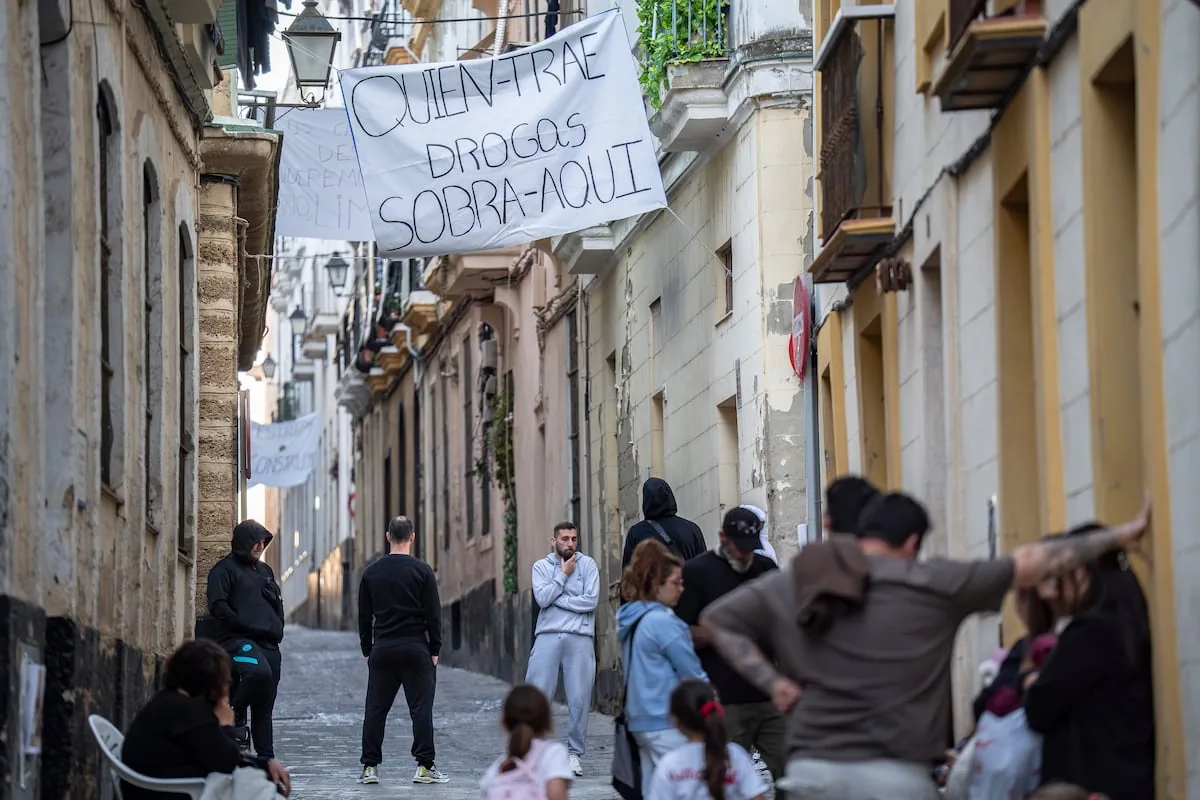
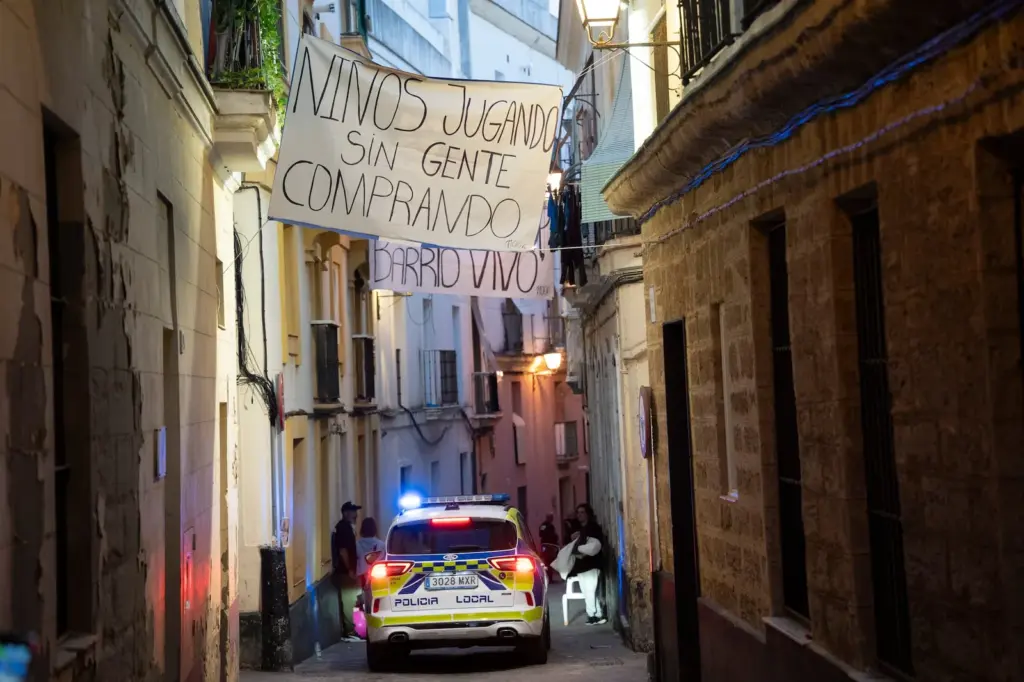
A heterogeneous group of about 30 neighbors restlessly gathers around a building at the end of Santo Domingo street, in the central neighborhood of Santa María de Cádiz. It is past ten o’clock on a weekday night, and the group of ladies, middle-aged locals from Cádiz, and youngsters watch expectantly at the balcony on the second floor. Sonia Novoa, a neighbor who anxiously claims to live in fear of the tenants of a nearby drug spot, looks out: “I’m fine.” The gathered crowd breathes a sigh of relief, bids her farewell, and continues their patrol. Down the street, more than five banners hang from balcony to balcony. “Drugs destroy, the neighborhood builds,” “children playing without people buying,” “less dealing, more small change,” they read. “We are the neighborhood, there are no names here. We are humble people who want security, not anyone selling drugs. This is worse than the 90s because now they are more aggressive,” denounces a 60-year-old neighbor who acts as an impromptu anonymous spokesperson. The patrol continues; the night will be long, until dawn.
The Santa María neighborhood — historically the cradle of flamenco in Cádiz, a nearly overcome scene of substandard housing and poverty — has decided to organize to stop the return of drugs to its streets, the same that turned those picturesque corners into a hostile setting in the 80s and 90s of the last century. “We are in a bad state, we have been silent for a long time, but we must already have about 14 or 15 drug spots,” estimates the spokesperson of tonight’s patrol. Everything has happened so fast that it caught the rest of the city and the authorities off guard. Last Saturday, April 11, Isa, another neighborhood resident, posted a call to mobilize on her Facebook wall. A day later, the first neighborhood patrol started, which since then has been peacefully patrolling the neighborhood’s hot spots, as the spokesperson emphasizes. This Friday, a large demonstration with hundreds of people marched through the streets of Santa María to shout “no to drugs,” a cry joined by their neighborhood association, Carnival groups, and all the neighborhood brotherhoods.
For Yolanda Gómez, 50, all this reminds her so much of the mothers of drugs movement, of which her late mother was a part, that she gets emotional: “My mother was one of them, I couldn’t imagine this would happen again.” Next to her, Cristina Vidal, 27, nods from the door of her house on Botica street: “But here we are, for my two-year-old daughter, so she can go out to play on the street safely.” The neighbors report that since late 2025, insecurity has increased. They talk about poly-drug addicts roaming the neighborhood — most of whom are not even residents — looking for a fix, fights among them in the early hours of the morning, or petty thefts where these criminals harass minors or elderly ladies to give them “the euro they have on them,” as the spokesperson adds.
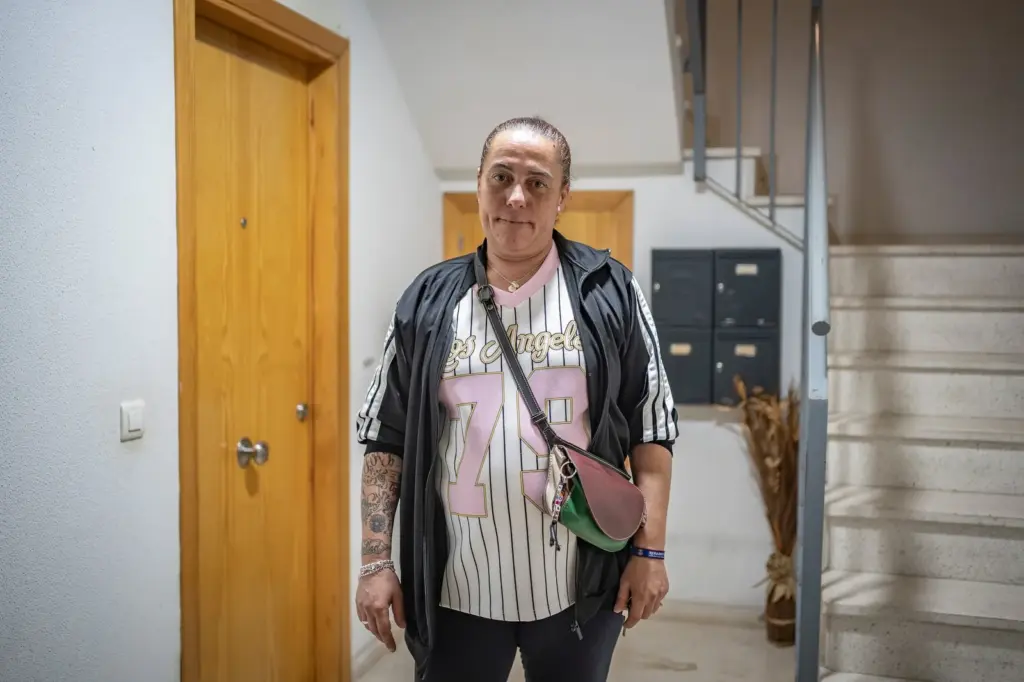
Novoa is already unable to hide the anxiety with which she lives. On April 1, she reported her neighbor to the police for the damage, thefts, and threats she suffers from him, whom she also accuses of living in an apartment where drugs are sold. She shows the damage to her mailbox and the entrance, in a building of Procasa, the municipal housing company. Her case is emblematic of the petty dealing problems the neighborhood denounces: ground-floor apartments that become sales points and consumers who adopt violent attitudes, largely caused by the most destructive and cheap drug consumed in recent years by poly-drug addicts: rebujito. “It’s a combination of cocaine and heroin that is very addictive and makes them very violent. A dose can cost about 10 euros,” points out an officer who has worked with this type of intervention.
The police do not deny the problem but admit they are partially unable to do much more. “It’s very unpleasant,” says the officer. “They are high all day, and when they are in withdrawal, trouble starts. These are small things [referring to crimes], but it’s a neighborhood ordeal,” adds the same officer, who assures that after the public complaint, the police presence in the area has increased. But he also says it is complicated to stop it: “If they are not committing a crime at that moment, we cannot kick them off the street; they have their rights like anyone else.” But the neighbors respond, in a sentiment summarized by Gómez: “What we want is to remove the drug apartments, we know where they are. Meanwhile, we will go out together to say we are here and we are accompanied.”
Read more A Busy Neolithic
The public denunciation of the problem, led by their neighborhood association Las Tres Torres, has also prompted the Government Subdelegation in Cádiz and the City Council to take action. Both the subdelegate, Blanca Flores, and the mayor, Bruno García, have already visited the neighborhood to listen to the residents’ demands, according to confirmations from both institutions. Additionally, this past Wednesday, the City Council evacuated and sealed a private building on Botica street that had been closed since 2024 due to risk of collapse but had become an occupied property where drugs were sold and consumed and where two vulnerable families lived, who have now been relocated. Since then, in addition to the National Police reinforcement, Local Police vehicles have been patrolling the streets.
Some pinpoint that newly sealed building as the start of the drug problem’s degradation. But Gómez talks about more spots on Mirador or Santo Domingo streets, in a situation that has been increasingly deteriorating in recent months. “We already saw how, at Christmas, a food delivery person refused to enter the neighborhood for fear of being robbed,” complains a young man who is part of one of the night patrols. Vidal lived in fear when one afternoon, in broad daylight, one of the usual drug users chased her through the streets while she was with her daughter. Antonio, husband of neighbor Isabel who made the social media post, has chosen to pick up his daughter at the neighborhood’s gates when she returns from a night out in the early morning. “Between the drugs, the rats, the scum that comes, and the illegal tourist apartments, they are ruining the neighborhood,” he exclaims angrily.
The breeze that precedes the east wind softens the spring night cold and makes the dozens of banners that have proliferated in every corner of the neighborhood flutter, all signed 11006, the postal code of Santa María. Madrid is playing against Bayern, and that deserted moment would have been ideal for the drug spot prowlers to show themselves in the area. But so many banners, the neighborhood patrols, and the comings and goings of journalists and cameras have them disappeared. Yoli Pérez, 69, walks up Santo Domingo street after a stroll; the day before she already participated in one of those neighborhood groups. “I was also a mother of drugs; when I was pregnant, we used to sit at the doors of places where drugs were sold, and when someone came to buy, we told them not to. Nothing ever happened to me, but now I have seen they are more aggressive,” reflects the woman on that experience lived 36 years ago.
Pérez’s five children grew up healthy and happy in a neighborhood that transformed with them. Various public housing plans ended the pauperized partiditos — rooms in parts of houses with shared bathrooms and kitchens — and the disappearance of drugs from the streets made Santa María stop being that dangerous area for the people of Cádiz, who even used to skirt it — to avoid entering — on their comings and goings to the new area, Puertatierra. So the neighborhood is not willing, not by a long shot, to return to that hostile scenario. “How long will we be here? Until we can live peacefully again, we will not stop,” Cristina Vidal concludes firmly.
Read more Jorge Fernández, 20 years on ‘The Wheel of Fortune’: “I am very comfortable being typecast”