









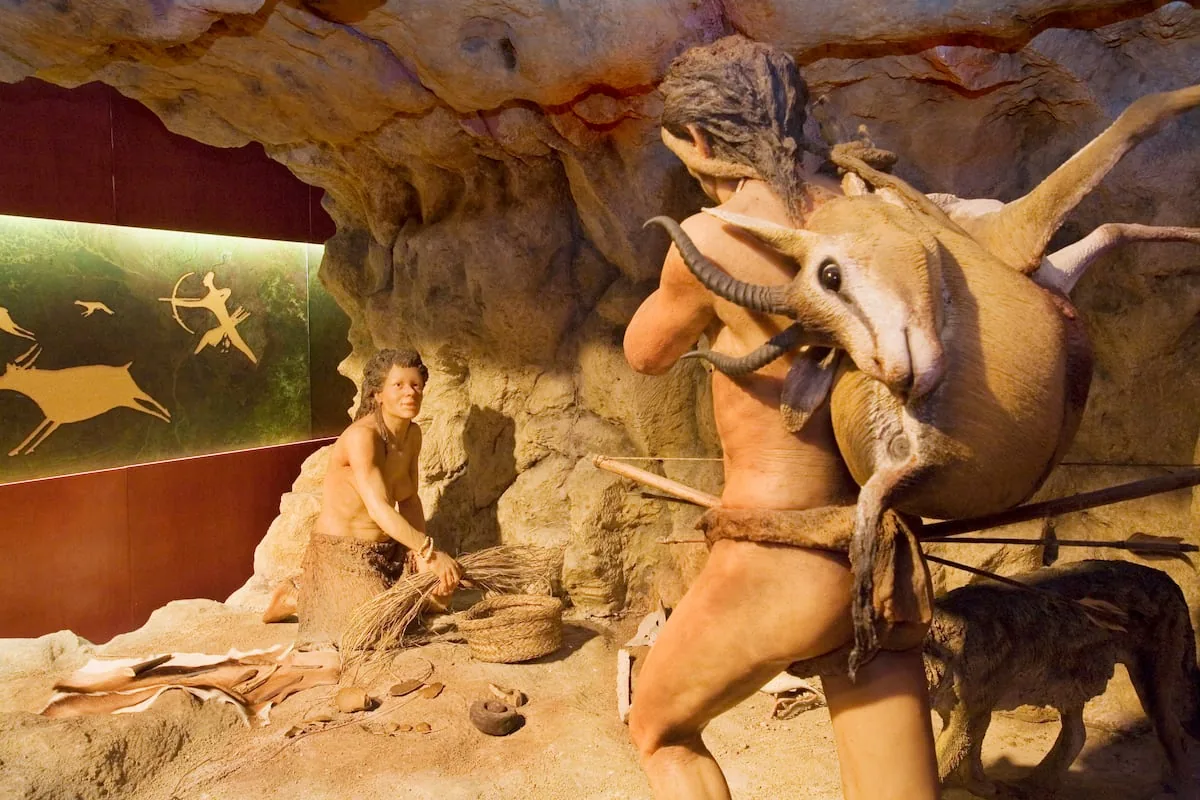
Forget everything you knew about recent human evolution. By recent, I mean that which occurred during the last 10,000 years, give or take a millennium. That is the Neolithic, the era marked by the invention of agriculture and the consequent emergence of civilization. That is only twice what we usually call History. And our species, Homo sapiens, is only 10 or 20 times that figure. This is the time frame in which our evolutionary drama unfolds.
Read more Jorge Fernández, 20 years on ‘The Wheel of Fortune’: “I am very comfortable being typecast”
The mere idea that biological evolution has played a role in such recent times was sacrilege until very recently, and perhaps it still is in certain university departments. Theodosius Dobzhansky and the other founding fathers of modern Darwinism (the synthetic theory, in jargon) thought that the engine of evolution, natural selection, had stopped with the appearance of Homo sapiens, a species that cares for its sick and, therefore, prevents the predominance of the best adapted by eliminating the weakest, which is what natural selection consists of.
But the data do not agree. Geneticists Ali Akbari and David Reich, from Harvard University, have developed a mathematical magnifying glass to compare in high resolution the genomes of 15,836 individuals who lived in Western Eurasia in the last 18,000 years. This is the state of the art in the discipline of ancient DNA. Akbari and Reich have thus discovered no less than 479 genetic variants that have emerged through “directional” natural selection in the last 10 millennia. That means they have spread through the population because they offer some advantage to their carriers. Note that the average is five genetic variants per century. The Neolithic has been eventful, at least from a Darwinian perspective.
For example, a genetic variant found in 20% of the current inhabitants of the area barely existed until 4,000 years ago. Interestingly, it is one of the risk factors for celiac disease, which makes its rapid spread even more striking. The paradox dissolves if we perceive that the same variant facilitates the immune system’s detection of pathogens. The increase in population density has surely turned this facilitation into an adaptive advantage. But celiac disease does not seem to be a consequence of the invention of agriculture, as has been believed until now, since that occurred 6,000 to 8,000 years before the gene’s spread.
Read more Trompe-l’œil: The childhood of a writer
This type of balance between advantageous and undesirable conditions of the same variant has also been proposed for genes that increase the risk of cystic fibrosis, a very debilitating disease, since those same genes confer resistance to cholera. But here the numbers do not add up, because those genes do not bear the marks of Darwinian selection during the periods when cholera was endemic in the region.
Most biological systems do not depend on a single gene, but on coordinated variations in several dozen of them. The new analysis has enough power to detect coordinated changes in each of those genetic sets that affect complex traits. For example, genes that facilitate the accumulation of body fat have tended to decrease, as have those that favor schizophrenia. The opposite has happened with genetic systems that increase cognitive performance. This last data point is bound to raise eyebrows.
Against orthodox doctrine, it seems clear that human evolution has not only not stopped, but has accelerated in the last 10 millennia in response to the invention of agriculture and the consequent appearance of new foods, pathogens, and living conditions such as belonging to large human groups. Whether you like it or not, these are hard facts.
Read more Author’s tail