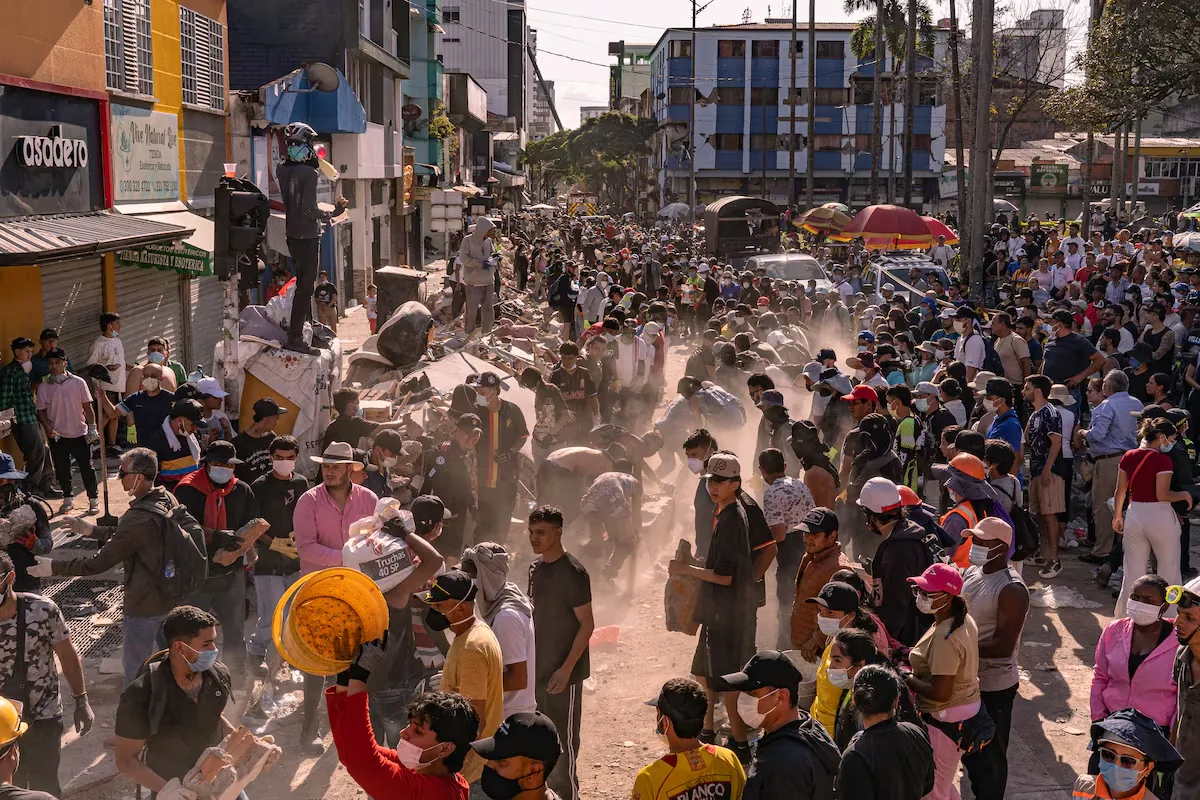
Donations from the Sarmiento, Gilinski, Santo Domingo, Vélez families and others to the Solidarity Day for Colombia are the largest ever made in the country’s history, as far as I know. They have exceeded one trillion pesos. They are unprecedented magnitudes, impossible to ignore, and open up several reflections.
Read more The nearly 100 days that Yei, Nicole, and Janet took over the National Polytechnic Institute
Let me first say that these donations are welcome and speak well of the donors, of course. They show empathy and sensitivity to others’ pain. However, it is also impossible not to think about a key aspect: the tax issue. Especially since the new government is set to dismantle the wealth tax, and because President Abelardo de la Espriella considers this tax a punishment for those who invest and generate wealth in the country, as he stated in his inauguration speech.
Some well-known anecdotes come to mind. One is related to Mexican magnate Carlos Slim, who once asked Nobel Prize-winning economist Joseph Stiglitz what was the best thing he could do for his country, and Stiglitz, without hesitation, replied: “Pay taxes.” Another anecdote is linked to Warren Buffett, who in 2011 declared it was “outrageous” that his secretary, Debbie Bosanek, paid twice as much in taxes as he did. Buffett said he had paid an effective rate of 17.4% on his income, while the rest of his office—including Bosanek—paid between 33% and 41% in payroll and income taxes. There was no tax equity.
Buffett’s statement did not come out of nowhere; it was a reaction at a specific political and economic moment in the United States, following a national debate on fiscal inequality that erupted in 2011, when Congress was discussing whether to raise taxes on the richest to reduce the deficit and fund social programs.
The third anecdote is the letter signed in July 2021 by a group of super-rich individuals, addressed to the G-20, in which they demanded to pay more taxes, especially on large fortunes and inheritances. These super-millionaires belonged to three organizations, including two called Patriotic Millionaires and Millionaires for Humanity, which argue that extreme wealth concentration is incompatible with democracy and equal opportunities. The third group is Tax Me Now, a network of German and Austrian millionaires who hold the same view and call to prevent the formation of economic dynasties. “The ultra-rich must pay more taxes. It’s not charity: it’s democratic justice.”
The idea that taxes are a punishment for success, and not a mechanism for income and wealth redistribution, has been promoted by the United States Republican Party, of which De la Espriella is a member, as a naturalized U.S. citizen since 2023, a registered voter of that party, a donor to its campaign, and a Trump voter in 2024. It is not, therefore, a simple ideological affinity that I attribute by comparison. This is what Republicans have defended since the era of Ronald Reagan, who pushed for major tax cuts (1981 and 1986), through George W. Bush, who reduced taxes on dividends and capital gains, to Donald Trump, who in 2017 lowered corporate taxes from 35% to 21%. Trump governs in his own interest, with a far-fetched thesis: lowering taxes on the rich increases investment and growth.
This claim has a corollary: the idea that the poor are poor because they want to be, because they don’t like to work and are lazy. For that current, taxes discourage work and merit, and reward the loafer who wants to live off the state teat. What Republicans don’t say is that the poor pay more taxes than the rich.
Read more Fear of ICE hinders the rebuilding of areas devastated by wildfires in California
The poor pay more than the rich
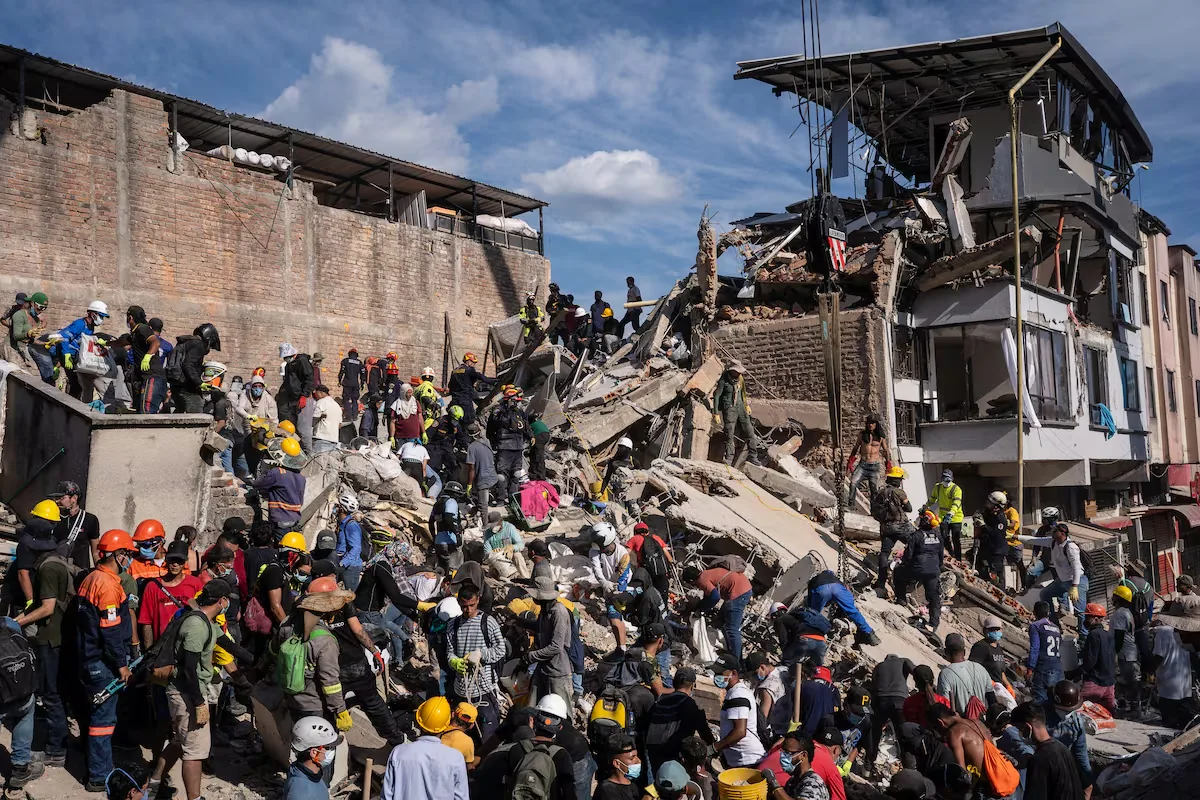
In July last year, a report by EL PAÍS questioned the myth that the poor do not pay taxes. Based on reports from the General Comptroller of the Republic and university studies, the report proved two things: one, that the poor pay proportionally more taxes than the rich — “A person belonging to the richest 1% paid an average of 17 cents in taxes per dollar of income until 2021, while a person in the poorest 50% paid 21.1 cents per dollar of income” — and two, that tax evasion in Colombia amounts to 8% of GDP, about 130 trillion pesos each year. To understand how much this figure is, it suffices to know that 30 trillion are needed for the reconstruction of the damage caused by the August 10 earthquake.
Tax evasion and avoidance are forms of corruption. Colombia loses between 80 and 100 trillion pesos a year just from this concept. And if tax benefits, exemptions, and preferential treatments are added, the total loss amounts to about 230 trillion pesos annually, according to analyses by the National University and DIAN data. For something, and for some reason, tax havens exist. I also referred to this issue, and forgive me for quoting myself, in the article titled Evading Does Pay!, which remains fully relevant today. It is impossible for the poor to evade taxes, as they mainly pay through indirect taxes, such as VAT.
Now, with the same logic used to argue that taxes on the rich are a kind of punishment for success, it could be said that taxes on the poor are a punishment for structural poverty. It is a perverse logic that can be summarized as follows: the rich must be rewarded and the poor punished. That is, “kick the fallen.” It is not a very Christian approach, to say the least.
Returning to Colombia’s wealthy families, I reiterate that their generosity is to be appreciated. Hopefully many more will follow their example. However, it would be appreciated if they encouraged the government not to lower their taxes, especially amid a tragedy of the proportions we are experiencing, and if they asked the government — since it listens to them — to make more rational, efficient, and clean use of public resources. Hence the importance of a frontal fight against corruption, which is a chronic problem in public management, a problem in which, it is worth remembering, the private sector is also a relevant actor. From the poem by Mexican Sor Juana Inés de la Cruz, we know that we do not know who is more guilty: “Who will have the greater guilt, although anyone does wrong: the one who sins for pay, or the one who pays to sin.”
Removing taxes from the rich and shifting them to the poor is the most regressive thing that can exist. The argument that donations prove that the wealth tax is not needed is shameful. Donations amount to one trillion, and evasion, 130 trillion. If this tax induces them not to donate, then let them not donate. But instead, let them pay taxes. The country needs solidarity, not mercy. Why should the rich be rewarded and the poor punished?