





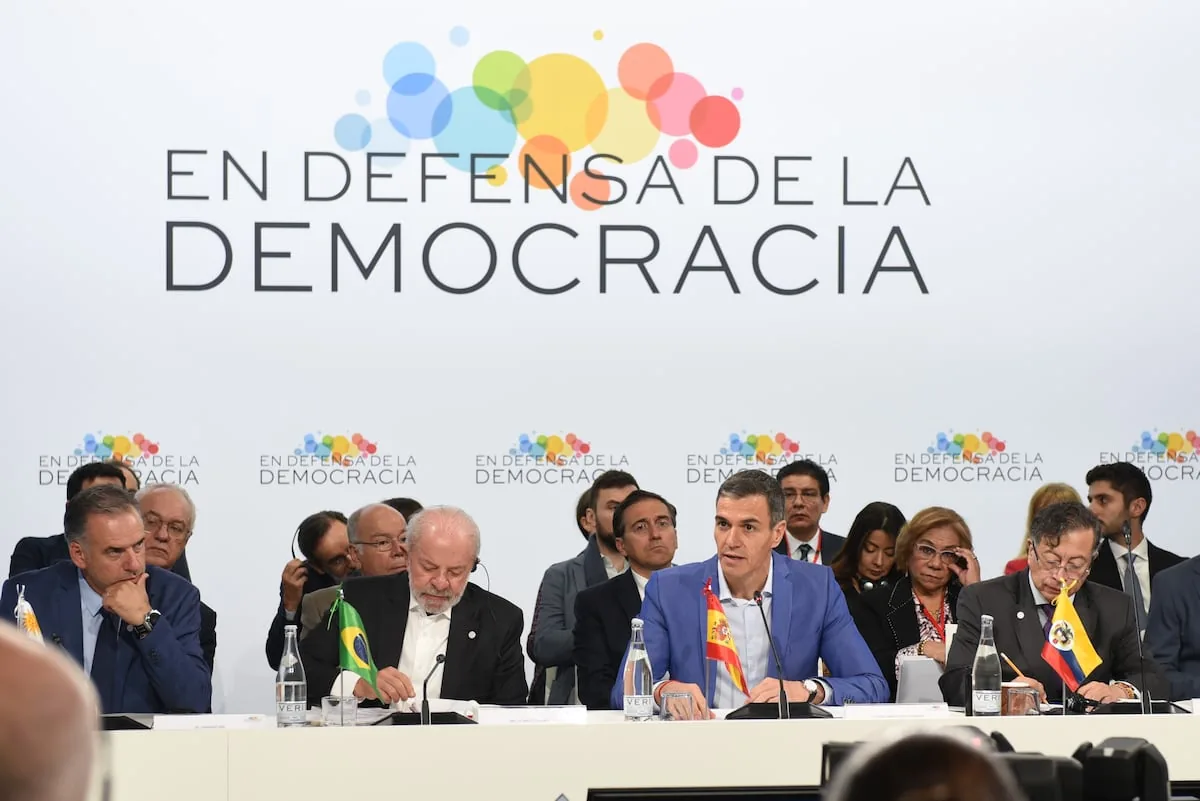
The main left-wing leaders of Latin America met again this Saturday in Barcelona. Mexico’s Claudia Sheinbaum, Brazil’s Luiz Inácio Lula da Silva, and Colombia’s Gustavo Petro answered the call of Spanish Prime Minister Pedro Sánchez to participate in the IV Meeting in Defense of Democracy, focused on forming a common front and proposing an alternative to the world of Donald Trump. They did so, moreover, at a critical moment for progressivism in Latin America, a region where conservatism and the far-right are advancing and occupying more and more positions under the impulse of the White House. Lula and Petro, in fact, will put the survival of their political projects to the test this year: Colombians will go to the polls in May and Brazilians next October.
Read more Spain recovers from the defeat at Wembley with a restorative thrashing against Ukraine
Lula was the most critical when speaking about Trump’s threats to international stability. “We have to go against this lord of war,” he warned at the closing of the official summit. “The return of emperors who believe they own the world bothers me,” he added, alluding to the US president. The Brazilian president recalled the economic impact of the war campaign launched against Iran: “It is the poor who will pay the price of a war that no one wants.” He also condemned the military intervention in Venezuela to capture Nicolás Maduro and admitted being “concerned” about the suffocation imposed on Cuba: “This blockade must be stopped, and Cubans must be allowed to live their lives.” “No president of any country, no matter how big,” he concluded, “has the right to impose rules on another.”
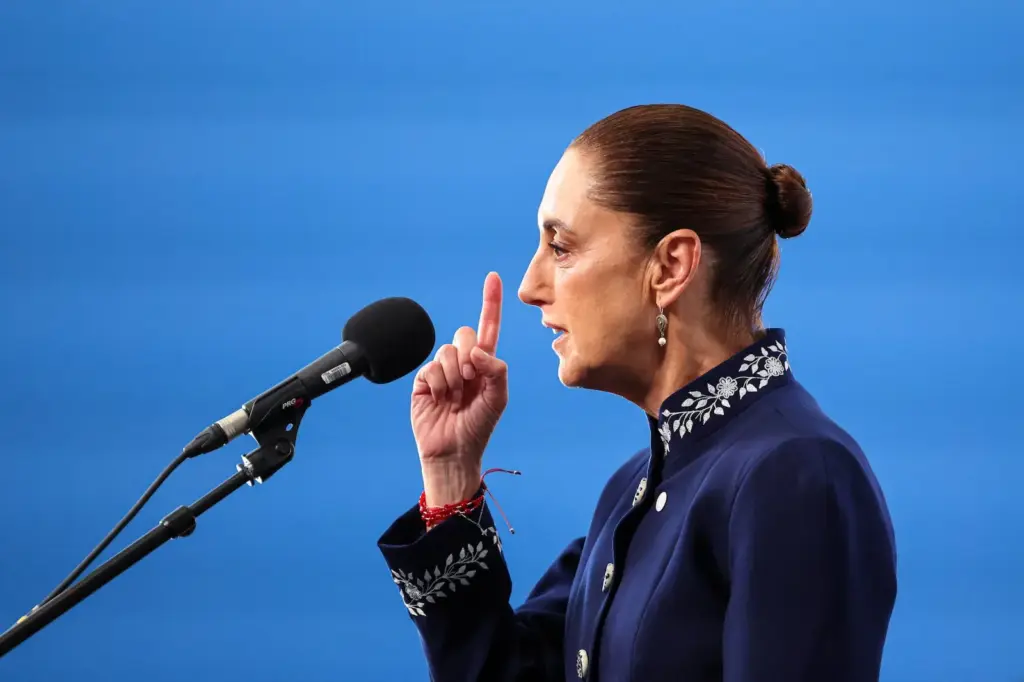
Sheinbaum, for her part, emphasized, alluding to the pressure on Cuba: “No people are small, but great and stoic when defending their sovereignty and the right to a full life.” The Mexican president proposed adopting a common declaration among the summit participants condemning a possible military intervention on the island. “May dialogue and peace prevail,” she urged.
The Mexican president’s visit generated enormous anticipation since it was announced last week due to the tensions of the last seven years with Spain and has been a decisive step to normalize relations with Pedro Sánchez’s government after a crisis that both administrations consider overcome. In her first visit to Europe, Sheinbaum seeks to regain prominence beyond her borders, always avoiding a direct clash with the United States, a neighboring country and main commercial partner.
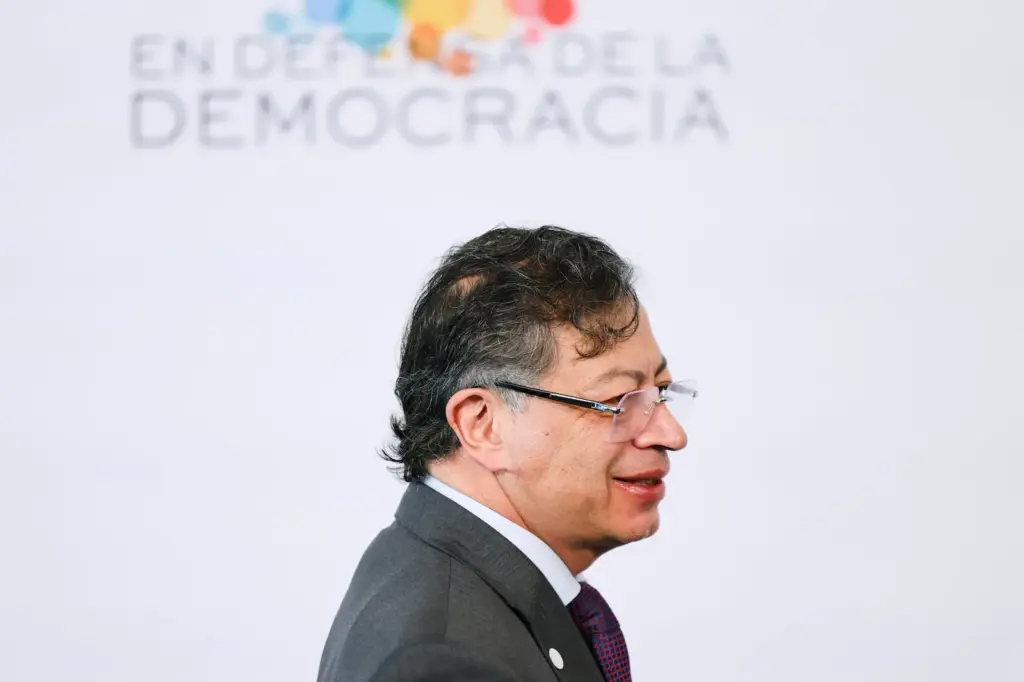
Petro, in turn, landed in Barcelona at a decisive time for the presidential campaign in Colombia and expressed his repudiation of the Israeli occupation in Gaza and the climate denialism championed by ultraconservative governments. Regarding the latest military escalation in the Middle East, the Colombian president assured that “it is one of the worst steps in the world recently, outside of the genocide in Gaza” and called for seeking alternatives to fossil fuels amid the global oil crisis due to blockades in the Strait of Hormuz.
Beyond their particular circumstances and convictions, the protagonists of the summit recognized the need to form a common front to propose solutions to the crisis of institutions and the questioning of the rules of international order. “Individually, we have no way out of this problem,” remarked Lula, who self-critically addressed the advance of conservatism and authoritarianism: “Democracy is losing credibility by failing to respond to society’s aspirations.”
Last Friday, at the Spain-Brazil bilateral summit, the Brazilian president outlined the crossroads facing the left at regional and global levels. “Progressives are fewer and fewer,” he lamented. Lula assumed the role of a key ally upon his arrival in Spain. He arrived with 14 ministers from his Cabinet. He echoed the “no to war.” He praised the efforts of Sánchez’s government to confront technological oligarchs and regulate the use of social media for minors. He broke official protocol a couple of times, chewing gum during the national anthem of his country and shaking hands with Spanish ministers with an endearing, almost paternal aura. He spoke vehemently about his convictions and aired his concerns: the weakness of international institutions, the growing difficulties of the left to reach certain sectors, and the lack of ideological partners worldwide.
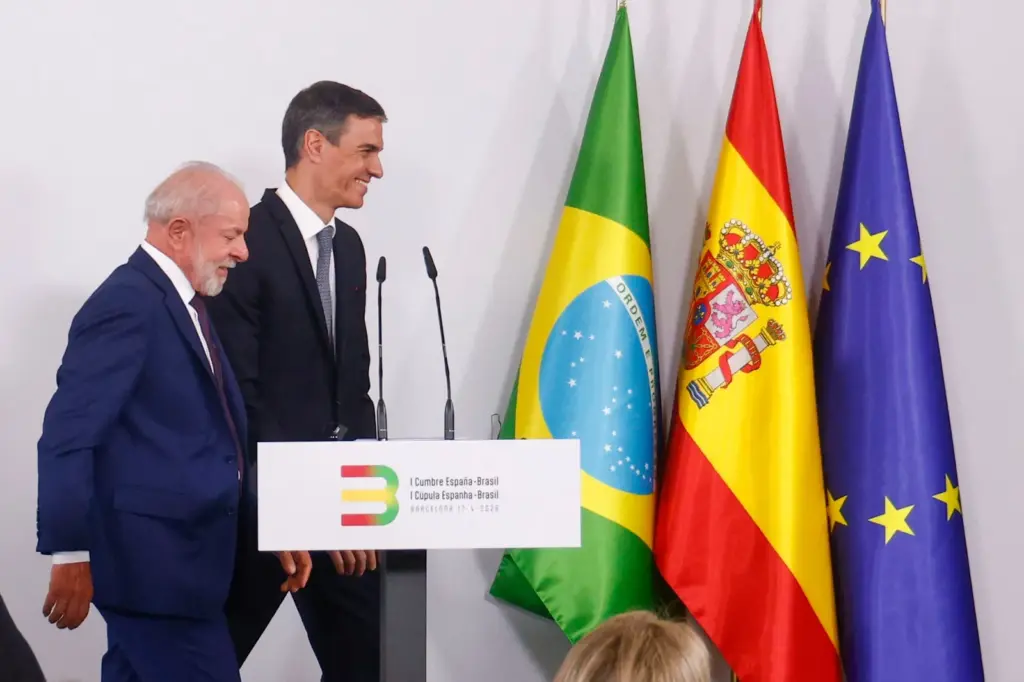
Sánchez recognized Lula as a strategic partner, especially during the bilateral summit, the first that Spain has held with a Latin American country and the most ambitious rapprochement in the history of both governments. “Our countries are called to be the engines that bring the European Union and Latin America and the Caribbean closer together,” he said. The summit also brought back figures such as former Chilean president Gabriel Boric, who left power in March after the triumph of ultraconservative José Antonio Kast in the presidential elections.
Read more The gift of Beatriz de Moura’s ability to anticipate
On the other side of the spectrum, this same weekend, Venezuelan opposition leader María Corina Machado was received in Madrid with great fanfare by the Spanish right and far-right. The Nobel Peace Prize laureate rejected an invitation to meet with Sánchez, considering it not “convenient” for her political platform, and decided to embrace Vox and the Popular Party. Venezuela, in any case, was a protagonist in the meetings convened by the opposition and the Spanish Government. “The future of Venezuelans must be decided by Venezuelans, without interference,” Sánchez affirmed last Friday, while apologizing on behalf of Spaniards for the statements of the president of the Community of Madrid, Isabel Díaz Ayuso, who assured that the Barcelona summit was a summit of “narco-states.”
In one of the conferences of the World Progressive Mobilization, the summit that ran parallel to the events convened by the Spanish Government, former Colombian president Ernesto Samper declared: “Latin America is experiencing a dangerous process of right-wing shift, which is not endogenous, but a result of reactionary political forces in Europe.” Kevin Casas-Zamora, secretary general of IDEA International, another participant in the forum, agrees: “There is much evidence that right-wing and far-right political forces are collaborating very ostensibly; this is seeking to be a counterweight.”
That sense of urgency has been omnipresent this weekend in Barcelona. “The future of Latin America is at stake,” concludes María José Pizarro, co-president of the Historical Pact, Petro’s party, at the end of one of the talks. “If we lose in Colombia, then the elections in Brazil come, and we risk a right-wing shift in the region,” says the debate chief for the official presidential candidate, Iván Cepeda, about the decision to travel to Europe in the final stretch of the campaign. “What happens will reverberate in Spain because Sánchez and other progressive leaders could be left alone in the world.”
Casas-Zamora emphasizes that, beyond the ideological leaning of the initiative, the effort to defend democracy and a rules-based multilateral order is crucial for Latin America. “The jungle is a very lonely place for a region like ours,” says the former Costa Rican minister. “That a system of norms exists, even if imperfect, is of absolutely existential interest to our countries, and there is an opportunity to reform it; hopefully, it will not be wasted,” he adds.
The future, however, is uncertain. The summits held simultaneously in Barcelona are a prelude to the Ibero-American summit next November in Madrid. But before that, the political landscape of the region could change drastically. Also on the horizon are the process to succeed António Guterres, whose term as head of the UN Secretary-General ends this year, and later, the celebration of a new summit of progressive leaders next year in Mexico, proposed by Sheinbaum at this edition of the meeting. In between, the permanent challenge remains to go beyond summits and provide concrete content and proposals to major positions.
“We cannot wake up every morning,” Lula affirmed, “and go to sleep at night always with a tweet from a president of the republic threatening the world, declaring war.” “The democracy of the United Nations depends on us. Strengthening multilateralism depends on us. It depends on no one else. We have to act,” he concluded.
Read more One of Europe’s most wanted fugitives arrested in Cancun