





The rise of nationalist right-wing parties, endorsed by some of the biggest techno-emperors, has plunged the world into an era of profound convulsions shaking the international, national, and, by both paths, individual spheres. Their most extreme representatives are waging an assault against the ideals of a rules-based multilateral world order, democratic fullness, social cohesion, and universal human rights. The assault is in full swing, but its fury, noise, and devastating consequences seem to be opening a window of opportunity to turn the tide. This perception and hope emerged in the speeches and debates of the forces of the global progressive world gathered this Friday and Saturday in Barcelona and form the basis of their attempt to resist and counterattack after a period marked by many setbacks.
The President of the Government of Spain, Pedro Sánchez, sought to highlight the cracks in contemporary right-wing projects in his speech at the plenary session of the ‘Global Progressive Mobilization’ (MPG) forum, in which prominent leaders from many countries participated: “The far-right international and the subservient right are lacking inspiring ideas. They make a lot of noise. But they don’t shout because they are winning. They shout because they know their time is running out,” said Sánchez.
“They know that their neoliberal orthodoxy – which, besides being inefficient, is cruel – died in 2008 with the great financial crisis and has been surpassed by progressive policies,” argued the Spanish leader. “They know that their vision of the international order is being dismantled as a consequence of tariffs and illegal wars. They know that their surrender to climate denialism, xenophobia, and machismo has been their biggest mistake, from which it will take them a long time to recover. People are realizing that they have no project, that they have no solutions,” Sánchez maintained.
Cyril Ramaphosa, President of South Africa, a great fighter against apartheid in the past and today leader of a government firmly opposed to the administrations of Donald Trump and Benjamin Netanyahu, clearly summarized that feeling of hope born from the excesses and errors of the right-wing parties that outrage and mobilize: “This moment of grave crisis is, at the same time, a moment of unique opportunity. It is an opportunity to mobilize, to unite the forces of progressive change, to forge a new path of peace, democracy, and social justice. This is a time we must not waste,” said the South African leader.
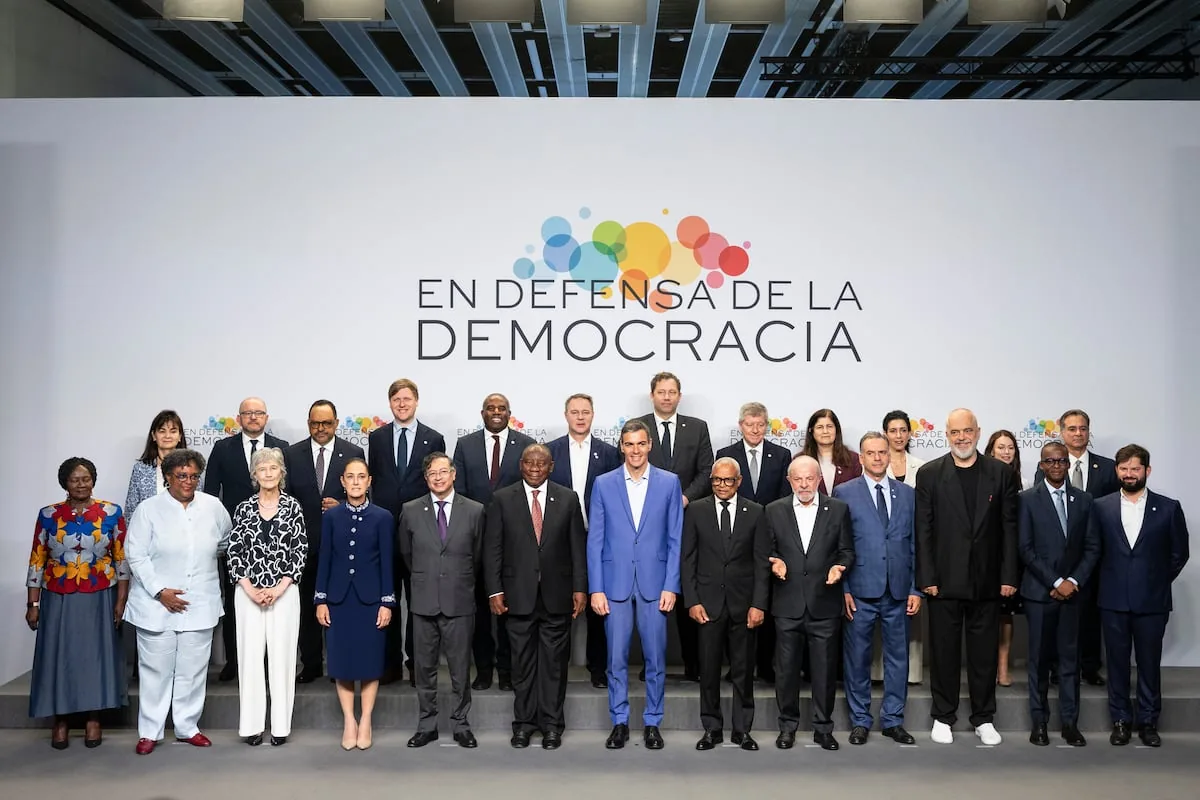
Sánchez and Ramaphosa were two of the leaders who spoke at the MPG forum, alongside others, notably the President of Brazil, Luiz Inácio Lula da Silva. The three also participated in the fourth edition of a summit in defense of democracy, held on Saturday morning and attended by about twenty countries, most represented by their leaders – including Claudia Sheinbaum (Mexico) and Gustavo Petro (Colombia).
The sense of opportunity perceived by progressives is supported by some recent political events that demonstrate the far-right’s wear and tear and the will to mobilize: Orbán’s defeat, the failure of the referendum promoted by Meloni, the progressive success in important cities in the municipal elections in France – at levels not seen since 2008, as noted by Olivier Faure, first secretary of the French PS – the strength of indignation at the wars in Gaza and Iran, and Trump’s notable decline in opinion polls.
This, however, does not allow progressivism any unbridled optimism. In Hungary – as in Poland – the one who managed to defeat the national-populists was a conservative. In other parts of Europe – as in Germany – the level of depression among social democrats is at historic lows. In Latin America, the far-right push is persistent, and the association with Trump does not yet seem to be taking its toll, whether due to calculated interest or fear.
Against this backdrop, the Barcelona meeting sought to promote two objectives, in terms of political spirit and policy design.
Firstly, Sánchez emphasized the desire to strengthen unity and restore pride within the progressive family. It is evident that this political sector suffers from fragmentation and even friction, and that in recent years it has been in a state of depression. The gathering could not erase deep discrepancies, such as the very different sensitivities regarding Russian aggression in Ukraine between European social democratic forces and Lula and Ramaphosa, who are much more lukewarm towards Putin; or the abysmal distances between many moderate European social democracies and Petro’s populist leftism. But the considerable convergence of leaders and prominent representatives in Barcelona, as well as significant messages of support, are relevant political signs.
In addition to the aforementioned leaders, the forum featured Lars Klingbeil, Vice-Chancellor and Minister of Finance of Germany, and co-leader of the SPD; Elly Schlein, Secretary General of the Democratic Party of Italy; Tim Walz, candidate for Vice President of the US with Kamala Harris; messages were sent by Hillary Clinton, Zoran Mamdani, and Bernie Sanders; economists Mariana Mazzucato and Gabriel Zucman spoke; many more intervened representing different sensibilities within the progressive landscape.
“The global right is organized across borders and continents. So we must be too. The extreme right is international, and we must be too. The future does not belong to the loudest, but to those who build bridges,” Klingbeil stated, regarding the need for unity.
In a corridor of the center where the conference was held, Schlein emphasized the idea that the far-right “spent years fostering fear,” and “now they are the ones who are scary,” a dynamic with an undoubtedly mobilizing effect.
In terms of policy design, the Barcelona meeting was a great showcase of ideas.
Regarding international order, Lula considered that “progressivism must defend a reformed multilateralism and democratize institutions such as the Security Council, the IMF, and the World Bank.” His approach resonated with what Sánchez had declared in the morning: “We believe in a rules-based international order. But the multilateral system needs to be renewed. The UN can only survive if it represents reality. We need a more democratic, more representative UN.”
In an important speech delivered days earlier at Tsinghua University in China, the Spanish Prime Minister clearly expressed the conviction that a multipolar reality has taken hold in the world, that this requires a multilateral governance system, and that for it to function, it must be adapted to better reflect current times. In this sense, “the West must relinquish part of its representation quotas in favor of global stability and the trust of the countries of the South,” said Sánchez.
Regarding democratic defense, Lula emphasized that “the threat of the extreme right to democracy is not a rhetorical matter; it represents a real risk. In Brazil, they attempted a coup d’état. They present themselves as defenders of the people, but they govern for the elites (…) elites who claim to defend meritocracy, but then kick away the ladder so no one can climb.”
The Barcelona conference has particularly focused on the risks posed by large technological elites, the oligarchs who own tools with enormous potential to manipulate minds and capture pieces of state sovereignty.
Expert Francesca Bria very clearly warned about this in a morning panel: techno-oligarchs don’t just want to get rich without limits, “they want political power; they manage parts of the state.” “It is not possible to build a democratic model on structures rented by techno-oligarchs. Public digital infrastructure that serves humanity is necessary,” Bria urged.
In this sector, the progressive will to advance in the task of regulation emerged strongly.
Of course, reflection on public action as a tool to achieve social justice in this new era played a major role. In the broad flow of ideas, two stood out.
Mariana Mazzucato presented her proposed solutions to extractivist capitalism, in which companies have enormous profits channeled into share buybacks and disproportionate bonuses, while investments often falter and wages suffer strong containment pressure. Mazzucato denounced the dysfunctionality of this system of very high profits, low labor share, and low investments, and presented her idea of conditioning all public procurement, investments, and subsidies on recipient companies respecting criteria that better recognize the value of labor and the importance of sustainable investments.
Gabriel Zucman, for his part, eloquently highlighted the painful reality of tax evasion by the wealthiest, and put forward his proposal to design a wealth tax for the most prosperous, given the difficulty of achieving adequate taxation through income.
But the public sphere is fundamental in many other ways for the progressive project. The Frenchman Olivier Faure spoke of a study according to which, in his country, France, the distance from public transport hubs is a factor that spurs votes for the far-right. It is not the distance itself from a city center that dictates the direction of the vote, but the possibility of being agilely connected to it via public transport that differentiates between feeling included or excluded.
And it is the failure of progressives, who for too many years did not oppose the neoliberal approach, that Lula highlighted as a crucial error and encouraged correcting. “The neoliberal project promised prosperity and delivered inequality and insecurity. It caused crisis after crisis. Even so, many of us adopted it. Left-wing governments abandoned public policies in the name of governability. We became the system,” said the Brazilian leader.
The veteran politician, seasoned in a thousand battles, thus pointed the way for his political family: “Democracy is not a destination; it is a daily construction. It is not just voting: it must translate into concrete improvements in people’s lives. We must replace discouragement with dreams, hatred with hope. Global progressive mobilization has a fundamental mission: to recover progressivism’s transformative capacity and project a future with social justice, equality, and democracy.”
Read more Marrero crowns Real Sociedad in an epic Cup final against Atlético