









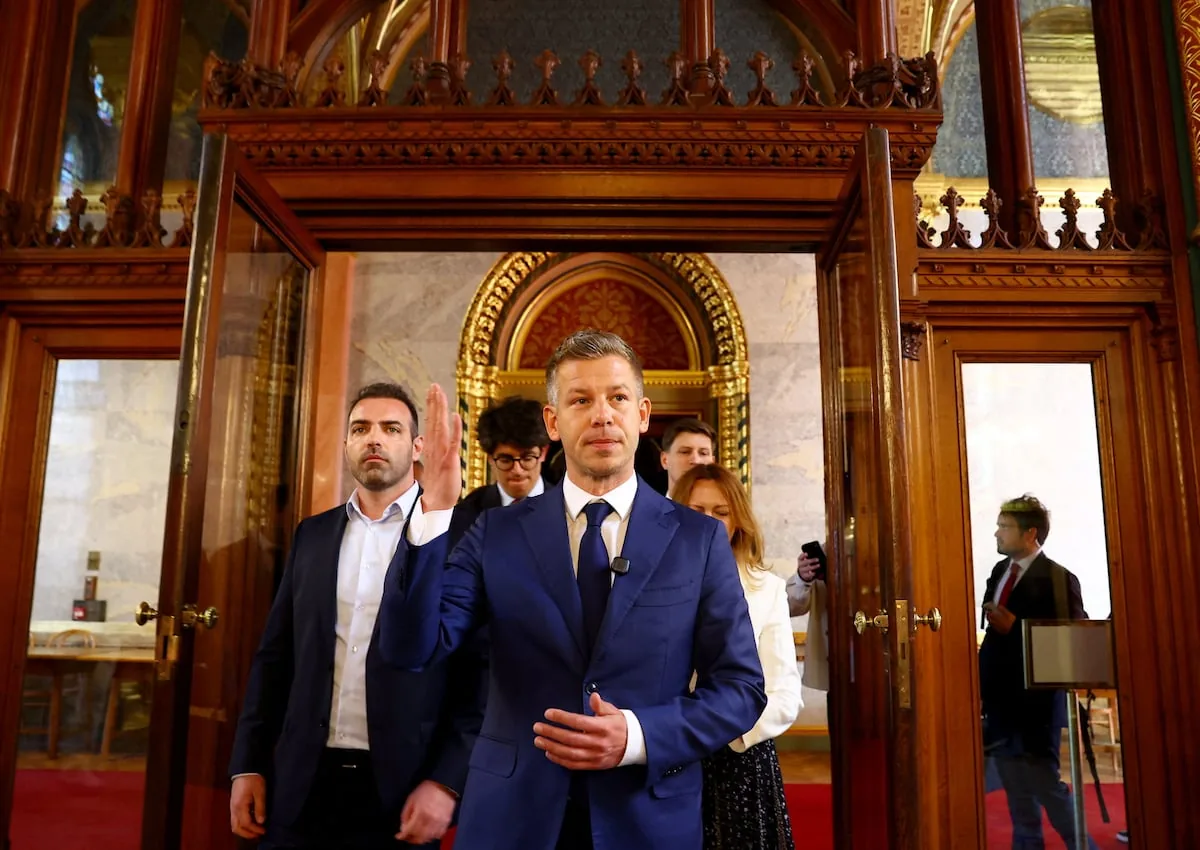
Péter Magyar achieved the political feat of defeating national-populist Prime Minister Viktor Orbán last Sunday. Orbán and his party, Fidesz, had built a bunker at the cost of the deterioration of the rule of law. During 16 years of absolute hegemony, they took control of all state powers. “The Hungarian people did not vote for a simple change of government, but for a complete change of regime,” Magyar proclaimed to an euphoric crowd. The task is monumental.
Read more The excesses of the far-right open an opportunity for the global left
Orbán not only controlled the executive, legislative, and judicial branches of power; but also the economy, the media, and think tanks. “This country was kidnapped. It is a captured state,” Magyar stated on that historic night.
Ironically, the weapon Orbán had honed with more than 300 legislative reforms to entrench himself, turned against him. Thanks to an enormously disproportionate electoral system, Magyar obtained a two-thirds parliamentary supermajority. With 141 out of 199 seats in the Chamber, he can reverse the legal framework custom-built by Fidesz. Tisza, his party, achieved a record with over 3.3 million votes and a turnout close to 80%. He has the legitimacy and the explicit mandate to dismantle the system built by Orbán.
Bálint Magyar, former Minister of Education and researcher at the Central European University (CEU), explains that “with a two-thirds majority, Magyar can do whatever he wants legally.” In his office in central Budapest, he details that the new prime minister, who will take office in May, can reform the Constitution or approve a new one. He also has the possibility to repeal or amend cardinal laws with his qualified majority. These are norms that constitute the core of Fidesz’s institutional shielding and regulate the electoral system, the judiciary, taxation, the media, or independent authorities.
Orbán ensured control of the institutions that should act as a counterweight. He placed loyal individuals, with mandates in some cases up to nine years, at the head of the head of state, the Supreme Court (Kúria), or the Prosecutor General’s Office. On election night, Péter Magyar sent them a message: if they do not resign, he will force their dismissal. It’s not that simple.
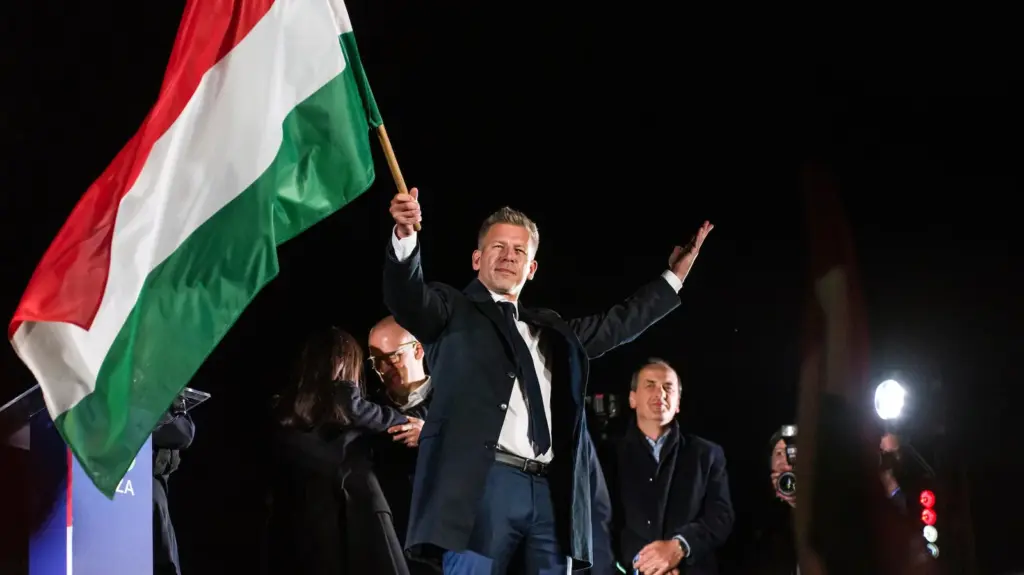
The prime minister-elect met with President Tamás Sulyok on Tuesday and asked him what he had already announced on election night: that after the formation of the government, he should leave with “whatever little dignity he has left.” The head of state has a ceremonial role, but among his few powers is the sanctioning of laws. The European Commission, to unblock the 18 billion euros frozen for Hungary due to Orbán’s systematic deterioration of the rule of law, wants to see legislative reforms, not just promises, as happened in Poland.
For now, none of these high-ranking officials have shown signs of wanting to leave their posts voluntarily, as reported by 24.hu. If they do not resign, Professor Magyar (unrelated to the Tisza leader) argues that they could be dismissed “alleging that their actions were not in line with their constitutional obligations.” Ultimately, the expert states, they can be stripped of their powers.
Csaba Gyory, professor of law at ELTE University, explained in an online seminar by Democracy Reporting International this week that European law introduces limitations on the dismissal of judges. This would complicate the replacement of the president of the Kúria, András Varga, or the members of the Constitutional Court.
In the conversation, the professor looked beyond the short and medium term and pointed out the need to open a debate on “how to reform the electoral system and the constitutional reform procedure itself to prevent a re-occurrence of a power entrenchment like the current one.” Márta Pardavi, co-chair of the Helsinki Committee, advocated at that meeting for a new style of governance that facilitates the “legitimate political contribution of citizens and civil society.” To begin with, the lawyer and activist hopes to see the “dismantling of the Office for the Protection of Sovereignty and the legislation that has posed a threat and an obstacle to civil society.”
The propaganda machine
Magyar has begun to target the propaganda and thought machinery set in motion by Fidesz. On one hand, there are the media. This Tuesday, in his first appearance on public television in a year and a half, he announced that his government will suspend the news programs of that channel until an impartial public service is guaranteed. The network of hundreds of pro-Fidesz private media outlets fed with public money — and which account for 80% of the media ecosystem — can be financially suffocated by cutting off the tap of institutional advertising that feeds them, experts believe.
The same applies to the constellation of think tanks that worked at Orbán’s service, to amplify his influence among the ultraconservative elite, not only Hungarian but global. The new government plans to deprive them of public funding. The most powerful of them is the Mathias Corvinus Collegium (MCC), to which Orbán granted 10% of the shares of the oil company MOL and the pharmaceutical company Gedeon Richter. This past Thursday, Magyar warned the president of MOL not to transfer the dividends approved two days before the elections.
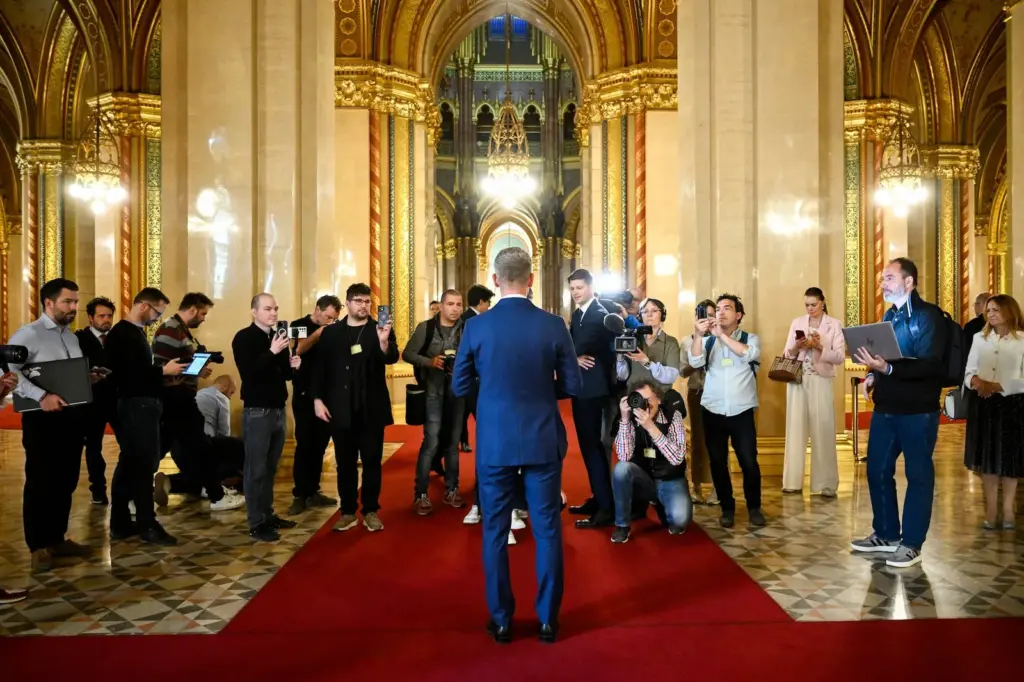
Orbán’s power in the economy will be more complicated to reverse. “They really emptied the country in every sense,” Magyar states. First, they “extracted” billions of public euros from state accounts, which they allocated “to various private funds linked to the president of the National Bank of Hungary and his son,” he asserts. At the same time, they appropriated private pension funds while underfunding healthcare, along with education and welfare state services.
Orbán’s Hungary also had a decisive source of income: European funds, channeled through public contracts, state investments, and awards. This is how businessmen close to the national-populist leader, including members of his family, “built their own clan: a clientelist network of patronage in the economy,” the economist states.
In parallel, the State built a fiscal architecture designed to shift the social cost of the plunder. It implemented a flat rate for income tax. At the same time, it raised VAT, more invisible as a tax, to 27%, the highest in the EU, and imposed special taxes on some sectors that indirectly impacted prices. Meanwhile, “government handouts, personalized as gifts from Orbán,” were granted to certain groups. “Politically, reversing that situation is not easy at all,” explains Magyar.
State-funded companies
Although the source of income represented by European funds has been closed since 2022, companies of the National Cooperation System (NER, in its Hungarian acronym) created by Orbán continue to be fed by public procurement. Jozsef Péter Martin, executive director of Transparency International, believes that “if that funding is cut, many of these companies would go bankrupt, and that wouldn’t be a big problem. However, there are some that cannot be pushed into bankruptcy, because it would affect the entire economy.”
One example is the large banking holding company belonging to Lorinc Mészáros, a childhood friend of Orbán who became the richest person in the country. “It cannot be allowed to go bankrupt, because it would infect the entire financial system.” Another case is 4iG, a large business conglomerate that controls practically the entire defense sector and can access European funds through the SAFE program. “There is no simple solution to this problem,” Martin concludes.
A delegation from the European Commission traveled to Budapest on Friday to begin working on releasing European money. A portion of these, the recovery funds, expire at the end of August. Hungary must meet 27 conditions to access them.
Magyar has promised that the country will join the European Public Prosecutor’s Office, which will strengthen the investigation of fraud crimes, and that it will create an office for the recovery of state assets transferred to foundations, such as those that control universities. But in addition to corruption, the Commission demanded commitments from Orbán to safeguard the rights of the LGTBI community and refugees. Regarding the former, Magyar showed a change of stance on Sunday. However, he does not back down from Orbán’s hardline anti-immigration policy.
The return of the rule of law and European values in Hungary has been the focus of public debate this week among academics, legal experts, and civil society. The new government will have to navigate the mines planted by Fidesz. But it has on its side the instrument of the qualified majority and the legitimacy granted by a citizenry clamoring for change.