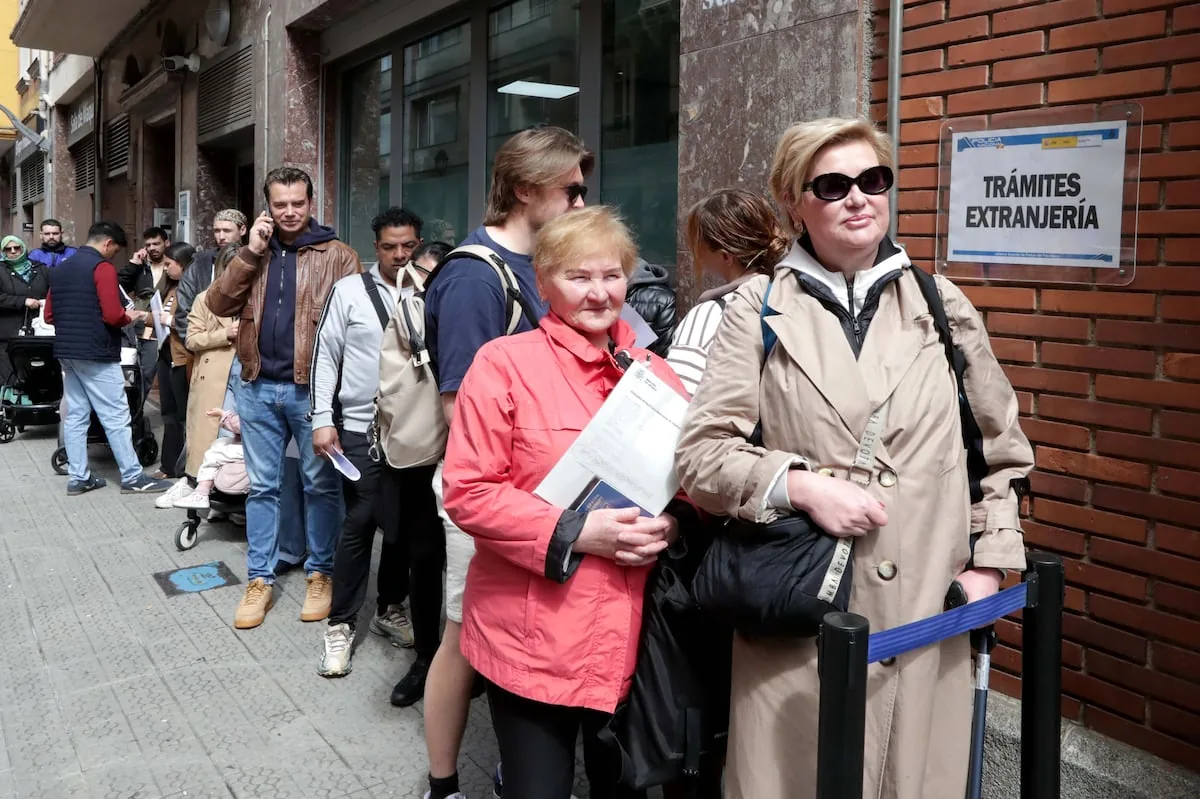










The economic policy of the coalition government has been heavily criticized by Spanish business owners. “Interventionist,” “contrary to market unity,” “typical of authoritarian regimes,” “regulatory suffocation,” or “deceptive” are terms used by the CEOE to define various proposals from the Executive in recent years. These criticisms have not been repeated regarding the instrument for the massive regularization of foreigners agreed upon with Podemos, approved in the last Council of Ministers, which plans to formalize the situation of around half a million people already residing in Spain. The organization chaired by Antonio Garamendi has not issued a statement to assess the measure, which it supports with some reservations, in contrast to the enthusiastic backing of most sectoral employers’ associations consulted by this newspaper. Construction, agriculture, care, hospitality, and transport are rubbing their hands together at the potential hires that the regularization will facilitate and which, they believe, will help their businesses.
Read more Hungary after Orbán: a democracy to rebuild
The central argument of these business associations for applauding the initiative is that it will help alleviate the labor shortage they claim to suffer. Andrés Góngora, head of labor relations at the Coordinator of Farmers and Ranchers Organizations (COAG), reports that there have been agricultural campaigns “in which part of the fruit has been left unharvested due to lack of personnel.” He considers it a “necessary and very positive” measure for his sector. “It makes no sense that you need people to work, they want to do it, and it couldn’t happen due to an administrative issue,” says Pere Roqué, president in Catalonia of the agricultural employers’ association Asaja.

This logic applies identically to other sectors, such as passenger transport. Rafael Barbadillo, president of Confebús, assures that given “the tourist boom Spain is experiencing,” there have been occasions when he had customers willing to travel and vehicles available, “but no drivers to provide the service.” In the main freight transport employers’ association, they add the nuance that national employees are less willing than foreigners to get behind the wheel of a truck. “We see that migrants come with a strong desire and need to work, to earn money. Long-distance is where we have the most problems, as it is the most demanding and best-paid position, and we see that they want to do it,” indicates Miguel Pereira, labor advisor for the Spanish Confederation of Freight Transport (CETM).
Against the union argument that with better salaries they would find more drivers, Pereira counters that, in his opinion, it is not a question of money, but of attitude towards these types of jobs. “It’s a structural problem, closely related to a change in mentality that not only affects Spain. Our parents sacrificed more, took a truck and spent several days away from home if necessary. That’s more complicated with today’s youth,” says this employer representative. He insists that among foreigners, it is more common to make such sacrifices.
“Either we rely on immigration or I don’t know who is going to take care of us. It’s a great opportunity for the care sector,” says Rafael Sánchez-Ostiz, president of the Business Circle for People Care (CEAPs). He assures that his sector suffers from an “evident staff deficit” and that they will need about 160,000 new employees in the coming years to cope with the aging population.
The president of the National Confederation of Construction, Pedro Fernández Alén, also looks to the future to argue his support for regularization. “We value it positively for the sector, but also in terms of human rights and contribution to the welfare state through Social Security contributions. It is a response to a demand that construction has been expressing for years: to comply with the ambitious housing policy set by this country, we need young people, women, and above all, immigrants,” he says, before emphasizing: “Many can come from outside, but there are also those who are already among us and we must count on them.” The other leg of the sector, real estate, elaborates on this idea. “As long as there is control that they come to work, we think it’s good, because they will also be people who need housing and it will be business for the industry. That people come to contribute and generate wealth is excellent news,” says the president of the Federation of Real Estate Business Associations, Miguel Ángel Gómez Huecas.
All these discourses start from a premise that is not shared by all economic actors: that Spain suffers from a structural problem of labor shortage. It is a discourse that employers’ associations have been repeating for years, but which unions reject and which divides the coalition government. Workers’ representatives argue that the labor shortage is limited to very specific sectors and that the problem is that employers do not offer attractive working conditions. And they put data on the table: Spain continues to be one of the countries with the highest unemployment in Europe (9.9%) and its vacancy rate is at the bottom of the EU (0.9%). Employers counter that many of these unemployed do not accept job offers in sectors with the greatest need for staff and that these official data do not reflect the reality of the sectors.

What does Garamendi think?
The main employer voice in Spain, Antonio Garamendi, has been showing his support for regularization, but with more buts than those added by sectoral voices. “We have always said that we need to incorporate people due to the problem of vacancies we have in many sectors. Moving what was in B to A is not bad. Giving space to people who have been working in Spain for years is not bad,” said the CEOE president this Wednesday at an El Español forum, before listing the problems he sees in the Executive’s approach: “I miss the involvement of Congress. Within social dialogue, we could have discussed this matter to see how we orient it towards employment.”
Business sources who often clash with Garamendi believe that his low-profile support, without official communications on the matter, is due to a strategy of opposition to the Executive, with the backdrop of the CEOE elections to be held throughout this year. These sources believe that he now does not want to project an image of understanding with the Government that could weaken him in those elections. This is the same argument Yolanda Díaz uses to explain why the employers’ association has not signed an agreement with her ministry for almost two years.

In conversation with this newspaper, the president of Cepyme (the main employers’ association for small and medium-sized enterprises) and also vice-president of CEOE, Ángela de Miguel, sends a message similar to Garamendi’s: “This regularization is an opportunity for these people to integrate into Spanish society and fill the vacancy problem suffered by SMEs, which have a harder time competing than large companies.” And she clarifies: “Such important decisions should always be consensual. It is important to discuss it in Parliament because regulations that come out with agreements are more stable.”
The large Catalan employers’ association, Foment del Treball, sets aside these nuances and emphasizes that regularization “is a necessary measure to guarantee the functioning of the labor market and the continuity of productive activity,” says Foment’s labor director, Yésika Aguilar. Among the few clearly dissenting voices is that of another large regional employers’ association, Madrid’s CEIM. “Companies need labor to fill vacancies in certain sectors, and, in many cases, immigration can be the answer, but massive regularization without clear criteria, as proposed by the decree, can generate more problems than solutions, especially for the autonomous communities, which have not been consulted, and which bear the impact on employment, public services, and resources,” says the president of the Madrid employers’ association, Miguel Garrido.
Regarding that last idea, the Spanish Private Healthcare Alliance (ASPE) argues that regularization “will increase the number of citizens entitled to comprehensive healthcare.” This business association sees the business opportunity implied by the measure: “This scenario, with an already strained healthcare system, implies greater healthcare co-responsibility of actors and resources in a coordinated and joint manner. From ASPE, we extend a hand to public administrations to provide our resources if necessary.”
Read more The excesses of the far-right open an opportunity for the global left
Homologation of qualifications
Foreigners account for 14% of Social Security affiliates, according to the latest data distributed by the Government. There are sectors where, although their participation is slowly growing, they have little presence. These are the ones with better salaries and shorter working hours, such as public administration (1.4%), education (4.8%), or energy supply (5%). They are much more numerous in sectors where wages hover around the minimum wage and register the longest agreed working hours, such as domestic employment (43%), agriculture (39%), or hospitality (29%).

One of the main employer voices in that last activity is Emilio Gallego. “As a sector affected by the lack of professionals, we view regularization positively; it’s an opportunity. But it seems a shame that we have to reach this point, like other governments of other colors before,” says the general secretary of Hospitality of Spain. He believes that instead of a massive regularization like the one now opening, there should be “ordered and dignified migration channels for both parties, with selection and training at origin.” “It’s regrettable that these poor people have had to go through such journeys to get here and wait so long to be regularized. The ideal is to quantify sectoral needs and have them arrive in an orderly manner,” says Gallego.
Francisco Aranda, from the logistics and transport employers’ association UNO, criticizes that regularization “is not linked to job offers or training itineraries.” And he highlights an aspect also emphasized by other transport employers’ associations: regularized foreigners will not be able to join their sector directly, but will have to invest in permits and qualifications for which they ask the Executive for collaboration. “There are already bonus policies, but we need more. We want more aid in that sense,” indicate sources from CETM, the freight transport employers’ association.
The lack of qualification also worries care sector employers. “To work in residences, a professional certificate is required. Little progress has been made to help foreigners obtain it,” denounces Sánchez-Ostiz, who also calls for greater agility in the homologation of higher education degrees from countries of origin. This is one of the main demands of the migrant community, a bottleneck that keeps thousands of foreigners in sectors below their qualification. “If the people who are going to be regularized do not have the required qualification, they will not be able to teach,” adds Luis Centeno, deputy general secretary of one of the main educational employers’ associations, Escuelas Católicas.
The CEAPs representative concedes that regularization could draw personnel away from home care. That is, people who now work informally caring for the elderly might move to less demanding sectors: “Evidently, that’s a possibility.” This scenario is also foreseeable in domestic employment, as warned by Ana Garrido, president of the Spanish Association of Personal and Domestic Services (AESPD): “This regularization will give many families the opportunity to hire professionals they couldn’t register. We hope that many regularizations will turn into real contracts, but at the same time, there will be those who move to other sectors because this is not a sector as attractive in terms of working conditions.”
Agricultural employers believe that most workers they will incorporate after regularization were not working in the sector, given that “the hiring of undocumented people is very residual because inspection pressure in rural areas is very high,” says Góngora, from COAG. “The penalties are very high. There may be some isolated situations, but no one risks their assets for this.” Roqué, from Asaja, insists: “There are cases where the documentation they give us is manipulated and we cannot know it. In those cases, the responsibility is not ours; we are not the police.”

According to the latest data from the Labor and Social Security Inspectorate, in 2024 there were 1,266 infractions for irregular employment of foreigners in agriculture. It was the fourth sector with the most non-compliance, followed by construction (1,340), services (1,467), and hospitality (3,538). It should be noted that the Inspectorate has little capacity to detect irregularities in domestic employment (there were only 222 infractions in 2024), given the impossibility of accessing homes.
At the same time, several business owners are asking the Government to go further in migration policy by strengthening the catalog of hard-to-fill occupations. This is a list of professions for which companies can hire from third countries because the labor authority certifies a shortage of employees. More than two years ago, the Government—divided between the vision of Social Security, which calls for expanding it, and Labor, which is reluctant and aligned with the unions—opened up to expanding it slightly, with the inclusion of some technical construction professions. Specialists have been pointing out that it has barely worked, but Elma Saiz’s ministry continues to seek ways to strengthen it and include new occupations.
Union support

UGT “positively” assesses the proposal for the regularization of foreigners. “From a human and rights perspective, no person is illegal,” states the union led by Pepe Álvarez in the communiqué it issued upon learning of the decision. “Regularization is a step to address the large pool of irregular employment that exists in our country, which is structural, part of the system of profit accumulation in some sectors, and generates spaces for labor exploitation,” adds UGT, which calls for providing extraordinary resources to public immigration services.
CC OO also reacts with enthusiasm to the regularization. “On the right, they are perfectly aware that undocumented people are vulnerable. And they don’t want citizens, they want slaves. It’s easier to exploit a temporary worker when they can’t report you,” said CC OO head Unai Sordo recently. He believes that some employers’ associations agree with this type of regularization because “they know it can be a tool to drive down wages.” “This must be avoided and can be avoided. The application of collective agreements must be guaranteed, and this is better done if they are legal than irregular. It is a national challenge that requires intense public policies,” he added. The union has announced that it is enabling its offices to help migrants seeking regularization and will activate online information channels.