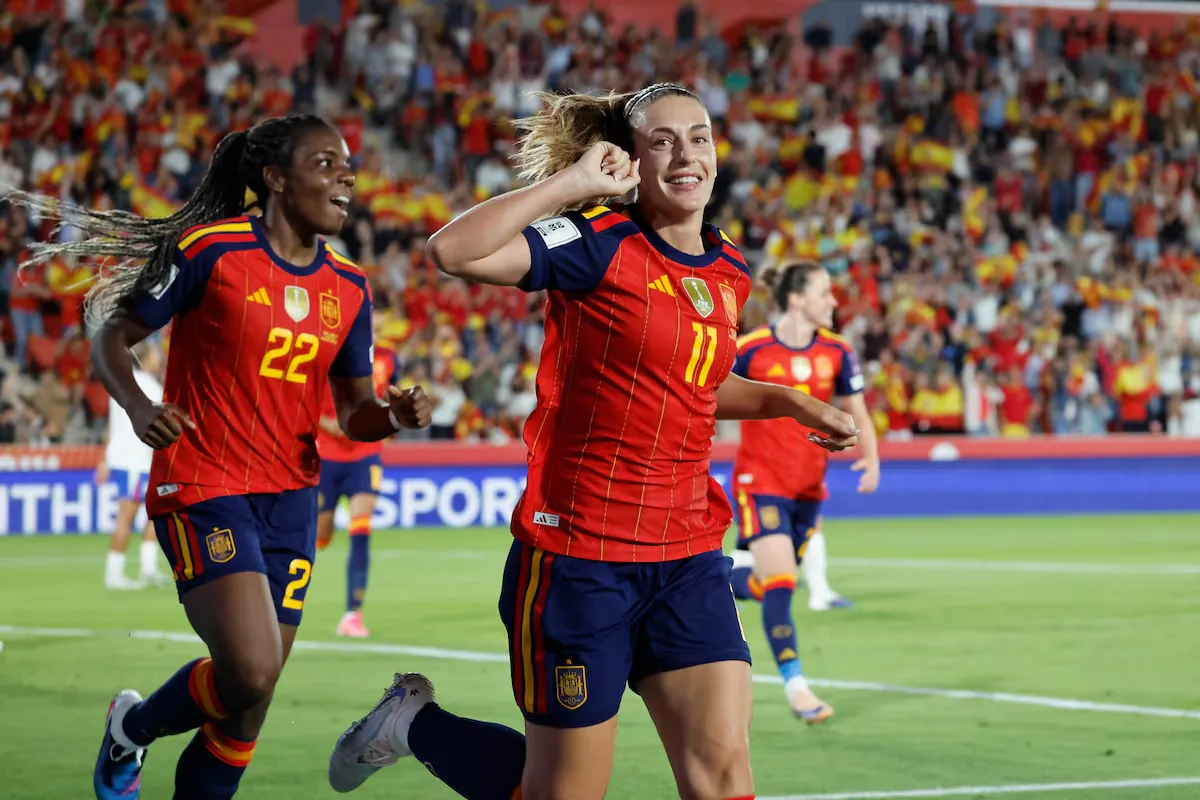
Some players from the Spanish national football team had been pondering for some time how to reconcile motherhood with their careers. In an interview with EL PAÍS Semanal published this Sunday, Alexia Putellas explains that the captains brought this up to the Royal Spanish Football Federation (RFEF), which is finalizing an agreement with a fertility clinic to facilitate players freezing their eggs, according to sources from the entity confirmed to this newspaper.
“For me, it is a huge step forward because the federation understands that you are serving your country against your biological clock, that you cannot stop and you cannot be a mother because you need your body to work,” recounted Putellas, who describes what happens to many elite athletes, whose short professional careers coincide with their peak fertility period.
The RFEF has confirmed to EL PAÍS that it is closing the agreement with a fertility clinic, which has not yet been made public, and whose details are planned to be presented in the second half of September. It will then likely be known, in addition to the company that will provide the treatments, the fine print of this collaboration: what exactly is covered, which players will benefit (all those who have ever been called up to the national team? Those who participate in World Cups or European Championships?), how long they can have their eggs frozen, what happens if they prematurely leave professional sports, get injured, or decide to have children by other means…
For some years now, fertility clinics have been linked in one way or another to women’s sports. Through sponsorships, as has happened in recent seasons with Córdoba Club de Fútbol or Lucentum Alicante basketball team. Or in broader collaboration frameworks, as the British footballers’ union did this year with a UK clinic or as Natuvitro did in 2023 with Futpro, the largest association of female football players in Spain.
Its president, Marta Perarnau, explains that they try to help their members with everything they need regarding reproduction, whether through these advantageous agreements with certain clinics (not only Natruvivo) or with advice if they decide to become mothers during their professional careers.
“Many footballers delay the decision to become mothers, and when they make it, it might be too late. We try to ensure they are not so conditioned by their careers,” says Perarnau. They also advise them when they want to have children before retirement, either with clinics, depending on their personal circumstances, or also attending to what happens when they want to return to play after giving birth.
“We have the pending task of working together to improve that return after motherhood. Returning to competition after becoming a mother is very difficult; we have no scientific studies on female footballers, no recovery protocols, we don’t know what they have to do to recover while performing at their best,” she points out.
What the 2025 collective agreement for professional players did establish is an improvement in work-life balance, with support for daycare during the first three years. “This is important because it makes the player see fewer barriers,” assures the president of Futpro.
What was not common until now is an agreement like the one the RFEF is pointing to with its players, covering treatments at fertility clinics. The closest precedent to something similar was signed this summer by Chelsea with one of the main clinics in London. In a statement on August 14, it announced that its players will receive individualized fertility evaluations, treatments, advice, workshops, and training on fertility and reproductive health.
Chelsea does not detail which specific treatments the fund pays for. In its statement, it only uses the word “treatments.” It also does not specify how much money each player receives, if there is an annual limit, what percentage the club pays, or if certain techniques require medical indication.
Egg preservation for athletes
Candela Gallardo, gynecologist at IVI Málaga, has worked with many elite athletes who come to her clinic to delay motherhood. “If it is until the thirties, it does not necessarily imply problems, but many athletes then maintain a very high professional demand and not all can take a break to have children and sometimes they cannot afford it,” she explains.
What she proposes to a woman who right now cannot face motherhood because she is training at a very intense pace is to undergo preservation, which allows storing eggs obtained at a stage of higher fertility to use them later. It does not guarantee pregnancy, but in Gallardo’s words, “it gives an opportunity to undergo a treatment with a better prognosis” if in vitro fertilization is eventually necessary.
The specialist maintains that the procedure can fit relatively well into a sports career. “A fertility treatment lasts two weeks and is very schedulable,” she notes, so a period with less training and competition load can be sought.
During hormonal stimulation, swelling may appear and, around egg retrieval, it is necessary to reduce physical activity. “The week before the procedure and the week after we tell them not to do impact sports.” Even so, Gallardo emphasizes that “it can be very easily accommodated” and that neither the temporary absence of menstruation due to intense training nor the continuous use of contraceptives prevent undergoing the treatment. In her opinion, the important thing is that players know their best professional stage coincides with their most fertile years and “that they have that possibility, that the reproduction treatment is demystified.”
An added problem is that there is no protocol in professional women’s football regarding these types of treatments, as specialized lawyer Tania Tejeira explains in an article in Palco23. “Neither FIFA nor UEFA have specific protocols to regulate these treatments, despite more and more footballers resorting to egg vitrification or assisted reproduction techniques,” she assures.
The main international reference currently comes from the World Anti-Doping Agency (WADA), which requires reviewing the medications used in these treatments and, when appropriate, requesting a Therapeutic Use Exemption (TUE). As Tejeira explains, substances such as clomiphene or letrozole, used in some ovarian stimulation protocols, are prohibited and require prior authorization, while others, like FSH (a hormone that stimulates reproduction), can be used without it.
Here reproductive health, medical confidentiality, and anti-doping regulations mix, which has led some specialists to call for common rules that provide legal and health security to footballers.
Read more The first US attack on Iran since July causes several dead and injured