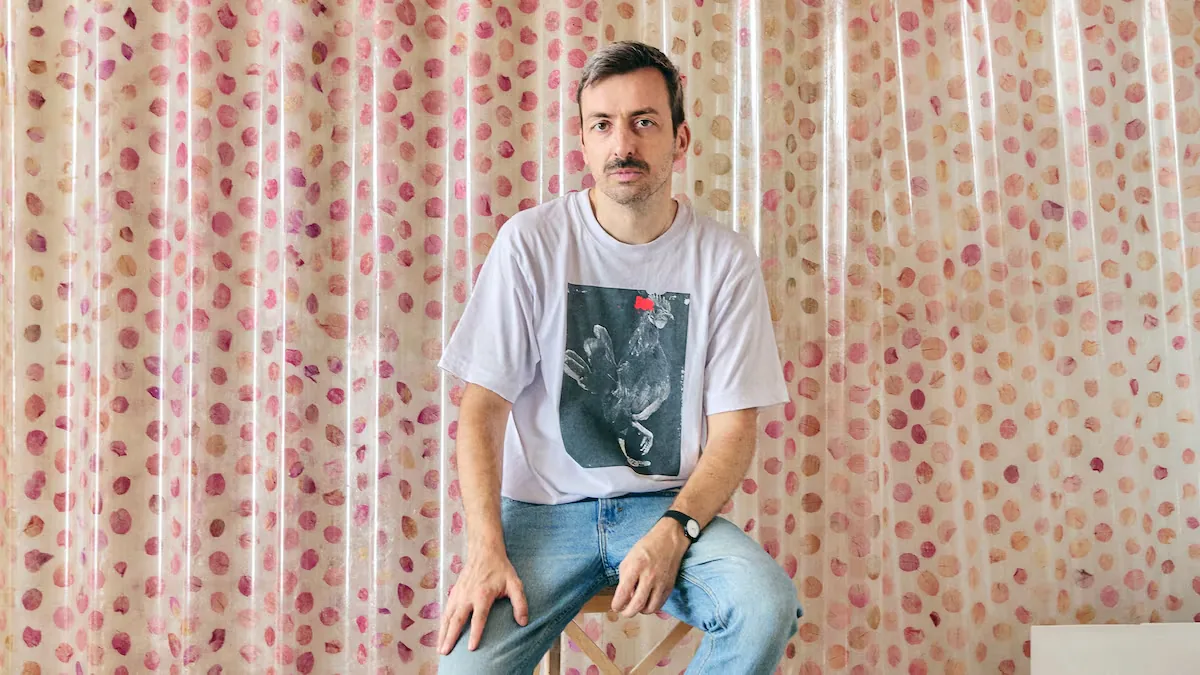
What to do in the face of what is unbearable to us. The killers of Samuel Luiz, a 24-year-old nursing assistant whose sexual orientation they could not tolerate, decided to brutally attack him in 2021, to erase him from the face of the earth. The artist David Bestué (Barcelona, 46 years old) reacted to that absence, equally unbearable for him: “I felt the need to replace Samuel with something, an object.” An object and a gesture: after a long creative process, Bestué went to the crime scene, the promenade of Riazor beach in A Coruña, and installed a sculpture in the shape of a tibia, made of ceramic and bone ashes, as a temporary monument. It stayed there for a few hours until it was removed by municipal services.
Read more Colette teaches us how to live in times of apocalypse
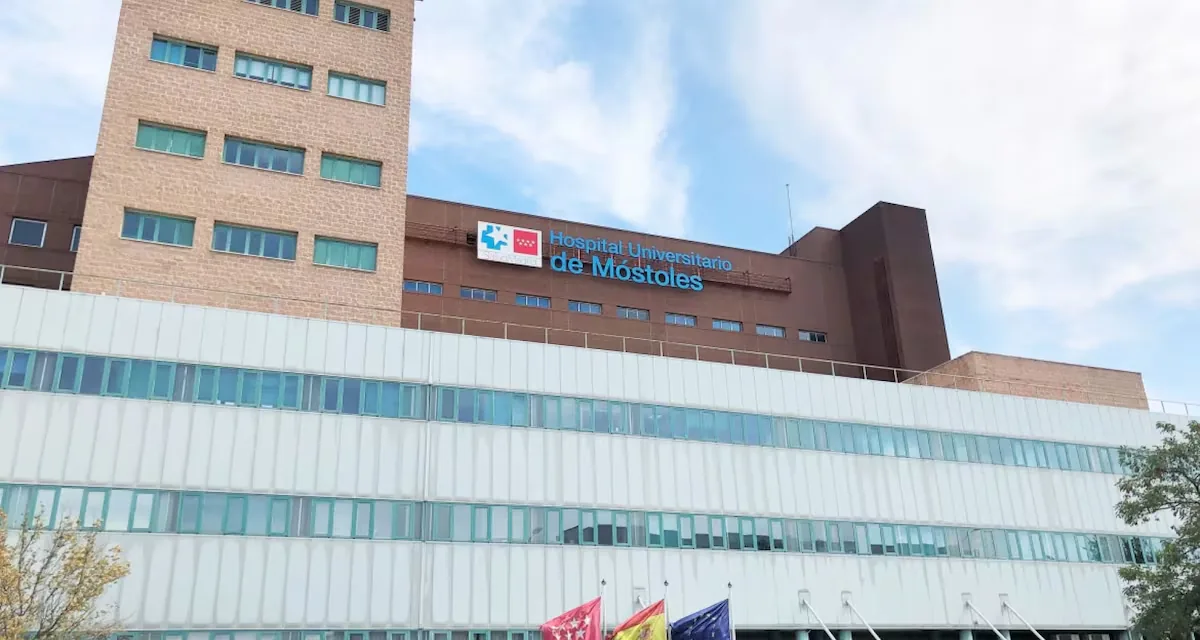
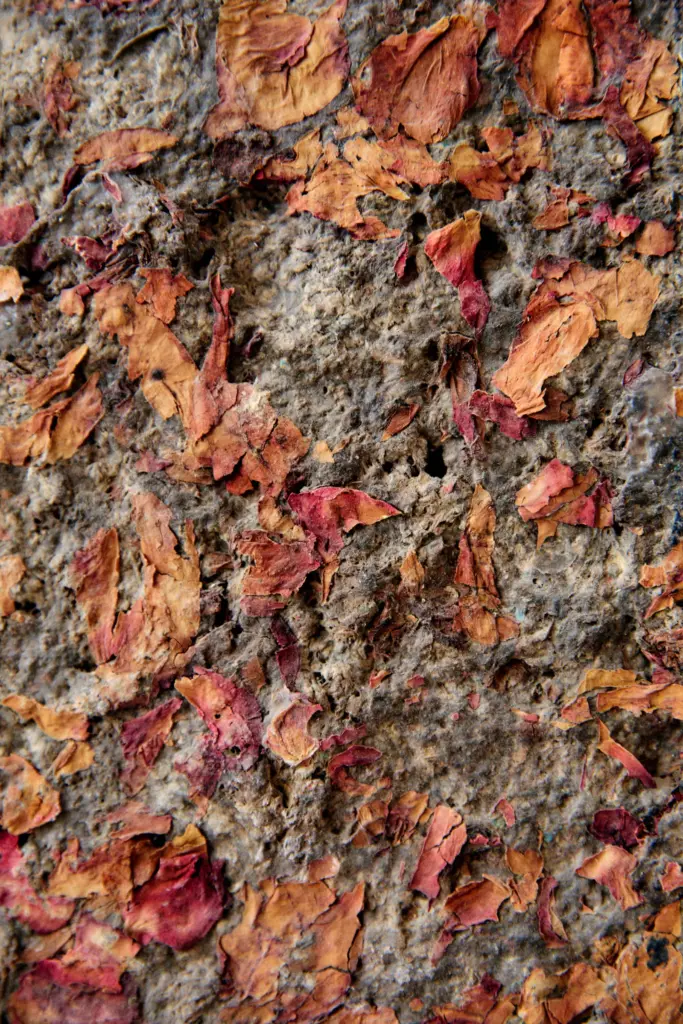
That project generated material results: a book (Samuel, Caniche publishing) and a series of sculptures that have been seen in contexts such as the CA2M museum in Móstoles and in the Parcours section of the last Art Basel fair in Basel (Switzerland). He does not completely abandon the theme in Gran ojo, his new solo exhibition, which opens on September 10 at the Ehrhardt Flórez gallery in Madrid, although it will also feature more recent series. “It is my first exhibition at the gallery, and most are new pieces,” he explains. “They will be closely linked to playing with perception: slats with rose petals, wavy sheets with bougainvillea… And structures that will move, with colors and filters. It will be very bright. I am interested in that production of color, but working with exhausted, gray materials: used felts, ashes. The colors also come from an evolution of Samuel, because of the rainbow flag, which has become so banalized. My idea is to give it another joy.” This happens in his sculpture Rainbow Moneo, an ironic reference to the ornamental modules designed by the Spanish architect for the Atocha station.
While researching for his project on Samuel’s murder, he even considered attending the trial and writing a chronicle in the style of the one Emmanuel Carrère published about the 2015 Paris jihadist attacks. But he soon changed his mind —“I realized I was neither a journalist nor a writer”— and his work shifted towards the relevance of the monument in the contemporary world. Other artists like Rogelio López Cuenca have reflected on the decline of the public monument. Bestué shares this same concern: “Until the seventies, many sculptors worked with monuments, like Oteiza in the Arantzazu basilica. I wanted to study how to do it again from contemporary sculpture. I am interested in spontaneous monuments because they arise in situations of tension and seek to ensure something is not forgotten.”
When he abandoned his decade-long practice in performance as a duo with Marc Vives and started a solo one in 2012, Bestué joined a generation of Spanish artists born between the late seventies and mid-eighties —Teresa Solar, Jacobo Castellano, June Crespo, Laia Estruch, Julia Spínola, Carlos F. Pello— who have mainly dedicated themselves to sculpture: “Surrounded as we are by virtual images, sculpture offers the possibility to interact with the real. But I am not interested in making something pretty, nor as an illustration of an idea. My intention is to give meaning, although, when you try to give too much meaning to something, sometimes you end up feeling empty.”
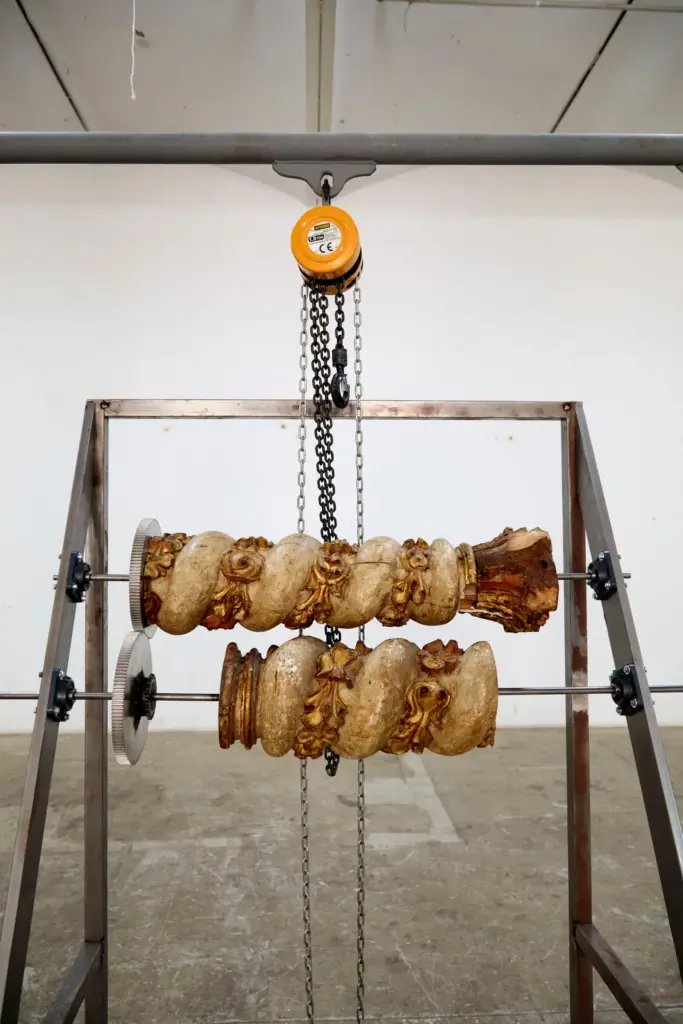
Something that has characterized his sculptures is the integration of elements taken from reality: sand, flower petals, or bone ashes. One of the works to be seen at Ehrhardt Flórez consists of two chairs with soil from the Víznar ravine and sand from Riazor beach, material residues from the places where the murders of Lorca in 1936 and Samuel Luiz in 2021 were committed. One of his historical pieces was an opaque metal sphere that contained rubble from a construction inside, like the relics of saints, also invisible, buried under old medieval altars. “I was interested in working with the material because it is not representation, but reality. That fascinates me about Christian iconography, which is pure representation, but at the same time shows a constant will to prove itself through matter. Relics become proof of the existence of what they come from. Like the Holy Host of El Escorial, which supposedly bled after a soldier stepped on it.”
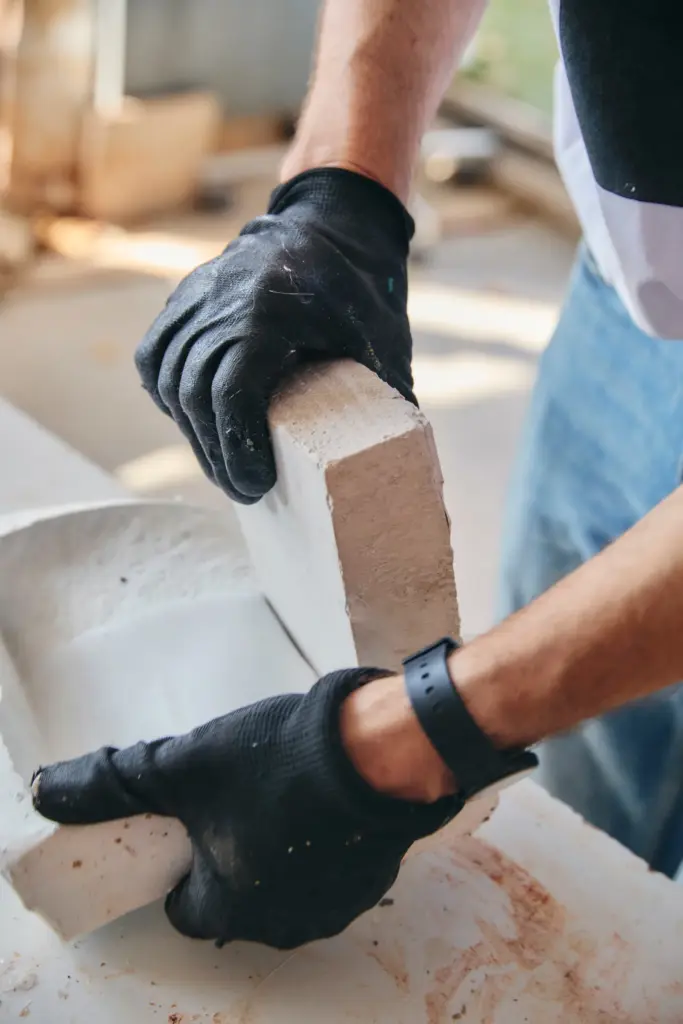
He refers to an alleged miracle that happened in the Dutch city of Gorcum in 1572, when Protestant troops looted the church and trampled a consecrated host, which then supposedly began to bleed. This relic is kept in the monastery of El Escorial, a monument on which Bestué also conducted research that was reflected in another book, El Escorial: imperio y estómago, winner of the 2022 FAD Award for Thought and Criticism. On that occasion, he started from the surprise caused by his visit to the complex built by order of Philip II: “They barely offer you information and show it to you without problematizing or contextualizing it. If you scratch a little, you realize that afterwards the place was abandoned and looted, it went through periods of decline, disentailment, and neglect. It is like a black box because it records everything that happens in Spain, even if it is hidden from us.”
Read more Lake Ontario and the growing frustration with big tech companies
—Since we’re at it, what do you think should be done with Cuelgamuros?
—El Escorial seems sexier to me than the Valley of the Fallen, richer in nuances: it starts from a Neoplatonic idea, an aspiration to perfection and purity. The Valley has the problem of that huge cross you see from very far away and it generates sadness. And something that generates that sadness makes no sense. I would destroy it. I think it’s fine to keep the basilica, but not the cross.
—There would be reactions against it.
—We are a generation linked to the perishable and the precarious. We have accepted the idea that what we do will not last. So maybe it is not necessary for everything done before to be preserved at all costs. Architecturally, that cross is nothing special either. Works made at the same time are already being dismantled because of their visual impact. Six years ago, a concrete chimney of the same height was demolished in Anllares, León. Why would this case be different?
Architecture and urbanism have been part of his obsessions, reflected in his studies on architect Enric Miralles or his exhibitions on the construction of the image of modern Barcelona and Madrid.
“I grew up in a transforming Barcelona,” he explains. “I remember the Macba under construction, as I remember the building of the Olympic Village. It was a very euphoric city from a citizen’s point of view, with people very involved. But then came disenchantment. At some point in the nineties, a line was crossed and everything that was being built ended up becoming a mechanism to expel you from the city and fill it with tourism. Madrid has followed a similar drift. Not a drift: a course. Because a course is taken with a map and intention.”
Again the unbearable. Maybe sculpture still serves for that: to give body to what should not disappear.