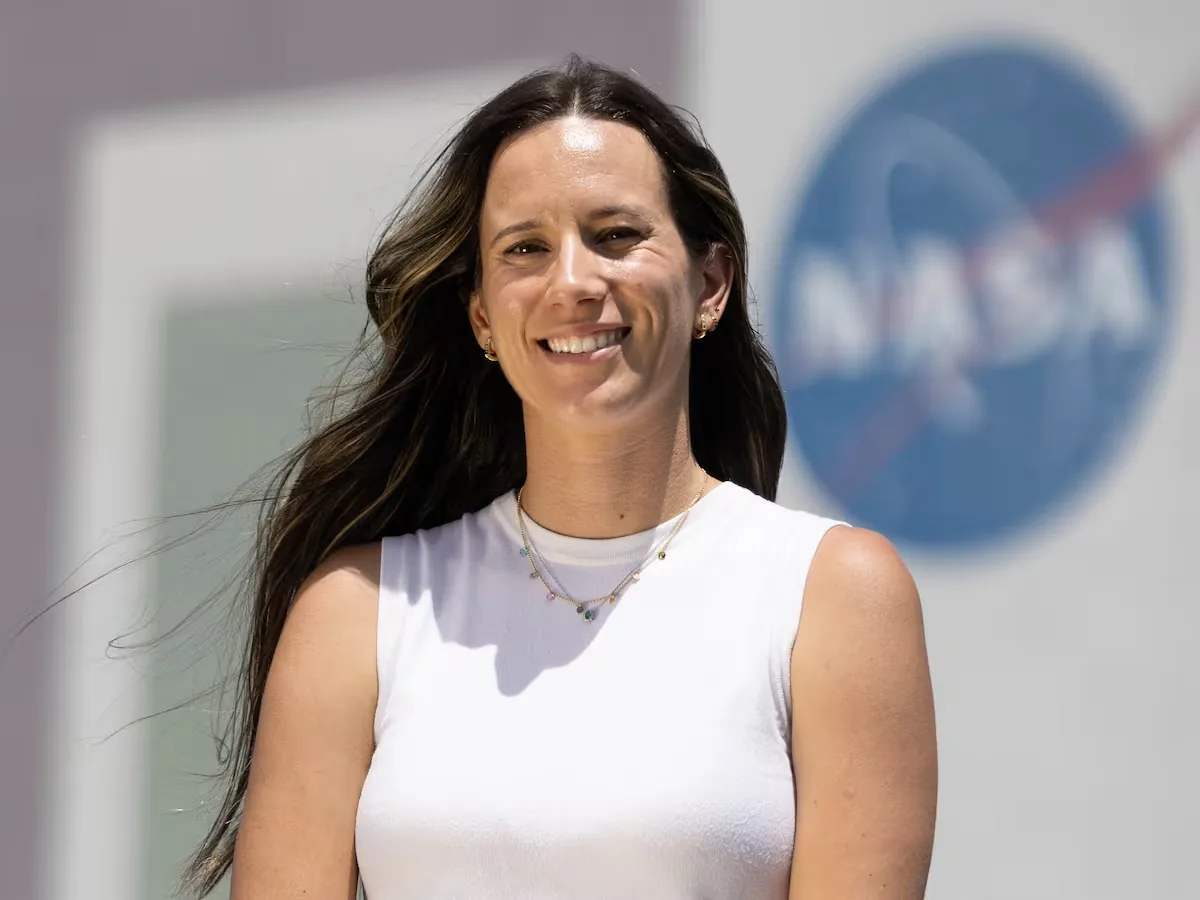
Paula Ortiz Couder, 31 years old, says she was born with a racket in her hand. Daughter and granddaughter of professional tennis players — her grandfather was a Davis Cup captain — her destiny seemed set in advance. She played the sport from the age of three, with daily three-hour training sessions. One day, at 12, she came home and said: “Mom, I’m going to study aerospace engineering.” And her mother replied: “Well, go ahead, let’s do it.”
Read more El Roto: an invasion
Ortiz speaks with EL PAÍS via videoconference from NASA’s Kennedy Space Center, where she works as an expert in crewed space mission safety. On April 1, just as the gigantic Artemis 2 space rocket with four astronauts on board was taking off, four white metal cages, like cable car cabins, slid down cables and moved away from the rocket, which by then was spewing a huge column of fire in its slow initial ascent. In case of an accident before takeoff, the astronauts would board this emergency evacuation system to escape as quickly as possible from the SLS rocket, which is the largest controlled bomb ever to carry humans into space.
Those baskets “are my baby,” Ortiz confesses, who has worked on their design and improvement since 2019, first as a contractor for the U.S. space agency and since 2024 as a permanent NASA employee. Her dream of becoming an aerospace engineer, elevated to a space category, came true, partly thanks to tennis.
Ortiz is the daughter of Arturo Ortiz, nine-time Spanish high jump champion and still the national record holder in that discipline: 2.34 meters. A training partner nicknamed him Alturo. Her mother, Patricia, is a professional tennis player and still runs the tennis academy founded by her father, Juan Manuel Couder, in the 1980s on the outskirts of Madrid.
From her hometown Majadahonda, Paula went to the United States to study engineering with a tennis scholarship at Embry-Riddle Aeronautical University. One day, some classmates invited her to Titusville to watch a NASA launch. “That moment changed my career,” she recalls. “It was very powerful to feel the vibration in my chest, the sound, everything; it’s hard for me to think that anyone could see something like that and not feel inspired, fascinated,” she adds. During her last year of studies, she had an injury and stopped playing. According to her father, she threw away the racket and never picked it up again.

The next challenge for this engineer is to colonize the Moon. The motto of the department where she works, NASA’s Mission Safety and Assurance Office, is that the response to a new project should never be a justified no (“no, because…”), but a conditional yes (“yes, if…”). This means finding a way for the mission to move forward while minimizing risks to the astronauts, even if these are impossible to avoid. As Ortiz says: “What isn’t hostile in space?”.
The biggest enemy NASA faces in its lunar settlement plan is microscopic and sharp as a razor. The dust that is part of the lunar regolith is made of tiny particles with sharp edges — like shards of glass — that stick to anything they touch and are very hard to shake off.
Read more Feijóo and Abascal join forces in a protest they expect to be massive over the Ceuta crisis
During the Apollo program that took Neil Armstrong to the Moon half a century ago, the first astronauts to step on it had serious problems with this dust, which stuck to their spacesuits, spread throughout the lunar module, and got into their lungs, causing allergic reactions. It is unknown what harmful effects this sand will have on future lunar settlers. On Earth, a similar type of particle causes silicosis, a very common chronic disease in miners that attacks the lungs and can cause death.
“NASA has been thinking for quite some time about how to try to manage it,” Ortiz acknowledges. “It is a very small, sharp, and electrostatic particle, it has a charge, and that’s why it sticks to everything. Designing systems compatible with this will be a great challenge,” the engineer details about her new job overseeing the safety of transport, landing, or scientific missions of the agency’s Lunar Base project.
The first major milestone of this program will come when the Artemis 4 astronauts step on the Moon’s south pole, at the earliest in early 2028. The original plan, designed during Donald Trump’s first term, was for a woman and a non-white person to be the astronauts, although that goal has faded after the Republican’s return to power. That same year, the last of his current term, there will be a second crewed landing in this area of the satellite, which has never been explored, and which is the new object of desire for the United States and China because there is frozen water that could support permanent colonies. Later, NASA wants to lay the foundations of a colony so that the Moon is permanently inhabited in just six years, according to the project, whose head is another Madrilenian: 51-year-old engineer Carlos García Galán.
In the craters of the south pole, where the ice is, perpetual night reigns, and temperatures plunge to 200 below zero. Outside them, days last 14 Earth days, and the sun never rises much above the horizon. “It is very different from what we are used to here on Earth. The other day we saw some simulations and honestly my brain had a hard time adapting. And that is the lighting condition that exists all year round,” Ortiz admits. One of NASA’s goals, along with the Department of War renamed by Trump, is to plant the first nuclear power plants there, to maintain settlements without relying on solar panels.

Ortiz has supported the Artemis 1 mission, uncrewed, and 2, which was the first crewed mission to orbit the Moon in more than half a century. She has also helped design devices that would have allowed mission specialist Christina Koch, the first woman to travel to the Moon, to open the Orion spacecraft from inside after falling into the Pacific Ocean. In the end, it was not necessary, as U.S. Navy personnel were able to reach the capsule and open the hatch to get the crew out. At that moment, NASA’s live video showed two other innovations, to whose design Ortiz contributed. They are the front porch, an inflatable system so the rescue team can access the spacecraft, even with four-meter waves; and the round floats on the top, specially designed so the capsule does not flip over in the water. “When you see them, they might not seem incredible, but there is a lot of engineering dedicated to designing these things to make sure they work in different ocean conditions,” Ortiz reasons.
The engineer had her first child a little over a year ago. The grandfather jokes only half-seriously when he says that the granddaughter will never lack good floats in the pool.
Read more The Batlleiroig studio resurrects Casa Moratiel, an icon of the modern movement in Catalonia