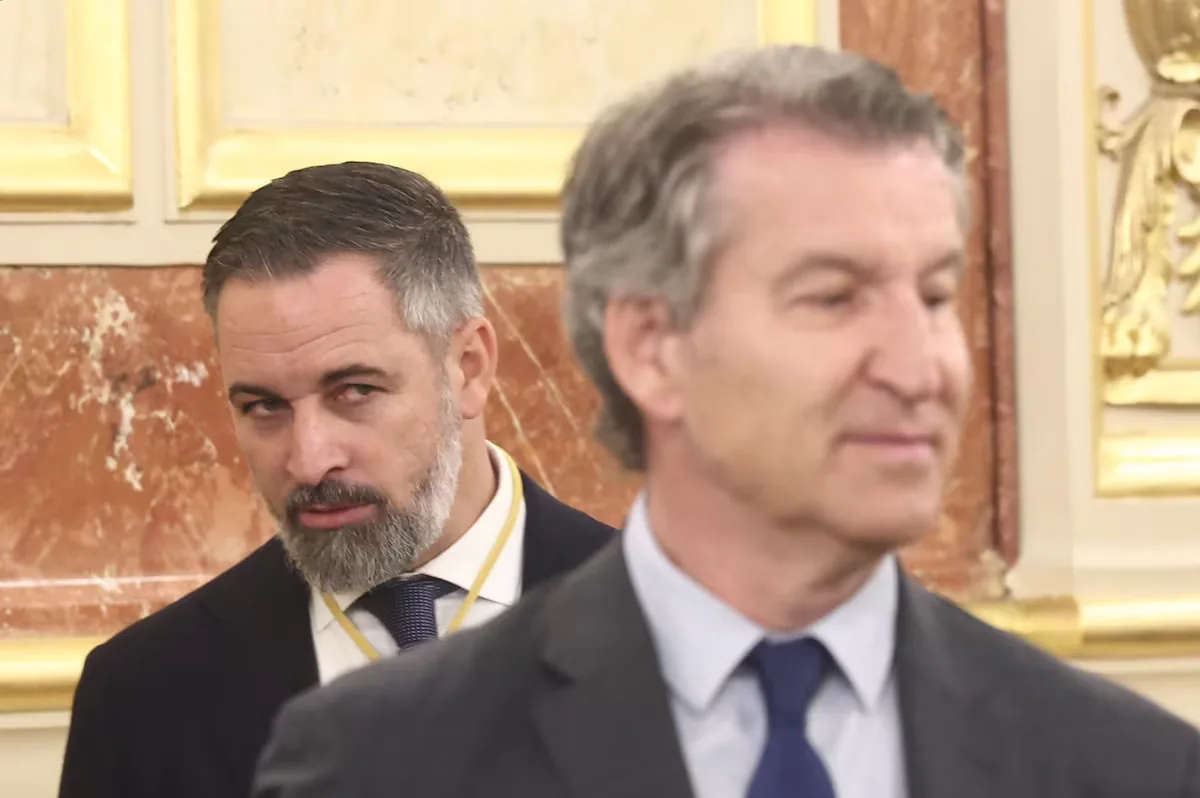
The right-wing parties join forces at the start of the political season to mobilize the streets in a protest they predict will be “massive” due to the Ceuta crisis, with which they hope to increase pressure on the Government on the eve of Pedro Sánchez’s appearance on Thursday in Congress. The PP, through the Spanish Federation of Municipalities and Provinces (FEMP), which it presides over, has called for gatherings this Wednesday at eight in the evening in front of all town halls across the country coinciding with Ceuta Day, presenting them as “non-partisan” mobilizations to show support for the autonomous city. Meanwhile, Vox, which has joined the call, urges people to back them “against the traitorous Government.” The leaders of PP and Vox, Alberto Núñez Feijóo and Santiago Abascal, will show unity by meeting at the gathering in front of Madrid City Hall. The Government, which asks that the protests take place without violence, accuses the PP of “instrumentalizing” the FEMP and presenting as neutral protests that are actually conceived as a “partisan use” of the Ceuta crisis.
Read more The Batlleiroig studio resurrects Casa Moratiel, an icon of the modern movement in Catalonia
The gathering that Feijóo and Abascal will attend in Madrid will be preceded by a clash between the PP and the Government Delegation in Madrid, with the Populars accusing the Executive of “boycotting” the protest, despite the Delegation confirming yesterday that it will be able to take place normally. The cause of the confusion was a formal defect in the communication from the Madrid City Council, which intended the procedure to be carried out under the rules for citizen demonstrations and gatherings, when only natural persons, not legal entities, hold the right of assembly.

Sources from the Delegation clarified late in the afternoon that the Government “has not prohibited the event nor prevented it from taking place” but “only clarified that, when it is called by a City Council, it must be considered an institutional act and not a demonstration exercised under the fundamental right of assembly.” Although the Government clarified that under no circumstances would the event be banned and that a “legal clarification about the nature of the call was being confused with a non-existent prohibition,” PP and Vox rushed to accuse the Government of trying to prevent their demonstrations. The PP leader tweeted: “Let Spain speak. That’s what they are afraid of.”
The president of Ceuta, the Popular Juan Jesús Vivas, published a letter addressed to all Spaniards this Tuesday in which he asks for support for the gatherings called this Wednesday to “express unity in support of a city that has suffered an attack on its territorial integrity, continues to suffer as a consequence of that attack and that, for that reason, is overwhelmed and on the brink of collapse; it is in a high-risk situation in all aspects, feels threatened, and needs the support of all Spaniards.” In the letter, later shared by the PP leader, Alberto Núñez Feijóo, the president of Ceuta defends that the mobilizations called by the FEMP “are not marked by political color or ideologies” and asks that they be supported, since the cause of Ceuta “is the cause of all Spain.”
The PP insists on presenting the protests as “non-partisan,” in the words of spokesperson Borja Sémper, and party sources assured yesterday that “it is not a gathering against anyone, but in support of national sovereignty and the return to normality in Spanish territory.” The Génova movement seeks to stir the contradictions of PSOE mayors, after Ferraz sent an internal circular to its federations urging them not to participate in a “unilateral” PP call “without agreement” within the FEMP and which seeks to turn the Ceuta crisis into “mobilization and political confrontation.” A handful of socialist mayors will back the gatherings despite this, such as the mayor of León and some from Andalusian and Valencian municipalities. The Government sent a message of “maximum respect” regarding the mobilizations yesterday, which the Minister of Territorial Policy, Ángel Víctor Torres, described as “absolutely legitimate.”
Read more David Bestué, memory of sculpture and sculpture of memory
But Vox, which announced this Tuesday that it will fully support the protest and that its leader, Santiago Abascal, will participate in the one in Madrid, makes clear that the goal of the mobilizations, besides supporting Ceuta, is to protest against the Government. “We must call for constant mobilization against this traitorous Government,” emphasized Vox’s spokesperson in Congress, Pepa Millán, who accused the PP of “timidity” for presenting the mobilization as neutral. “We are already starting against timidity. We have an invasion in Ceuta and we protest against no one? Of course it is in support of the people of Ceuta, but the culprits must be pointed out,” Millán objected. “Here there has been a coordinated operation by the Moroccan regime. What are we going to do [at the gatherings], sing a Christmas carol? We must point to those responsible. The PP will have to explain why it remains so timid and why it does not break its agreements with the PSOE and Islamist parties in Ceuta.”
The far right is pressuring the PP for Juan Jesús Vivas, who was invested for the seventh time three years ago as president of Ceuta with the abstention of the PSOE and Vox, to break with the socialists and rely only on Vox to govern, but Vivas has chosen to seek unity among all parties in the Ceuta Assembly and Génova supports him in this path. “The city of Ceuta is not for political maneuvers,” rejected the Vox proposal yesterday the PP parliamentary spokesperson, Ester Muñoz.
Despite the unity of action with the gatherings this Wednesday, PP and Vox also have tensions over how to respond to the Ceuta crisis, with Abascal’s group pressuring the Populars to go further not only in breaking with the PSOE but also in the reaction against Morocco, which Génova, despite accusing Sánchez of appeasement towards Rabat, is also measuring. Vox’s reaction is, however, frontal against the Alaouite regime. Abascal’s group urges the PP to join its call to suspend the Friendship Treaty with Morocco and challenges it to support in the Senate the withdrawal of the Spanish ambassador in Morocco. The PP even called for the Moroccan ambassador to be summoned for consultations in mid-August after the words of the Minister of Justice that questioned the Spanishness of Ceuta and Melilla, but the Populars have not reiterated that idea and have not joined the initiative to suspend the Friendship Treaty with the neighboring country.
Despite these tensions, the two right-wing parties will join forces this Wednesday in protests that sources from both formations expect to be “massive.” Feijóo tries to capitalize on the discontent over the Ceuta crisis and will also be in the autonomous city in the morning, where he will meet with President Vivas, and will travel in the afternoon to Madrid to arrive in time for the gathering in Plaza de Cibeles. But Abascal also seeks his share of the spotlight and will compete with the PP leader for attention at the Madrid protest, where both will coincide.
Read more Colette teaches us how to live in times of apocalypse