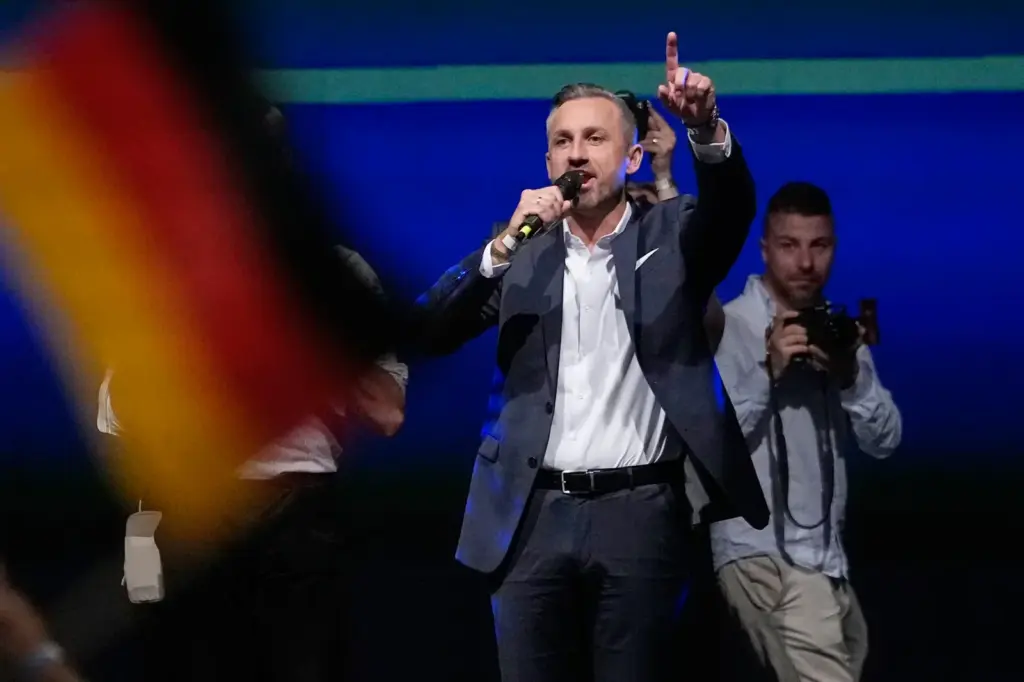
His constant smile and good humor have become his trademark. Ulrich Siegmund has changed the image of the far-right party Alternative for Germany (AfD) by leaving aside anger and rage to focus on optimistic messages like “everything will be fine,” the slogan of a successful electoral campaign in which people lined up for selfies with him and to get an autograph.
This 35-year-old man, born in the small town of Havelberg, in Saxony-Anhalt, three weeks after German reunification, in October 1990, and with a strong media presence, could become the first far-right president in a German federal state since World War II.
But his career was not initially focused on politics. After completing vocational training as a commercial technician in wholesale and foreign trade, he studied economic psychology and business administration. At 23, he founded a company dedicated to marketing in the air freshener sector and other types of scenting systems. However, he was interested in politics from a young age.
Siegmund joined the CDU at 18 and six years later left to join AfD in 2014, a party created a year earlier. At that time, it was an anti-euro formation that emerged after the 2008 economic crisis and the EU financial bailouts. In fact, the euro bailout policy followed by the CDU is what, according to him, led him to leave the conservative party. Two years later, at 26, in 2016, he entered the Saxony-Anhalt regional parliament for the first time with AfD. Since August 2022, he has co-chaired the AfD parliamentary group in that parliament alongside Oliver Kirchner. In 2025, he was elected AfD’s lead candidate for the regional elections held last Sunday, in which he obtained 44% of the votes. AfD, a party that the Federal Office for the Protection of the Constitution — the domestic intelligence service — classifies as clearly far-right, came close to an absolute majority.
One of the most popular politicians
With more than 670,000 followers on Instagram and over 900,000 on TikTok, he is one of Germany’s most popular politicians. It is said that as a teenager he was “the most popular boy in school.” He usually appears friendly, casual, and approachable. He tirelessly poses with his hundreds of followers, and during the electoral campaign, he focused on family parties, dialogues with citizens, and face-to-face meetings. A tactic that has brought him great success. International media often describe him as the “smiling face” of AfD. Siegmund is married and has a daughter. His wife, Julia, has appeared on television cameras a few times. She participated in the VOX channel’s wedding docu-reality Zwischen Tüll & Tränen (Between Tulle and Tears), where she chose her wedding dress for the wedding with Siegmund. In 2017, he left the Catholic Church. According to his words, he carries his values “in his heart,” but rejects the German institution behind it.
The politician advocates, among other things, for a much more restrictive migration policy, deportations, and a fundamental change in regional policy. In his circle, there are trusted people who actively participated in the Heimattreue Deutsche Jugend (HDJ), an organization banned in 2009 for its “affinity with National Socialism” that aimed to educate children to become “National Socialist fighters for freedom” and taught minors “racial science.” One of them is Patrick Harr, press spokesman for the parliamentary group and Siegmund’s right-hand man. But for Siegmund, those were “youthful sins,” “long prescribed.”
The leader has no problem praising the YouTuber Matthäus Westfal, aka Aktivist-Mann. “There are many good people who inform.” Siegmund does not seem bothered by the fact that this live content broadcaster was at the forefront of the attempted storming of the German Parliament in 2020 during a massive demonstration amid the covid pandemic and is known for his contacts with Holocaust deniers.
And then there is Sebastian Schmidtke, former federal vice president of the NPD — now Die Heimat — who now also broadcasts live content and was accredited at the AfD federal congress. Siegmund seems to have confidence in the convicted neo-Nazi. Also, when asked how he himself evaluates National Socialism and the Holocaust, and whether he would also describe the years 1933 to 1945 as “the worst crime against humanity,” Siegmund responds evasively: “I do not dare to judge it. Because I cannot make a judgment for all humanity.”
Scandals do not affect him
Likewise, scandals do not seem to affect him. He is deeply involved in his party’s nepotism case. His father works for a Bundestag deputy from Saxony-Anhalt. Previously, he had worked for other AfD deputies. Siegmund initially defended the hiring of relatives and party colleagues and pointed out, among other things, that AfD found it difficult to find good professionals, as anyone working for the party is stigmatized.
Despite this, his popularity was not diminished at all but continued to grow. Perhaps also, as Der Spiegel analyzed, because “AfD has long made distrust of state institutions part of its political strategy. Its own media universe reinforces the message: ‘we no longer believe you, we only believe ourselves.’” Nor was he affected by having been present at the controversial right-wing extremist meeting in Potsdam in November 2023, where a master plan to expel millions of people from Germany was outlined and which was uncovered by Correctiv, a German nonprofit investigative media outlet.
Siegmund managed to turn the Der Spiegel cover from late August into a campaign slogan, which under a passport photo of the AfD candidate highlighted in red letters: “Germany’s most dangerous man.” He even mocked it by saying that if he got 46% of the votes, he would reveal how much he had paid for this advertising to Der Spiegel.
Read more An uphill week for Ayuso due to the penthouse crisis awaiting a power move