








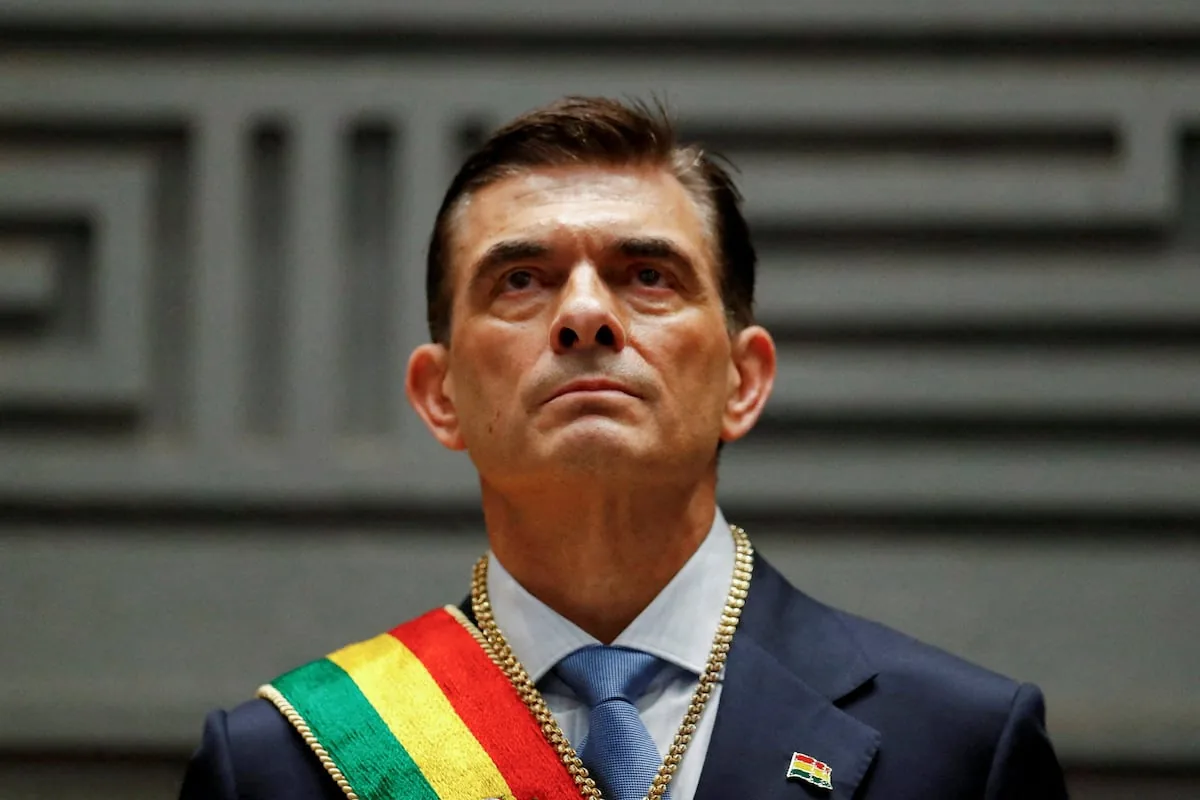
Five of Bolivia’s nine departments will vote this Sunday in a second round to elect governors. In four of the contests, one of the competitors represents President Rodrigo Paz’s party, Alianza Patria. The key dispute would be in La Paz, the seat of government, but, in an unprecedented event, the opposition organization declined its candidacy after conflicts with its candidate. The electoral court then proclaimed Paz’s ally, Luis Revilla, as the winner. In the rest of the contests, the president faces an evaluation after five months in office, during which a fleeting economic stability has begun to give way to social demands for structural changes.
Read more Gica Hagi will coach the Romanian national team again a quarter of a century later
Around 3.5 million voters from the departments of Santa Cruz de la Sierra, Chuquisaca, Oruro, Beni, and Tarija return to the polls after no candidate secured at least 40% of the votes on March 22. The president announced that, after that date, fundamental laws would be introduced to reverse the economic recession that the International Monetary Fund forecasts as a 3.3% decrease for this year. He will know on Sunday night whether he has achieved a territorial structure to support his reforms or if he will have to negotiate with autonomous local powers, characterized by their pragmatism and de-ideologization.
For sociologist and political analyst Luciana Jáuregui, the second round has opened a scenario —except in Santa Cruz de la Sierra— with candidates from currents affiliated with the ruling party facing autonomous forces. “The pro-government options seek to align with the central government and organize local governments under a national logic. The other trend is forces for autonomy, currents that seek greater margins of decision. They are not interested in being opponents of the government, but rather in safeguarding the interests of the department above the national government.” The entire electoral campaign has been marked by the candidates’ promises to fulfill the “50/50” slogan that Paz promised during his presidential campaign.
The slogan refers to a decentralization process in which the central government would transfer half of the national resources directly to municipalities and governorships, in addition to granting them greater responsibilities that are not yet within their competence, such as education or health. Having representation in the different territories will facilitate, Jáuregui points out, negotiations to carry out this process: “In a context of economic crisis, local governments will lose a significant amount of income. Having allies in the territories will mean cushioning the conflict over resource distribution and will help manage the territorial tensions of each region.”
For Paz, Sunday’s elections also present an opportunity to show political muscle. The solution to fuel shortages and the closing of the gap between the official and parallel exchange rates boosted his popularity in the first months, according to an Ipsos Ciesmori survey that gives him 60% approval in the central axis of the country. However, in recent weeks, citizen assemblies have been constant, demanding cuts in public salaries, marches to repeal laws, and departmental strikes over poor quality gasoline that the Government admitted to having distributed.
Alianza Patria turned out to be the leading force in the first round of subnational elections. The scope of its victory (37 municipalities out of more than 300), however, is limited in a context of political fragmentation. Nor can Paz’s candidates for this Sunday be understood as the natural result of an organic party structure, but rather as circumstantial alliances with local leaders who prioritize technocracy. “They should not be read as a united and cohesive bloc, but rather depend on the results that the Government produces. This is a characteristic of Paz’s Government at all levels: if it goes well, it will reproduce; if it goes badly, it is very likely that they will disaffiliate,” Jáuregui emphasizes.
These are the first regional or subnational elections after the collapse of the 20-year hegemony of the Movement for Socialism (MAS), and with it also fell the axis that coordinated the contest: masismo against antimasismo. A transition phase has begun where the electoral offer has atomized, with a resurgence of urban elites and citizen platforms. An “intra-elite” competition, Jáuregui calls it. “There is a displacement of indigenous peasant unionism as the axis of local power.” In the case of Santa Cruz, for example, Otto Ritter, a former councilman and self-proclaimed Falangist, faces the technology entrepreneur and former vice-presidential candidate for the far-right Jorge Tuto Quiroga, Juan Pablo Velasco.
The only department where the once dominant indigenous peasant organizations have managed to rearticulate is in Oruro and Cochabamba. In the former, through the Aymara engineer and former MAS deputy Edgar Sánchez, who in the first round secured 38% of the vote against 11% for economist Óscar Chambi, from Alianza Patria. Meanwhile, in Cochabamba, the candidate of former indigenous president Evo Morales, Leonardo Loza, managed to win in the first round, thanks to the disciplined and organized vote of the coca growers’ federations that populate the tropical part of the department.