The PISA exam, which caused a worldwide upheaval due to the widespread decline in secondary school students’ performance, challenged 760,000 students from 90 countries with problems of low, moderate, and high difficulty levels. The Ministry of Education published this Tuesday a list of about fifty questions on science, mathematics, reading comprehension, and other subjects that the 30,000 Spanish students aged 15 and 16 had to answer. Here are some of them.
Science
Problem. The mayor of a town in Zedlandia, a fictional country commonly used in these international tests, needs to replace his old diesel electricity generator. The exercise proposes four alternatives: wind energy, photovoltaic cells, hydroelectric, and natural gas. The test provides graphs with two types of information, the average amount of electricity each source can generate over 24 hours, expressed in megawatts (MW), and the cost of the energy produced in zeds, the official currency of the fictional country, per megawatt hour (MWh).
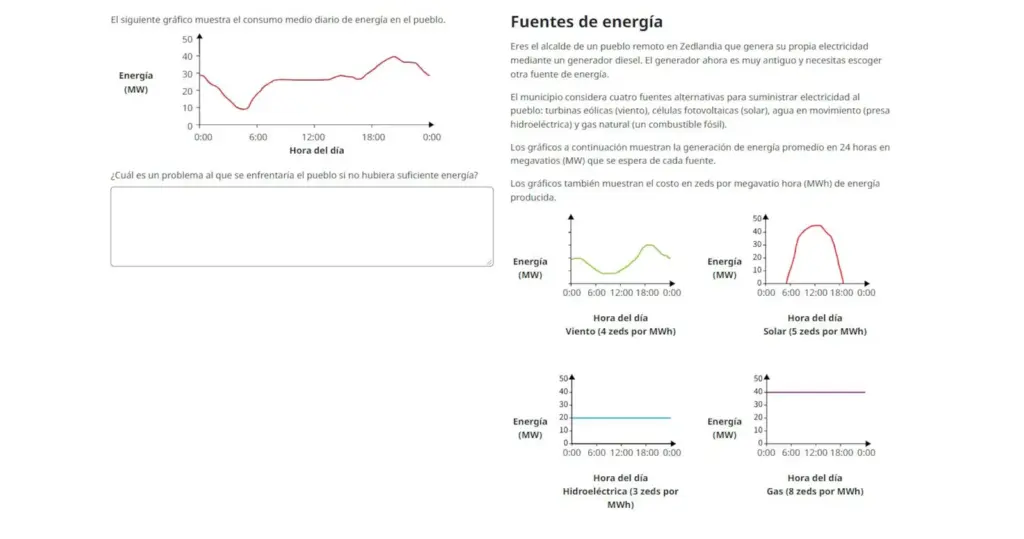
Although the problem provides all these data, students must mention the difficulties the town would face if there were not enough energy. The PISA exam itself rates this question as having a high level of cognitive demand, as it requires students to draw on their scientific understanding of a familiar phenomenon and reason about cause and effect to explain the impact of limited electricity availability.
Solution. According to the feedback released by the evaluators, the student must describe at least one consequence of the lack of electrical energy, such as impacts on daily activities, services, or infrastructure. As an example, the organization has suggested the following answers:
- The lack of street lighting could be dangerous at night.
- Hospitalized patients on life support could be at risk.
- The lack of heating/cooling could pose a health risk to vulnerable people.
Problem. Explain what will happen to a population of house flies if the population of another type of this insect, black soldier flies, which live in the same area, increases.
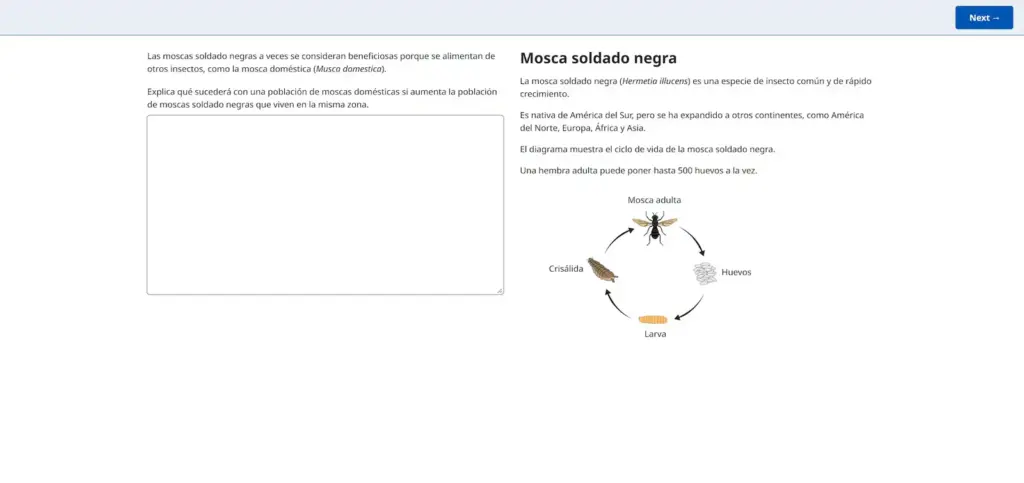
Solution. The answer establishes a direct link with the predator-prey relationship. An example solution, proposed by the organization, is this:
Read more Merz accuses the far right of wanting to carry out «an ethnic cleansing» in Germany
- As the population of black soldier flies increases, it can be assumed that the population of house flies will decrease.
As in previous years, the test contains some anchor questions, which are repeated in different editions, to allow comparison of the student’s performance with their own past performance. In this case, several of those questions focused on mathematics and reading comprehension.
Mathematics
Problem. The Zedlandia basketball team wins the championship. It has won all the games of the season and records an average point difference of 19 points (the difference between the number of points scored by the winning team and the number of points scored by the losing team in a game). Given the average point difference of the season, the PISA exam asks: is it possible that the team actually did not win any game by 19 points?
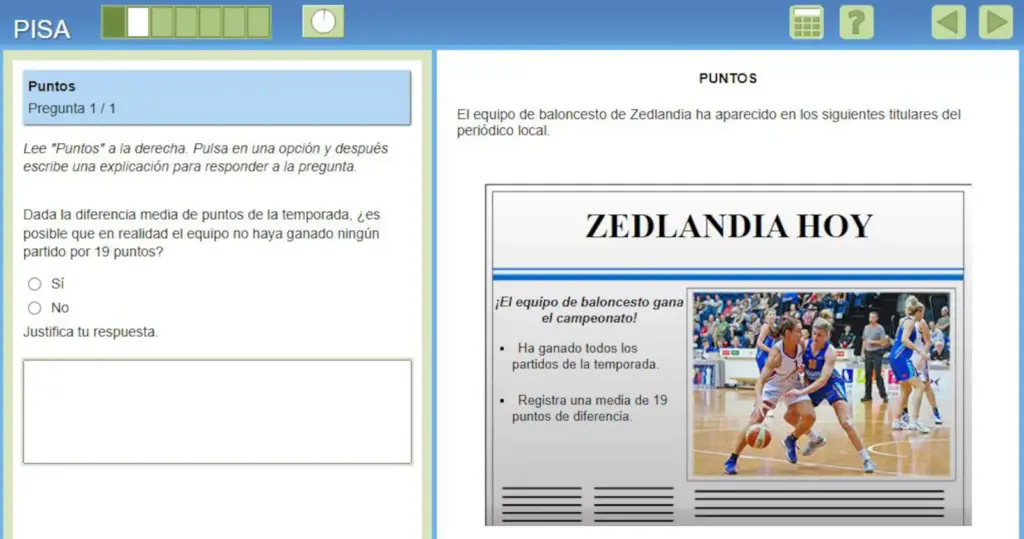
Solution. The correct answer is yes, since it is possible that the team never actually won a game by 19 points, even though 19 is the average winning margin. Students can answer by recognizing that the average does not have to be a member of the data set, or they can provide an example data set that has an average of 19 but does not contain 19 in the data set.
Reading
Problem. A local library offers a lecture next week, in which a professor will talk about her fieldwork on Easter Island, a Chilean territory in the Pacific Ocean. Your history class will attend the event and your teacher asks you to research the island before the lecture. The first source you will read is a blog entry written by the professor while she was living there. According to the text, when did the professor start her fieldwork?
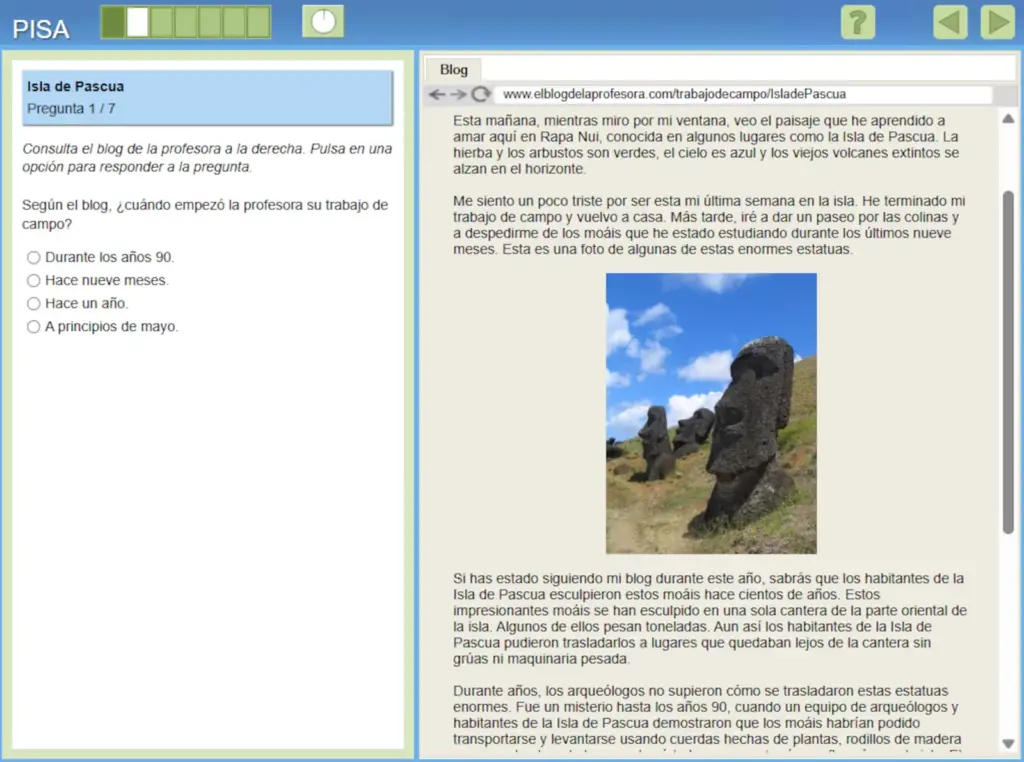
Solution. The correct answer is nine months ago. In this question, students must locate the correct information within the blog entry. Its difficulty probably arises from the existence of other time-related information in that entry, that is, the date it was published and the period during which the first mystery of the moais was solved (the 1990s).
Read more Brussels proposes limits on holiday rentals in high-pressure areas to improve access to housing