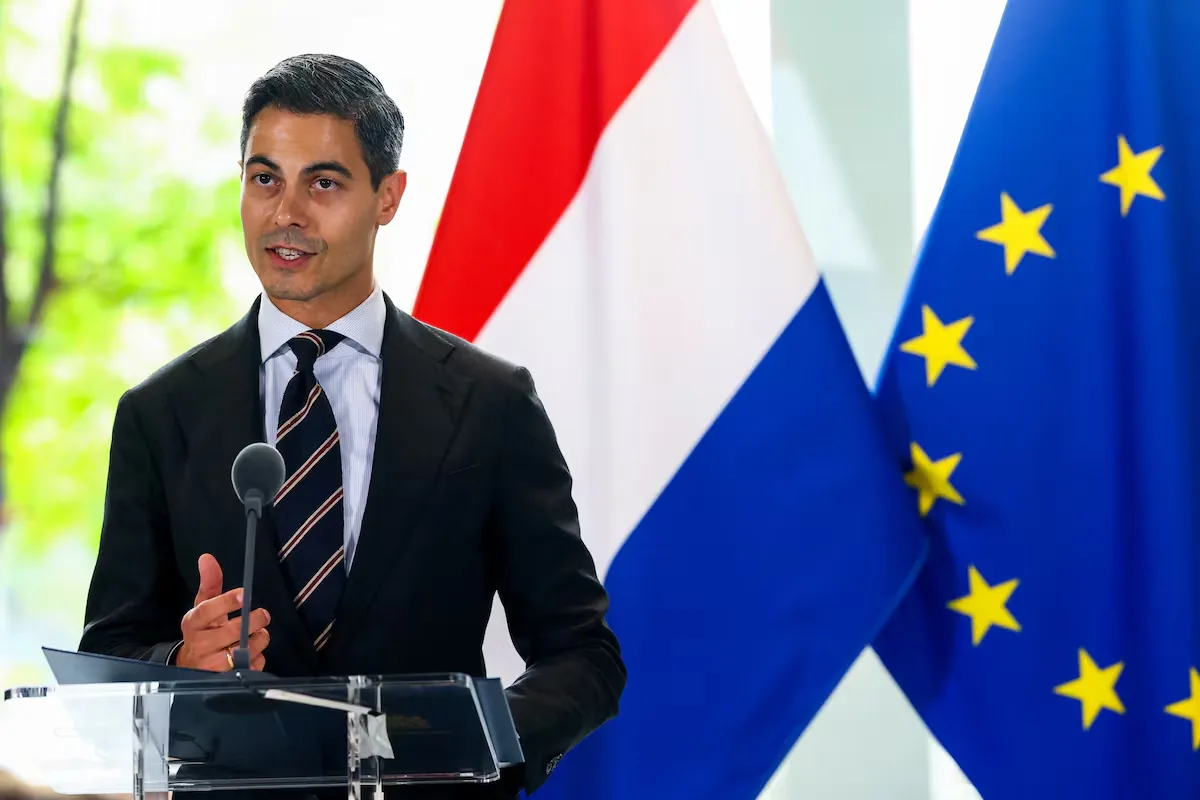
The use of artificial intelligence (AI) has reached the heart of the Government of the Netherlands, and Prime Minister Rob Jetten is one of its most enthusiastic users. An investigation carried out by the newspaper De Volkskrant has revealed that at least 232 messages posted on social media by the social-liberal leader and his party, D66, were written with the help of virtual assistants like ChatGPT. Another media outlet, the television program Nieuwsuur, analyzed 77 speeches from the Ministries of Defense and Education, and identified 15 texts as suspicious of including fragments, or of having been almost entirely generated by AI. While the speeches of political leaders are usually written by their closest collaborators, the widespread use of this type of software (chatbot) can damage their credibility for having commissioned supposedly personal or thoughtful messages from a machine.
Read more Six gang members arrested for an assault on another member of their own gang
Social media has replaced the calm of thought with the immediacy of communication, and Dutch Prime Minister Jetten told the public broadcaster NOS the following: “Using AI as a tool does not mean it is not also reviewed by human eyes.” To the commercial channel RTL Nieuws, he said this Thursday: “Yes, like three quarters of the Dutch, I also use AI from time to time to improve things.”
Jetten added that he believed “we all need to clearly consider how it can be properly integrated by 2026.” D66 has supported a new European AI Law that requires, from August 2026, the mandatory identification of content generated by artificial intelligence.
An example of Jetten’s messages analyzed by De Volkskrant appeared on his Instagram account. It referred to the apologies made this summer on behalf of the Government for the mistreatment of the Moluccans by the Netherlands, following their relocation in 1951 from Indonesia. The military members of this community fought with the Dutch Army in the colonial war of independence and expected to later obtain a Republic of the Moluccas. This did not happen; they were forbidden to return to their homeland because they were considered traitors, and were housed in deplorable conditions without an integration policy.
The Prime Minister visited the Nazi deportation camp Westerbork, in the northeast of the country, where the Moluccans were forcibly interned after World War II, and published a reflection. It said, in one passage: “Different stories, different forms of injustice. Not to compare them with each other, but to continue telling them side by side.” According to the journalistic investigation, these were generated by a chatbot, although published as his own.
Read more 25 years of global disorder
Pieter Walraven, an expert from the consultancy Public Matters, which analyzes political influence and strategic communication, told NOS that AI “is a welcome support for organizations and politicians.” “The situation becomes complicated if politicians start forming opinions based on AI. That is indeed a worrying development,” he stated. For its tracking, De Volkskrant used the AI detection program Pangram. As an additional check, it examined about 700 posts from Prime Minister Jetten and the D66 party prior to the launch of ChatGPT in 2022. None were identified as AI-generated, according to the same program.
In view of what happened with the Prime Minister’s social media messages, the television program Nieuwsuur analyzed the speeches of the Minister of Defense, Dilan Yesilgöx, and her Secretary of State, Derk Boswijk. In their case, they studied 77 texts with the same Pangram program, and flagged fifteen as suspicious. Ten contained fragments generated by AI, and five consisted almost entirely of AI texts. Thirteen of the total came from the minister and the Secretary of State, including five speeches that appear to have been entirely written by artificial intelligence.
On the other hand, in speeches by the Minister of Education, Rianne Letschert — who is a professor of International Law and was rector of Maastricht University — and her Secretary of State, Judith Tielen, at least 12% of the text had been generated by AI. All according to Nieuwsuur. So far, only Geert Wilders, the Dutch far-right leader, has reacted to the investigations into the use of AI by his colleagues. According to the newspaper NRC, he wrote on his X account that “not even the Prime Minister exists; Robbie is fake. #out,” only to delete the note shortly after.
Read more This was Madrid’s most exclusive «La Sobremesa» before its first Formula 1 Grand Prix