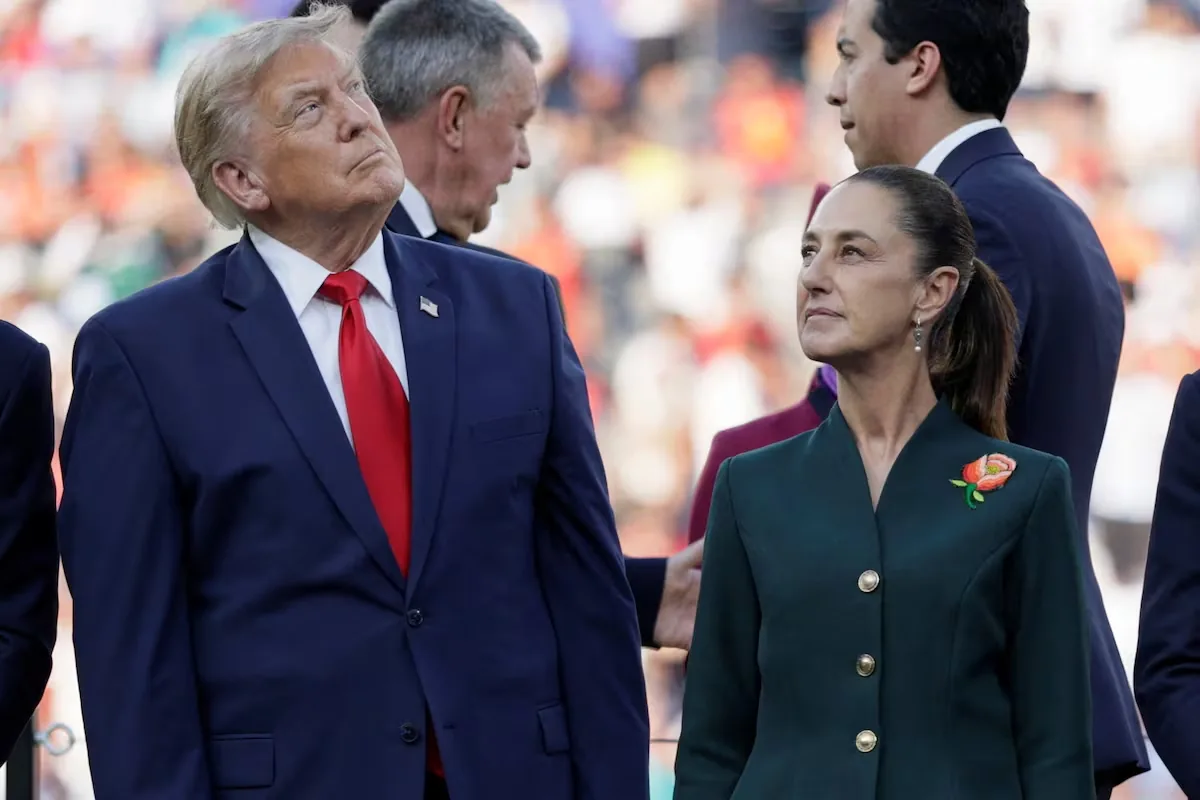









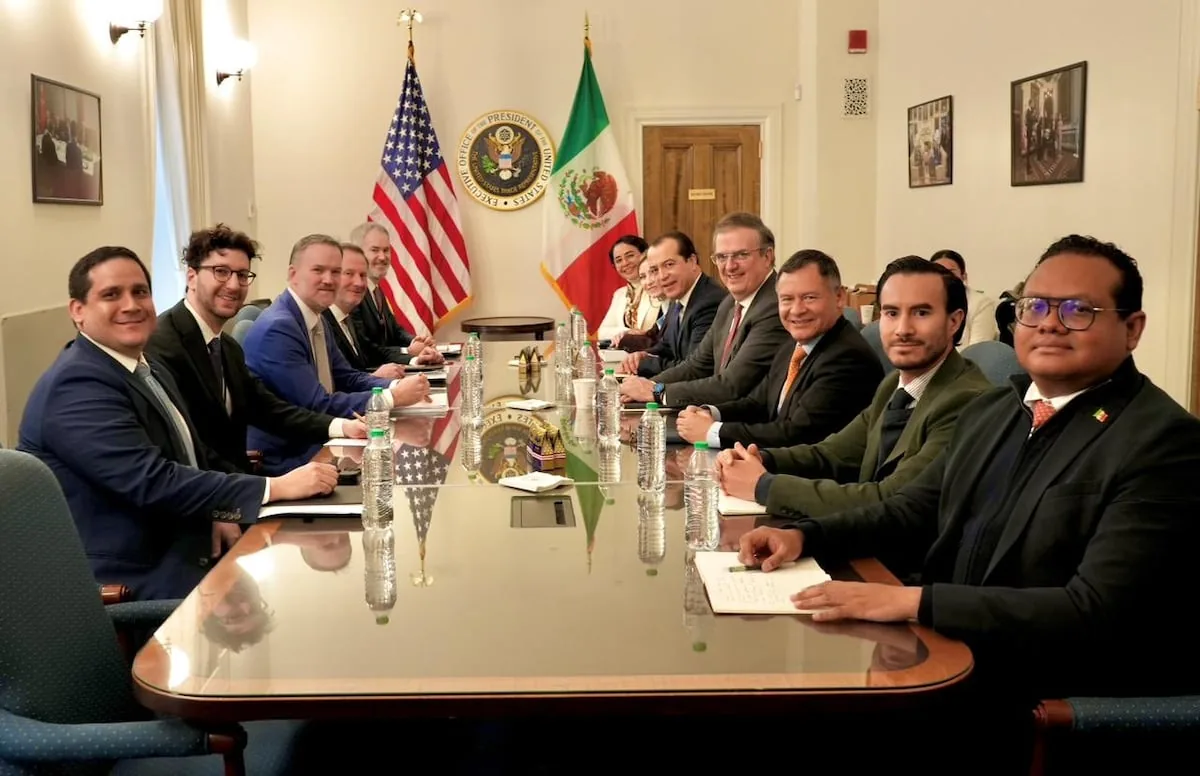
Mexico will play at home against the US to defend the USMCA. Conversations between Mexico and the United States are accelerating less than three months before the review of North America’s key trade agreement. The US trade representative, Jamieson Greer, will land in Mexico City next Monday to meet with Mexico’s president, Claudia Sheinbaum, and her economic cabinet. The express visit will address the agreement’s rules of origin, industrial property, sectoral tariffs, and agricultural trade rules. The binational meeting is part of the roadmap towards the review of the USMCA, between Mexico, the United States, and Canada, next July. More than 80% of Mexican exports are destined for the US market.
Read more The Los Angeles stadium where Iran will play the World Cup starts with the score against them
The Office of the United States Trade Representative (USTR), headed by Greer, will lead the discussions for this joint review. The US official acknowledged this week that rules of origin will be at the center of the debate because companies in his country continue to move their operations south of the border: “This way we avoid the transshipment of goods through Mexico.” The head of the USTR emphasized that his country must incentivize manufacturing in its territory through its tariff policy with the rest of the world. Along the same lines, US Secretary of Economy, Howard Lutnick, assured this Friday that President Donald Trump considers the USMCA to be “a bad deal” and that it is necessary to “reformulate it correctly.”

Despite the barbs that the United States throws against the USMCA day in and day out, Mexico and Canada defend the permanence of the trade agreement. The Secretary of Economy, Marcelo Ebrard, briefly indicated that a coordination of the commercial policies of both countries will be sought, as well as a joint strategy in supply chains to replace imports from Asia. According to the federal agency, the technical sessions will address topics such as the automotive industry, steel and aluminum, the pharmaceutical sector, electronics, and medical devices, among others. The Sheinbaum government begins the second round of talks with the United States, without yet having bilateral meetings with Canada.
Conversations between Mexico and the United States regarding the USMCA began on March 18 in Washington. Mexico and the United States share a 3,000-kilometer border and nearly $900 billion in binational trade annually. Thousands of trucks carrying goods, agricultural products, industrial materials, and vehicles cross the extensive border daily. The meeting with Greer will be key to defining the direction of economic cooperation between both countries. Despite Trump’s protectionist barriers, Mexico positioned itself in 2025 as the United States’ main trading partner with record figures in exports and imports, surpassing Canada and China. By the end of last year, the Latin American country sent more than $534 billion in goods to the US market, while importing more than $337 billion from its northern neighbor.
On the eve of the next round of USMCA talks between Mexico and the US, the Secretary of Finance, Édgar Amador Zamora, met with the head of the USTR to advance the binational critical minerals agreement, as well as the agenda on money laundering and illicit financing. Days earlier, the Treasury Department announced the freezing of assets and properties in the US belonging to three individuals and two Mexican casinos, allegedly linked to the Northeast Cartel. The operation, in conjunction with Hacienda, also involved financial blocking of those identified.
Ignacio Martínez, coordinator of the Laboratory of Analysis in Commerce, Economy and Business at UNAM, explains that the Government of Mexico has sent signals of integration with its northern neighbor regarding minerals and energy. For the expert, Sheinbaum’s openness to allowing mixed projects in fracking –hydraulic fracturing—to extract natural gas in the country, represents a good sign for US companies. Another point in favor of the Mexican government is the battery of measures to combat drug trafficking money laundering.
The specialist foresees that the US will ask its USMCA partners to raise the rules of origin in the automotive sector, at least, from 75% to 80%, and that the majority of this percentage be American. A demand that seeks to reduce imports and investments from Asia, specifically from China, in North America. “Another point that will also be present is that Mexico must eliminate non-tariff barriers on consumer products, health products, and regarding legislation for competition protection and industrial and intellectual property,” he concludes.
In its 2026 Trade Policy agenda, the Trump administration warns that US trade deficits with Mexico and Canada are on the rise, despite the USMCA. Last year, the US trade imbalance with Mexico exceeded $196 billion, a 14.8% increase compared to 2024. In its diagnosis, the USTR points out that Mexico has weakened its investment climate and has inadequate labor laws, to the detriment of American workers. “Mexico has adopted a series of preferential measures to benefit national companies in its energy and mining sectors, particularly in oil, gas, and electricity, to the detriment of US investors,” the document states.
Tariff pressure from Washington has raised the stakes on key issues such as regional content, pressure on US companies regarding tax and customs matters, as well as investments in energy and other sectors such as steel, copper, aluminum, and automotive. In addition, the US will put on the table restrictions on trade with China, the critical minerals agreement, and some agricultural issues.
With economic growth of less than 1% in 2025 and rising inflation in the first quarter of this year, the Sheinbaum government knows it must keep the engine of exports to the US running. In the run-up to the USMCA’s ultimate evaluation, Mexico will have to calibrate precisely and avoid any own goal to ensure the survival of the agreement, a key piece of North American trade integration.
Read more Locate valuable objects with the most desired high-sensitivity handheld metal detector on Amazon