







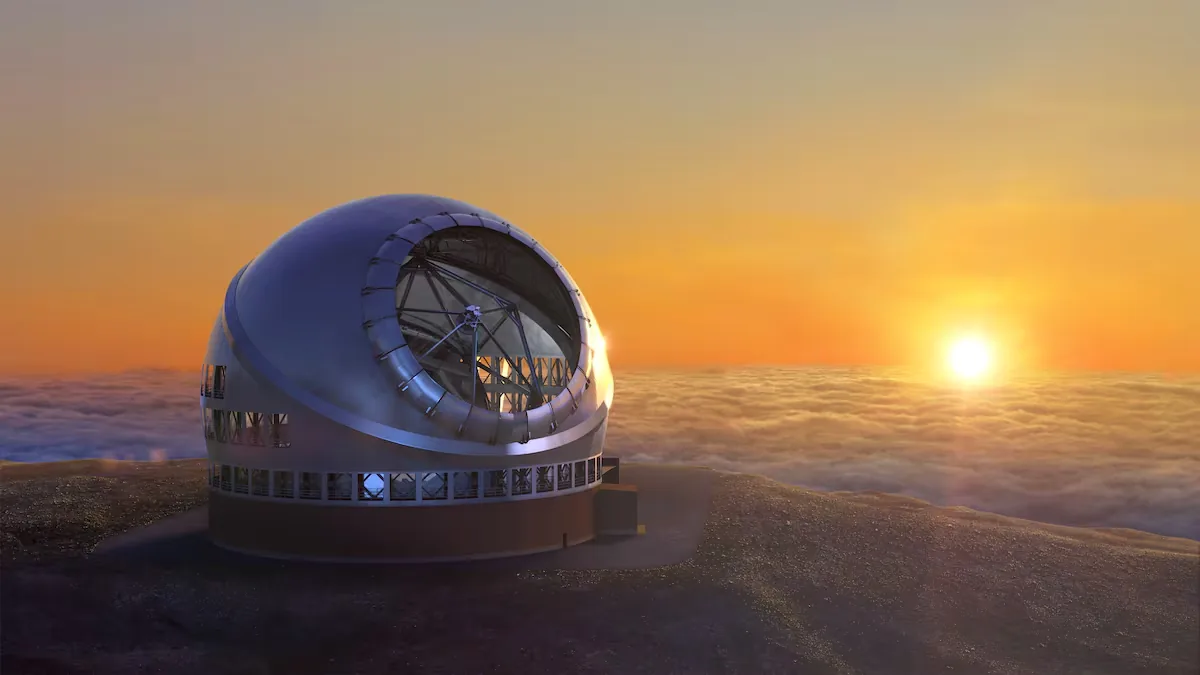
The Canary Island of La Palma will not finally host the long-awaited Thirty Meter Telescope, according to a spokesperson from the island’s Cabildo. La Palma’s candidacy had been activated due to the rejection the project had sparked among the population of Hawaii. The Spanish Government had committed 1 billion euros to attract what was going to be the largest optical telescope in the northern hemisphere, 400 million euros from the Ministry of Science, Innovation and Universities along with a loan of 600 million euros that would be provided by the European Investment Bank. The Ministry had set this Sunday as the deadline to know the response to its offer for the island to be awarded this infrastructure.
The new Thirty Meter Telescope (TMT) will be the largest infrastructure of its kind in the northern half of the planet, and would have allowed Spain to be at the forefront of astronomy for the next 50 years. The TMT was going to be installed at the Roque de los Muchachos Observatory, one of the most privileged points on the planet for astronomy, where it would generate significant technological investments and skilled jobs.
“I sincerely regret to have to inform you that the TIO [acronym for the TMT International Observatory] cannot accept Spain’s proposal,” explained Robert P. Kirshner, executive director of the TIO — a consortium formed by the University of California, Caltech, the National Astronomical Observatories of the Chinese Academy of Sciences, and Canada, India, and Japan — in a letter addressed to the Minister of Science, Innovation and Universities of the Government of Spain this Friday. “This result in no way diminishes our recognition of Spain’s extraordinary commitment to the project, the scientific excellence of the Roque de los Muchachos Observatory, nor the international prestige of the IAC [Canary Islands Astrophysics Institute]. We greatly value the relationships established with our Spanish colleagues over the past year and would be delighted to continue the dialogue to explore opportunities for scientific collaboration,” the letter continues.
Sources from the ministry have “deeply regretted” this decision on Friday. “The Government of Spain has done everything in its power: we have presented a scientifically and technically solid candidacy, we have developed intense scientific diplomacy, and we have put on the table an extraordinary financial commitment, which even contemplated mobilizing up to 1 billion euros from the Government of Spain and the European Investment Bank (EIB).” The TMT has a total approximate cost of 3 billion dollars (2.61 billion euros at the current exchange rate).
The Executive, however, has highlighted its conviction that “the Canary sky is an exceptional sky for astronomy and that La Palma had extraordinary conditions” to host this project. “But we respect the decision made by the international consortium, even if we do not share it.” And it concludes: “This Government can clearly say that it has defended to the end the interests of Spanish science, of the Canary Islands, and of La Palma. […] The decision on the TMT does not change our commitment to the Canary Islands, to the Canary Islands Astrophysics Institute, nor to large scientific infrastructures.”
Read more Mbappé breaks with Nike and signs with On, the sneaker brand part-owned by Federer
This scientific megaproject started in 2003 but has been stalled for years due to resistance from the native islanders of Hawaii, who refused to allow the sacred mountain of Mauna Kea, the highest volcano in Hawaii, to host this scientific infrastructure (the mountain already hosts 13 telescopes). The Hawaiian resistance has escalated to legal grounds. Puʻuhonua o Puʻuhuluhulu, the protest camp established in 2019 at the base of Mauna Kea as a sacred refuge space, delivered a formal cease and desist notice to TMT International Observatory LLC in June of this year. The document demands the abandonment of the project and states that there is a vast and significant contingent of native Hawaiians and their allies strongly opposed to the construction of the massive telescope on the mountain they consider sacred.
Since Donald Trump came to power — twice — the TMT fell out of favor. The recommendation pushed by the Government was to cut funding abruptly. Although Congress later approved a law not to abandon the project, budgets to finance it have not yet been committed, and the initiative has been left in limbo.
Spain saw the opportunity and launched into negotiations with the promoting consortium, and in 2016, the island obtained recognition as an alternative location to the US archipelago. The argument was geographical: most large ground-based telescopes operate in the southern hemisphere, so a facility in the north would have closed an important gap. In theory, an observatory here would have been decisive if, say, the only known habitable exoplanet were only observable from our hemisphere.
Read more “This Shakiralandia is great”: Macondo Park opens to the enthusiasm of thousands of people