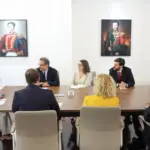


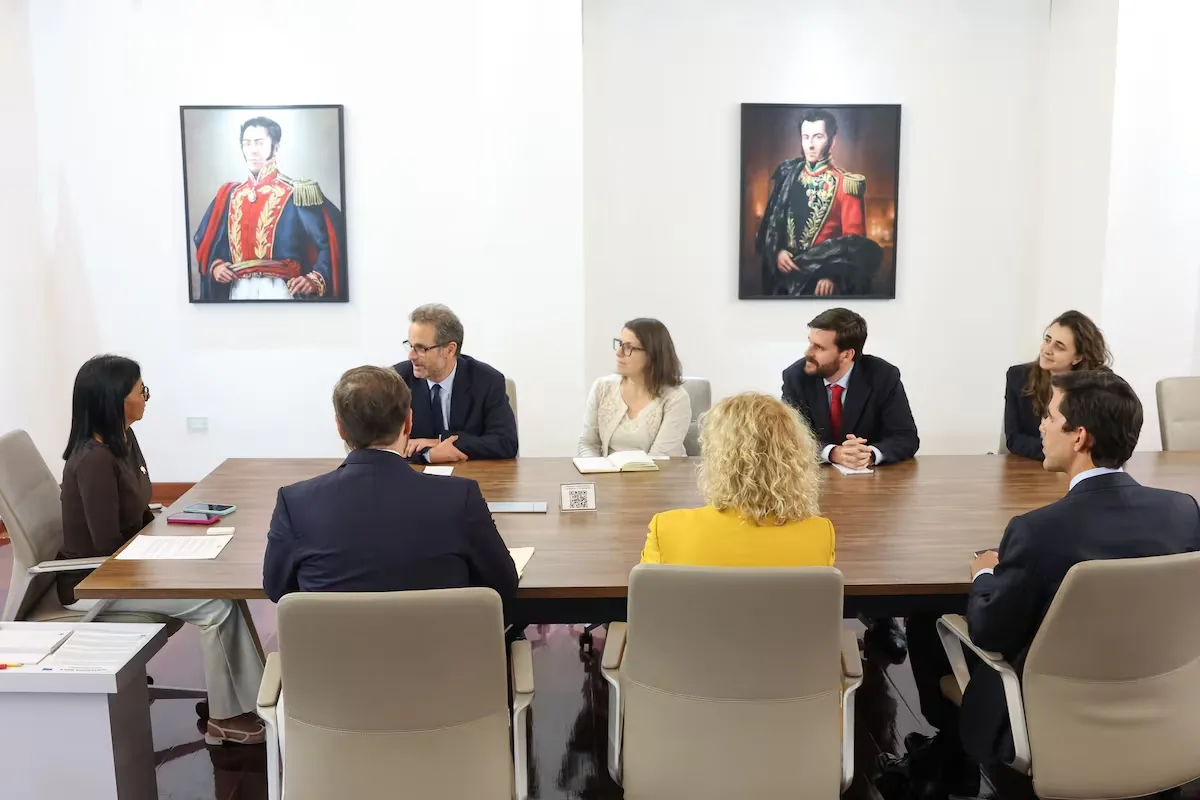
The team of directors and researchers from Human Rights Watch, consisting of Federico Borello, Juan Papier, Juanita Goebertus, and Marina Rápido, has been in Caracas for a week. It is the first visit in 18 years. On the last one, the then director, the Chilean José Miguel Vivanco, was expelled by order of a Hugo Chávez enraged by a critical report on the human rights situation, after which the NGO became a “tool of destabilization and foreign interference” for Chavismo. It was then his foreign minister, Nicolás Maduro, who told him: “Enough already, this is as far as you go: anyone who tries to meddle in Venezuelan internal affairs will receive the same treatment as Vivanco.”
Read more A new spiral of war begins in a country struck by an earthquake
In Venezuela in 2026, without Maduro and under the tutelage of the United States over the Government of Delcy Rodríguez, the defenders highlight “important signs of a decrease in repression” which, since that impasse with Chávez, has only worsened. “There is a pause, a kind of truce, but the state apparatus responsible for the abuses remains intact,” Borello said this Friday in a meeting with journalists, after a week of meetings with diplomats, opponents from different factions, government representatives, and members of civil society.
The HRW team arrived in a week in which an important step towards the liberalization of the country was made, such as the lifting of censorship on some digital media blocked by the government. This occurred the same day that regional political leader Javier Oropeza, recently returned from exile, was arbitrarily detained by police officers after leaving an interview on a local radio station in the western city of Barquisimeto, only to be released hours later, and at the same time that the dialogue table between the 2015 National Assembly and Chavismo resumed the second cycle of talks. They have also encountered a country caught between opposing tensions.
The representatives of the Washington-based organization were received by Delcy Rodríguez, to whom they raised the need to implement short-term measures while the deep reforms announced for the reinstitutionalization of Venezuela in the democratic system are carried out. “The actions we have seen are partial. Some prisoners are released, but not all, or they are given precautionary measures; some media are unblocked, but not all,” Borello commented. “We have told the acting president that there is a path that is medium-term and consists of institutional and legal reform, fundamental to making it more difficult for human rights violations like those that occurred to be repeated. But there is an impatience among the population that wants short-term measures while those reforms are achieved.”
HRW has pointed out a series of measures to build trust in the transition that Washington is pushing. The “unconditional” release of all political prisoners and arbitrarily detained persons is the first and most urgent. “There are people imprisoned without knowing why, who have release warrants and remain in jail. The amnesty law helped some, but the category of arbitrarily detained people in this country is so vast and diverse that we recommend creating a technical commission to review cases and have decision-making power.”
Read more The Latin American Art Museum of Buenos Aires grows: adds 1,250 works and doubles the space
The second issue the defenders considered worrisome is the detention conditions of inmates. “The Rodeo prison, defined as a torture center by all the prisoners’ relatives, must be closed.” This week, the UN Fact-Finding Mission revealed new methods of torture identified in this prison where most politicians are confined, such as punishment in underground tanks. “When detention centers reach such a level of abuse, they must be closed. We also request the closure of clandestine detention centers throughout the country. We have some geolocated and will send them to the government.” HRW reiterates the request of detainees’ families: to authorize the missions of the International Committee of the Red Cross and the High Commissioner for Human Rights to inspect prison conditions and make regular visits without prior notice.
Borello also recommended the government repeal or reform the anti-terrorism law, as well as other legislation used to persecute dissent such as the law against hate. “If the anti-terrorism law is repealed, hundreds of cases of absurd and arbitrary detentions will be closed without the need for any commission.” HRW also pointed out that reform of the security apparatus as a key actor in the repressive machinery is urgent.
The NGO also spoke about the need to advance conditions for elections, which is on the agenda of the dialogue table between the government and the 2015 National Assembly, but has not yet been discussed. “Venezuelans deserve to participate in timely, free, and fair elections,” Borello said. “That urgently requires allowing political opponents to participate in the political process and run for public office.” HRW’s approach seeks to expand the organization’s presence in the country. The visit has been months in the making with some government representatives and they hope to return before the end of 2026.
Read more Five arrested for attempting to steal copper from the tracks in Roda de Berà