




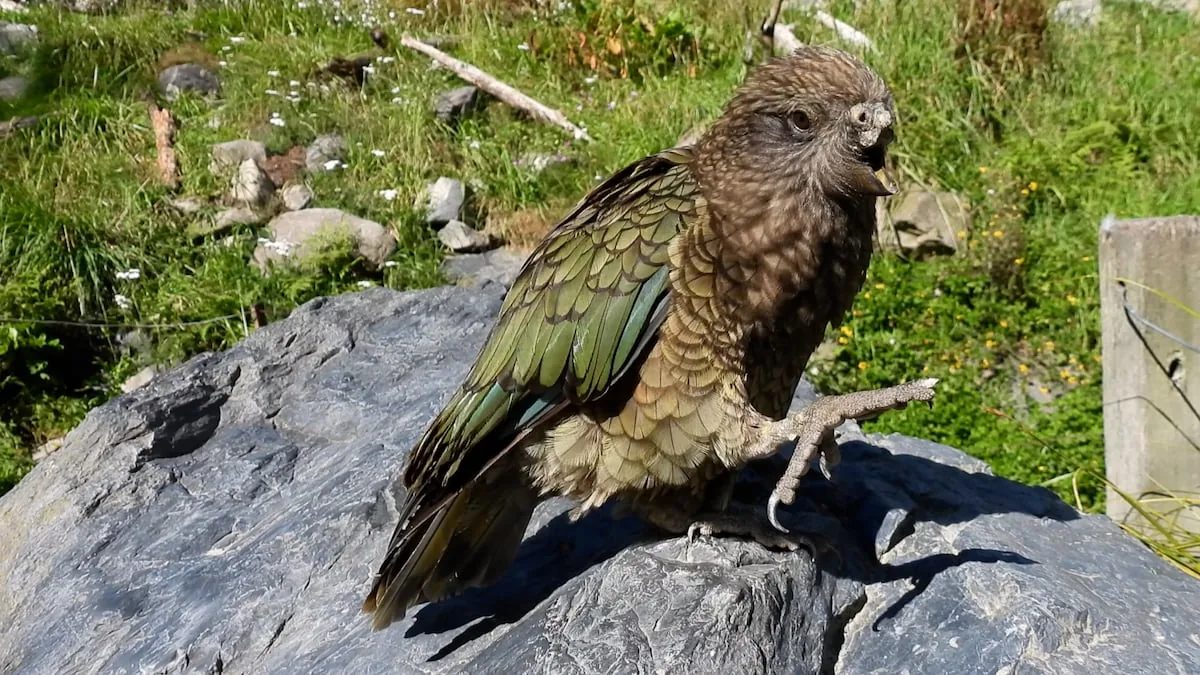
An endangered parrot has shown that living with a disability is not an impediment to achieving a privileged position within its group. His name is Bruce, a kea that lives in a wildlife sanctuary in New Zealand. This bird lacks its upper beak. In the animal world, this could leave him in a vulnerable situation when facing confrontations over space, food, or status. However, his story is different: Bruce is the alpha male.
Read more Chilean police arrest three university students for the assault on Minister Ximena Lincolao
This bird does not repeat the bites or the usual way keas have of fixing the rival’s neck to dominate it. Instead, he advances head-on, projects himself, pushes his body against that of his adversary, and uses his lower beak, the only one he has. This is documented by research published this Monday in the journal Cell Press.
Alex Grabham, a researcher at the University of Canterbury (New Zealand) and lead author of the study, says that Bruce is able to apply his strategy at short distances and also at longer distances or while in full motion. It is a technique irreplicable by his congeners: the anatomy of keas —with the upper beak covering the lower one— prevents them from imitating that type of attack.
According to the biologist, the team initially sought to analyze the stress hormones of captive keas at the Willowbank Wildlife Reserve in Christchurch, on the east coast of New Zealand. However, what happened with the bird surprised them. “We didn’t expect him to do badly with the disability, but we did expect him to survive as best he could,” the researcher notes. However, Bruce wasn’t just doing that. “The truth is, he’s doing very well,” Grabham emphasizes.
In four weeks, the research recorded 227 kea interactions, 162 of them between males. Bruce won all 36 fights he participated in and took over the leadership of dominance. No other male managed to surpass him. “It’s an example that disability doesn’t have to imply weakness,” Grabham states.
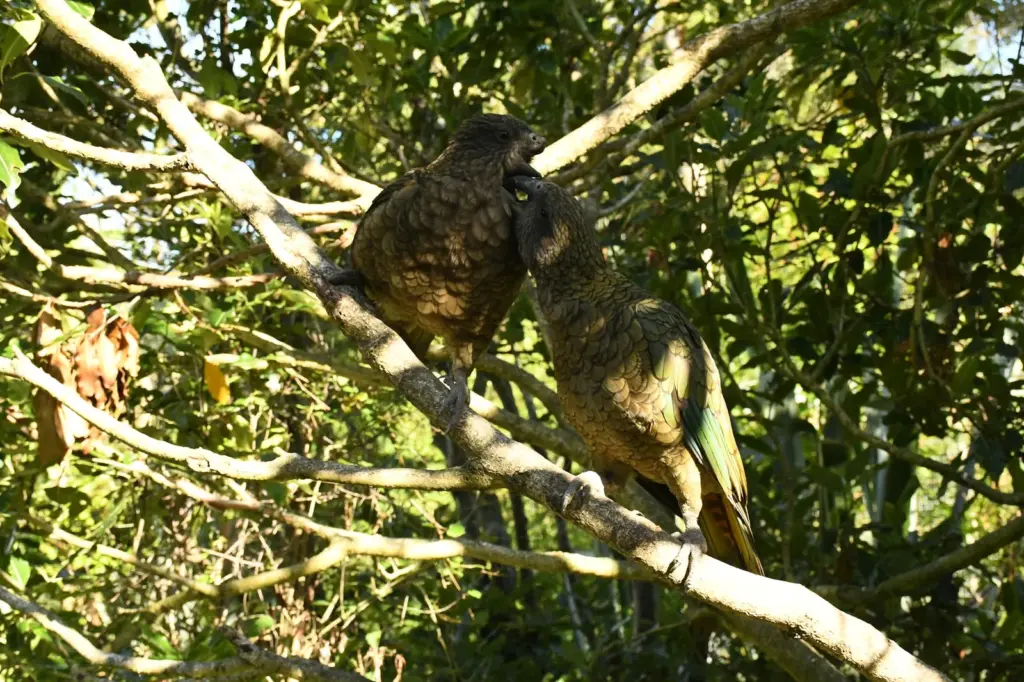
For ethologist Sara Álvarez, when an individual lives with a disability, has a malformation, or has suffered a pathology that has left sequelae, “they can be relegated to a more subordinate position.” Therefore, she admits, “it is quite surprising that this is not the case here.” She points out that there are documented cases of species where abilities such as environmental knowledge or the capacity to find resources can compensate for other disadvantages. “Surely, this individual has certain skills that allow him to maintain his status,” she suggests.
More privileges, lower stress levels
Bruce’s leadership is not limited to fights. Thanks to his status, he has priority access to feeders: he was never challenged while feeding and on several occasions monopolized all four feeding spots for at least 15 minutes, researchers confirmed.
Read more The ‘pescaito’ dinner and the ‘alumbrao’ kick off the most expensive Seville Fair
In addition, he received grooming. Lower-ranking males were responsible for cleaning his beak. Although for years it was interpreted as a matter of hygiene, this behavior is now understood as a social tool. “It is related to hierarchical status and the reduction of tensions,” says Álvarez.
Bruce’s case has another peculiarity. While in many animals alpha status is often associated with higher stress levels, this bird showed the lowest levels of fecal glucocorticoid metabolites (fGCM), a physiological indicator used to measure stress. “In most species, the dominant individual presents higher levels,” explains Álvarez. The reason, she says, may be because the alpha bears more pressure. But it is not an absolute measure. “It has some variability, it can be masked by other factors, even health,” she adds. “Stress studies should not only be based on hormones, but also on behavior,” the ethologist points out. Anomalous behaviors can also provide evidence.
Leadership without allies
For decades, it has been believed that in confrontations between animals, the strongest, largest, or best-armed individual prevails. In some species, if the leader has a weakness, they maintain their dominance with alliances —as happens with chimpanzees and macaques—. However, Bruce does not seem to need allies.
“Our findings provide the first example of a disabled animal of any species that individually achieves and maintains alpha male status solely through behavioral innovation,” the researchers reported in the study.
While in primates it is a repeated method, in birds, however, the scenario can vary. Although having allies is often advantageous, Álvarez points out, it is not always essential. The key could be in the environment. “If there are enough resources and the area is large, perhaps he doesn’t need them,” she notes. That is, in contexts with less pressure or conflict, dominance can be sustained without social support.
Read more Patrick Muldoon, actor from ‘Starship Troopers’ or ‘Melrose Place’, dies at 57