




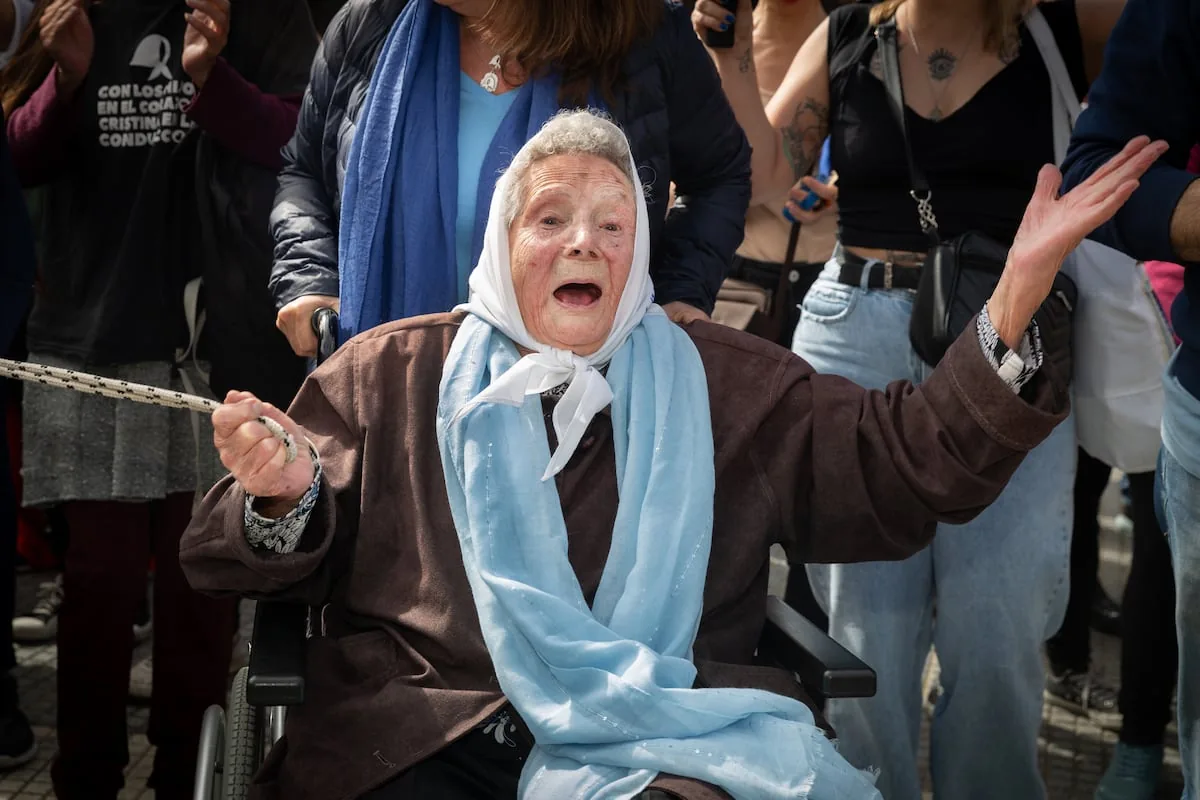
Madres de Plaza de Mayo, the women’s organization that made the crime of forced disappearance of people during Argentina’s last military dictatorship visible to the world, lost another of its members. Visitación Folgueiras de Loyola died this Sunday at the age of 101, after suffering a stroke.
Originally from Asturias, Folgueiras de Loyola lived in Argentina from a young age, where she worked for 35 years at the Grafa clothing factory. There she met her husband, Mario Loyola, with whom she had two children: Roberto Mario and Néstor.
On December 21, 1976, her 22-year-old son Roberto and her 21-year-old daughter-in-law, Dominga Antonia Maizano, were kidnapped by the military from their home in Loma Hermosa, in the Buenos Aires suburbs, where they lived with their young son. The six-month-old baby was handed over to a neighbor and was thus able to grow up with his family, unlike the approximately 500 children who were kidnapped with their parents or who were born during their mothers’ captivity and grew up without knowing their origin.
After the kidnapping of her relatives, Visitación Folgueiras began to pilgrimage through public offices and churches with the intention of finding out something about their whereabouts. In that coming and going, she met other women who were looking for the same thing and joined the Madres de Plaza de Mayo. The demand, then, was no longer just for her son and daughter-in-law but for the 30,000 disappeared detainees.
“There was a period when they wanted to silence our struggle, decreeing that the disappeared were dead and that the case expired. That’s why we had a slogan: ‘they were taken alive, we want them back alive,’” Visitación recalled in an interview, about the challenges of keeping the demand for justice alive after democracy was restored in 1983.
Visitación first learned of her son’s kidnapping through a change in routine. Her son and daughter-in-law passed by her house every day, but one day they were absent. Her husband went to where they lived and was met by soldiers with a machine gun, who were taking things from their house. “Your children are fugitives,” they told him. At first, she wasn’t worried; she had no reason to be. “I thought nothing would happen to them because they didn’t do bad things, on the contrary: they gave what they had,” she said.
Both did social work in humble areas of the Buenos Aires suburbs. Her son helped neighbors with electricity and water connections, while her daughter-in-law, a psychology student, provided support and parenting tools to mothers with children with disabilities. These neighborhood activism activities put them under the radar of the state’s repressive apparatus, which between 1976 and 1983 deployed its clandestine terror practices against those identified as “subversives.”
“Time has passed, yet every day I think of them,” she said, referring to her son and daughter-in-law. “When I put on the scarf —the symbol of the Mothers, originally a cloth scarf tied over the head— it’s like I’m filled with an energy that makes me strong to continue in this struggle.”
Hebe de Bonafini, a historical leader of the Madres de Plaza de Mayo association, who died in 2022, assured that Visitación was the one who knew the most about politics within an organization that, in recent decades, expanded to other causes and politically aligned itself with Kirchnerism.
“We no longer deal with trials; that’s what lawyers are for,” Visitación said in one of her last public appearances. “What we do is follow the path of our children, improving the lives of those most in need. That’s why we work in the most deprived neighborhoods, building roads, sewers, running water, gas, libraries.”
Active until the end, Visitación met with her companions on March 24, the day marking 50 years since the coup, and participated for the last time in the rounds that the Mothers make every Thursday around the Pirámide de Mayo last October, a few days after turning 101. That day she spoke in the square and criticized Javier Milei’s government. “We are here to fight with strength, with courage, and not let this scoundrel get away with it,” she stated.
Those who knew her remember her lively, mischievous, and tender eyes. “She will be with us forever, in the Plaza de Mayo. She will continue to be our example to follow. Not one step back!” published the Asociación Madres de Plaza de Mayo. The governor of the province of Buenos Aires, Axel Kicillof, also bid her farewell on social media. “Your example of struggle and coherence will continue to guide us. Until victory always, dear Visitación,” he wrote.
Read more Juan, the Mexican contestant in a MrBeast challenge who has won the love of the viewers