





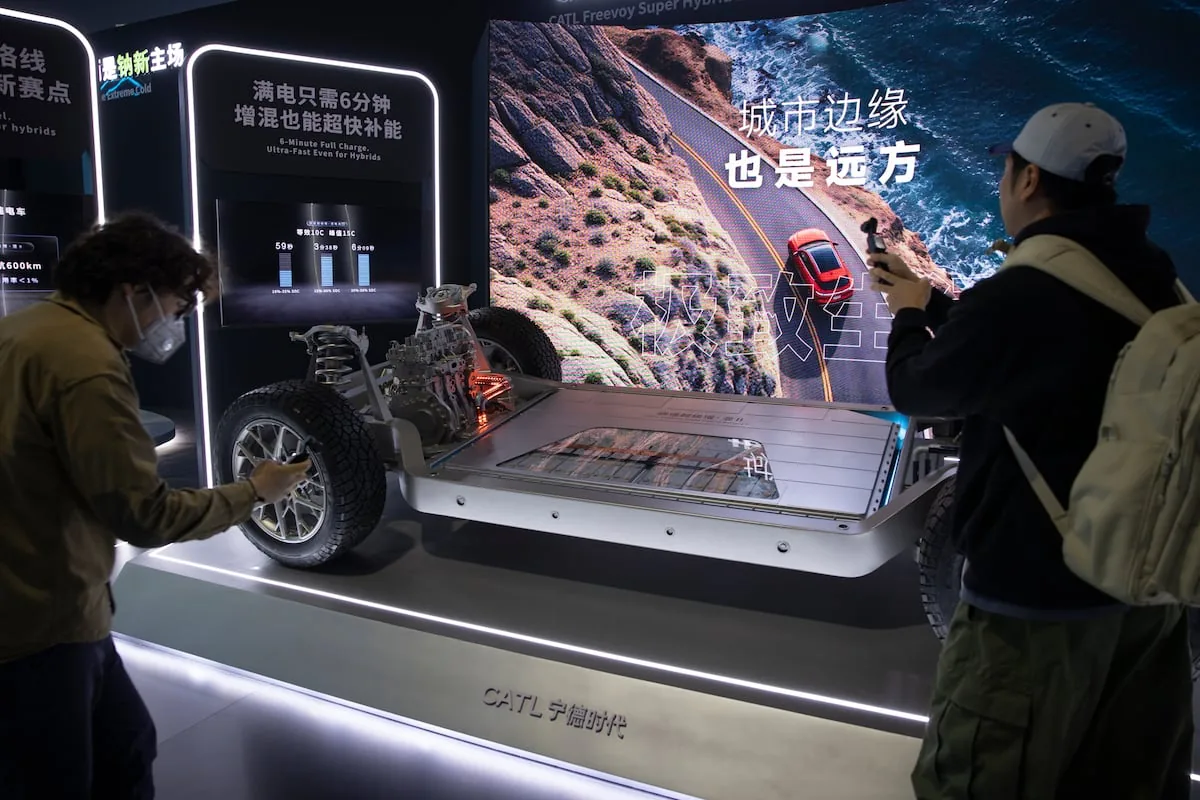
In a presentation in the style of major Silicon Valley unveilings, Chinese battery giant CATL revealed this Tuesday, during an event for journalists and investors in Beijing, its next generation of ultra-fast charging models with enough range to cover, in one go, practically the distance from Madrid to Brussels.
There was applause and shouts of genuine excitement—probably from company employees seated in the front rows—when CATL’s technical director, Gao Huan, unveiled the latest version of its Qilin condensation battery: the new model is capable of supplying energy to travel up to 1,500 kilometers on a single charge (Madrid to Brussels is 1,589 kilometers, according to Google Maps), surpassing the previous one, which reached 1,000 kilometers.
CATL also provided details on its new version of the ultra-fast Shenxing model, which recharges from 10% to 98% in 6 minutes and 27 seconds, a significant improvement over the previous generation, which charged from 5% to 80% in 15 minutes. And it advanced its vision for the future of recharging, with electrolineras (electric charging stations) where batteries can be swapped at high speed.
The presentation by the world’s largest battery company takes on even greater importance in a world grappling with a conflict in the Middle East, whose collateral effects have highlighted the costly geopolitical dependencies on fossil resources.
“Chinese technology should not only be based on speed and scale,” said Yuqun Robin Zeng, the billionaire founder of the company, from the stage. “More importantly, it should rely on high-quality innovations,” he added in a scientific discourse, in which he asserted that there was still room to explore new frontiers of materials: they are the foundation of their devices.
Zeng also summarized the philosophy of a rapidly expanding multinational, whose batteries already power more than 28 million cars, according to its own data: “The main enemy of the scientific spirit is not ignorance, but simplifying problems too early,” said the engineer who began his business career in the nineties manufacturing small batteries, mainly for Western companies in the then-flourishing consumer electronics industry. Today, those devices have grown into cars: “True science involves embracing complexity,” he added.
Read more Is eating sausages as carcinogenic as smoking? Myths and truths about processed meats and cold cuts
The presentation, at times, became a master class on materials, resistances, and electrochemistry, with formulas projected onto the screen. At other times, CATL opted for striking videos with epic music and powerful cars whizzing through mountains and deserts. The union of both poles would be a good synthesis of how China conceives its commitment to moving up the technological value chain: a mix of bombastic marketing and mathematical efficiency.
CATL, which saw a meteoric stock sale on the Hong Kong Stock Exchange last year, is also part of the influx of new Chinese investments in Spain; for months it has been building a battery plant in Zaragoza alongside Stellantis, a megaproject valued at more than 4 billion euros. In addition, it has another factory under construction in Hungary, just to mention its plans to integrate into the electric car supply chain in the European Union.
With a global market share of almost 40%, CATL continues to dominate the sector against its great rival, the also Chinese BYD, which not only produces batteries: it is the world’s leading manufacturer of electric cars.
Tuesday’s late event, an activity organized in parallel with the Beijing Auto Show, is a testament to the intensity of the battle for electric vehicles and their associated technologies. The epicenter of this contest is in China, the world leader in this field.