


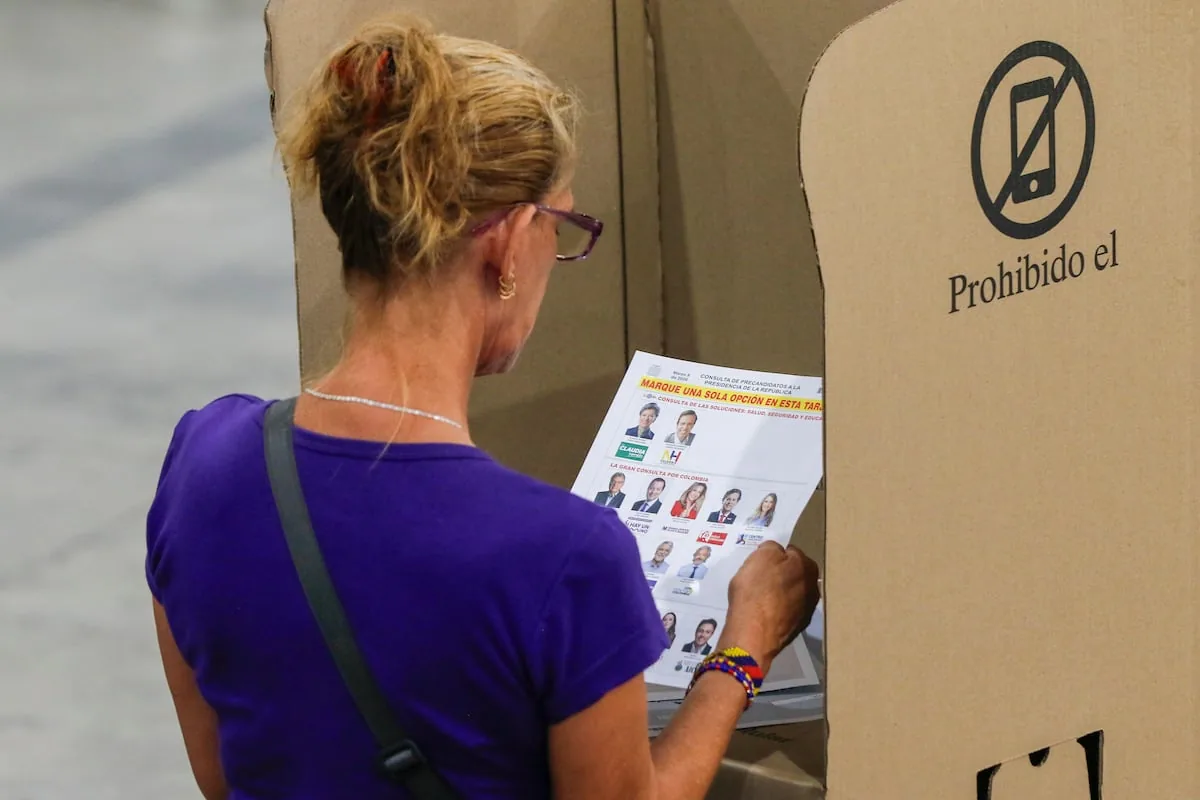
Fear defines us. As a species, in part. We are complex primates. We reason, learn, invent, speak, deceive, laugh, transmit, socialize, murder. And we are afraid. Very afraid, and we strive to hide it. But fear, like pain, has a valid function: in scenarios of threat, it protects us, channels our attention. It is an alarm signal that, at the beginning of time, surely helped a frail creature without major physical superiorities avoid ending up as someone else’s lunch.
Read more Running sales: sneakers, watches and accessories to train better for less
Beyond the distant look at fear in the ascent of human beings, it is evident that, in the here and now of the presidential campaign, we are afraid. We do not fear the same tsunami, the same volcano spitting lava, or the same furious beast cornering us. But, reorganizing one of Chapulín Colorado’s combat phrases (a fearful paladin), panic is indeed spreading.
We feel and are prey to impulses, so it is not easy to make a reliable catalog of the fears that now plague us. But we must try, understanding that it is assembled with the precautions and prejudices of diverse sectors.
Fear of Iván Cepeda. He will turn Colombia into a kind of South American U.S.S.R. He will nationalize even breathing. He will make us “sweat oil” (although he will finish burying Ecopetrol) and will put us in the “whistleblower” of reforms until we are like shredded meat. He will lead a constituent assembly in which he will sweep away institutions. He will wither the media and free expression. He will continue to sow fanatics where technicians and experts should flourish. He will converse fluently with the illegals who took over the country and will give them more perks in search of a peace they use to consolidate their great power (also bolstered by the fear they inspire in the regions). He will suffocate the private sector and will be the master of radicals.
Luz María Sierra, director of El Colombiano, asked Álvaro Uribe who he feared more, Petro or Cepeda: “I don’t know. Petro sometimes laughs, Petro sometimes perks up. Ah, that fixed gaze of Cepeda, like Idi Amin’s, who looked at the opponent’s liver. I am terrified of communism.” That business about looking at the liver goes beyond mere rhetoric: Amin, the “Butcher of Uganda,” littered the Nile and his country with corpses. He allegedly ate some, they say; perhaps of his enemies. When asked if he had such appetites, according to Rajiv Dogra in his book on tyrants, he replied: “I don’t like human flesh; it’s too salty for me.”
In December last year, Felipe López confessed to Federico Gómez Lara, director of Cambio, that he was “a little afraid of Cepeda,” because he believed that, if he reached the presidency, he would approve the reforms that Petro failed to implement and thought that the senator was “more Raúl Castro than Fidel.” By Christmas, it is clear in a text he published in that magazine, López has been losing his fear of Cepeda.
Fear of Abelardo de la Espriella. He will undertake a crusade to eradicate the presence of progressivism in public service. He will govern for the benefit of the powerful who were losing space and possibilities. He will send Petro’s social reforms to the “chopping block.” He will cover the fields with lead and glyphosate; he will bomb dissident camps at any cost. He will harass media and journalists who question him. He will not be able to detach himself from his appetite for business and a professional past that makes people uncomfortable. His inexperience in public affairs will make him fail as an executor. Hydrocarbons will once again be a driver for development, without major environmental considerations. Ethics, which for him has nothing to do with Law, would have little place in the Executive’s actions.
Jerson Ortiz, from La Silla Vacía, in an analysis of the candidate’s first proposals, concludes: “there are many similarities with the proposals of new right-wing campaigns in Latin America, specifically Nayib Bukele of El Salvador, Javier Milei of Argentina, and José Antonio Kast of Chile. Including the initial promise of the ‘miracle,’ taken from Bukele.” Such similarities frighten many.
Daniel Coronell (who stated in Los Danieles that “between Abelardo De La Espriella and a shoe, I vote for the shoe”) proposed a live interview with him. The journalist wrote: “I can imagine him rehearsing in front of the mirror the phrase he repeats and repeats, but does not fulfill.” That phrase, indeed uttered by the “Tiger” dozens of times, is: “I arrived late to the distribution of fear.” The interview had not materialized by the close of this column.
Read more The Government of Zacatecas accuses a group of farmers of causing a fire in some Segalmex warehouses
Fear of Paloma Valencia. She has moderated her far-right discourse to attract centrist voters (and undecided ones), but, once she comes to power, compared to her, María Fernanda Cabal will seem… a dove! She will discard any possibility that could lead to peace through dialogue and agreements. She will dedicate a good part of the money destined for social investment to strengthening the war. She will grant significant benefits to large conglomerates. She will do fracking at all costs and will disregard the energy transition. She will dynamite what remains of the implementation of the peace agreement. She will not deliver on her promises to Oviedo, nor to the sectors he represents. She will give carte blanche to private individuals with Health resources. She will work alongside disappointing exponents of the traditional political class. Hers will be a government of Álvaro Uribe by proxy.
In the arena of debates and Cepeda’s decision to avoid them, Valencia declared to the press: “We are ready for the debates. We are waiting for Senator Cepeda to come out and show his face.” Juan David Ríos, from Noticias Caracol asked her if she thought Cepeda was afraid to debate. She replied: “Well, I think he’s kind of scared, especially since he has to read his speeches.”
Cepeda will probably continue to stick to his papers on stage, but he has said about the debates: “I challenge the far right, its two candidacies, Senator Paloma Valencia and lawyer Abelardo de la Espriella, to debate on substantive proposals.” Paloma retorted: “At least Cepeda got over his fear. We have summoned him to debates several times, but he preferred to hide.” Cepeda, who does fear that debates will be manipulated, said: “We have no fear. We are not going to instill paranoia in people. Without fear and with determination, we will win.”
Fear of Sergio Fajardo. His obsession with unattainable purity will prevent him from governing with practical criteria. He will not build ties with political protagonists and will repeat Iván Duque’s first year in government, with zero agreements between the Executive and Legislative. Stubbornness will prevent him from making any concessions. What he exhibits as neatness and decency is, in reality, the inability to recognize the positive contributions of those who do not share his way of seeing things. He will be prey to egocentrism and vanity. Lukewarmness will permeate his decisions as president, but, if he fails and runs aground in the second round, he will repeat the episode of not endorsing votes and will dedicate himself to cetaceans.
The phrase with which Fajardo explained the essence of his management as mayor was “Medellín went from fear to hope.” Fajardo has said that “the main power of the violent is fear. Fear limits us, destroys us, fragments society, segregates and breaks the social fabric. Eventually, you end up in a every-man-for-himself situation, and that is fatality.”
In a debate during the Naturgás congress in Cartagena, he was heard saying: “While some insist on the discourse of fear, others of us are clear that Colombia needs unity; no more divisions.” It is not known if mathematicians, like some parents with their children, have preferences for basic operations, but many hope that the animosity towards division will soon manifest in a decision of addition that can still happen, although Fajardo rules it out. And that he moves away from a great mathematician, Descartes, in the passion for doubting. Unity, they demand, is now; not when things go to the depths of that sea that only whales access.
Fear is king in Colombia. Fear of change and fear of maintaining change. Fear of traditional politics and fear of dreamy progressivism. Fear of undoing the Constitution and fear of not being able to touch it. Fear of not enduring another four years and fear of losing four years to deepen the revolution. Fear of continuing to live in the hands of criminals and fear of not being able to continue talking with the Warlords. Fear of not ceasing to be afraid. Fear, ultimately, of being what we are.
***
Rearguard. In view of the complaining, despite Luis Díaz’s good performance, Félix de Bedout’s words on 6AM W apply to everything: “I understand that we put ‘buts’ on things. But, when we do well, why the ‘but’?”
Read more Bargain for your terrace: 11 meters of LED string lights to light up your outdoor dinners