






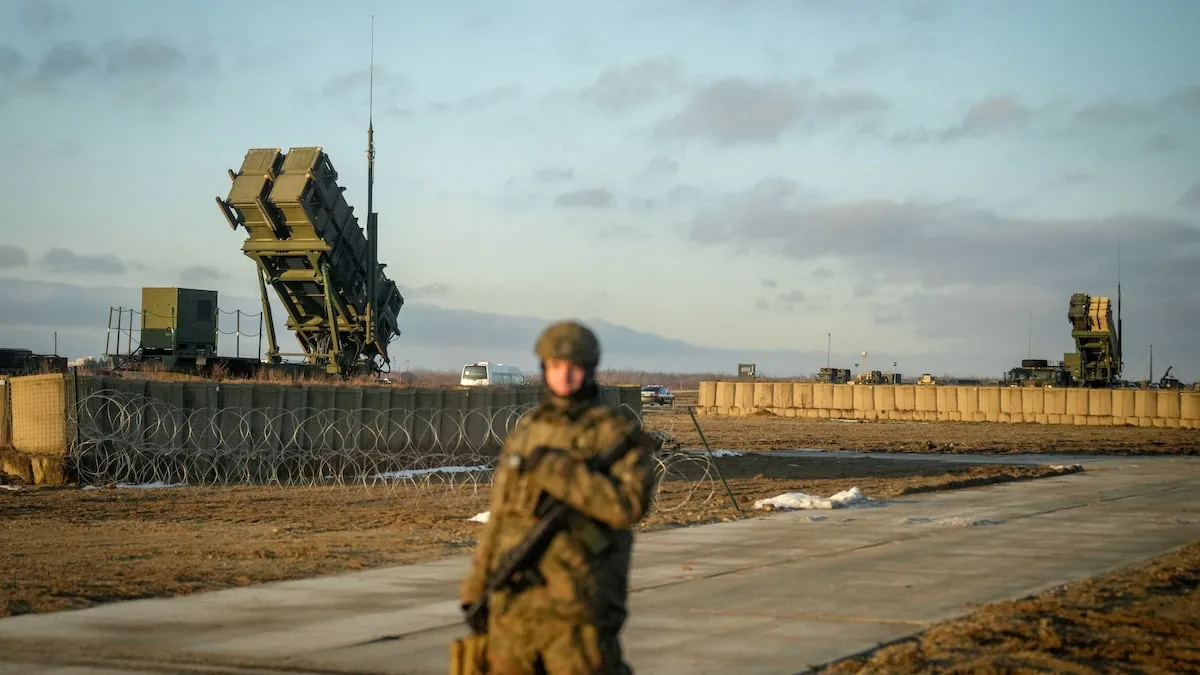
For the first time in the history of the German federal army, the Bundeswehr, Defense Minister Boris Pistorius, presented a military strategy this Wednesday to strengthen Germany’s Armed Forces to have in the future “the strongest conventional army in Europe” and thus be able to confront Russia, whom they consider “the main threat.”
Read more Surviving a heart attack in the best conditions
Although the full versions of the documents they have been working on for the past three years are classified as “secret” to “protect the security and interests of Germany and its partners,” the Defense Minister has presented the general outlines of his global concept of military defense and the strategy for the reserve.
“The world has become more unpredictable and, yes, it must be said, more dangerous,” said the social democratic politician, referring to Russia’s war of aggression against Ukraine and the succession of geopolitical crises. The new military strategy provides, in his opinion, the “necessary clarity” required in the face of the current threat. It must be accepted, he emphasized, that “peace, freedom, prosperity, and tolerance are no longer something that can be taken for granted, but must be defended, and that means we must be able to defend them.”
For his part, Carsten Breuer, inspector general —the highest-ranking military position in the German Armed Forces— has stated that, while the Bundeswehr must focus on the defense of the country and its allies, it must also continue to participate in international crisis management: “Often, security policy scenarios can no longer be clearly separated from each other.”
The military strategy, Breuer slipped, starts from the premise that war is no longer limited to specific battlefields: the state, the economy, and the population are threatened as a whole. Likewise, the inspector general has focused on how data is increasingly becoming a weapon and that the enemy could employ autonomous weapons controlled by artificial intelligence tools, which increases the speed of operations and shortens reaction times.
The foundational documents on the strategic orientation and capability development of the German Armed Forces for the coming years “form the basis for a specific, time-coordinated, and at the same time flexible development of the Bundeswehr towards technologically superior and innovative armed forces,” emphasizes the Ministry of Defense. “A military strategy for the Bundeswehr is now more necessary than ever.”
The central axis of the military strategy is to confront threats from Russia, given that Moscow considers the West “fundamentally hostile and presents the accession of democratic states to NATO as an encirclement.” Russia, Pistorius said, also selectively resorts to “hybrid means” such as espionage, acts of sabotage, cyberattacks, and disinformation campaigns, which “are no longer marginal phenomena.”
Read more The German government halves its growth forecast for this year due to the war in Iran
Russia intends, according to the German Defense Minister, “to weaken the cohesion of the alliance and achieve a US disconnection from Europe.” Its ultimate goal, he added, is the failure of NATO and the expansion of the Russian sphere of influence in Europe. In this context, Russia “is preparing, through its rearmament, for a military confrontation with NATO and considers the use of military force as a legitimate instrument to impose its interests.”
Along with the military strategy, Germany adds a new capability profile that establishes the composition, structure, and scope of the Armed Forces for the future. With a clear goal: for the Bundeswehr to gain in size and agility.
By 2035, the number of active soldiers must increase to 260,000 —a big jump from the current 185,000— and reservists to 200,000 —practically double today’s number—. In total, therefore, at least 460,000 uniformed personnel to face a possible aggression from Russia together with its European and NATO allies. In this way, the minister remains firm in his objective for the number of personnel, despite high-ranking military officials having demanded a much more significant increase, which would take the number of active soldiers above 300,000.
“We are turning the German Armed Forces into the strongest conventional army in Europe,” Pistorius announced. “In the short term, we will increase our defense and resilience capabilities. In the medium term, we aim for a significantly broader increase in capabilities. And in the long term, we will achieve technological superiority.”
After decades of limited funding for the Armed Forces and continuous reductions in the number of soldiers, the German government last year relaxed the debt brake established in the Constitution to massively increase defense spending. However, the government has so far rejected a return to compulsory military service, suspended in 2011, and has opted instead for voluntary military service and mandatory registration for all young people turning 18. The question is whether the set objectives can be achieved with these means.
Read more The PP and Vox reach a government pact in Aragon to invest the popular Jorge Azcón