









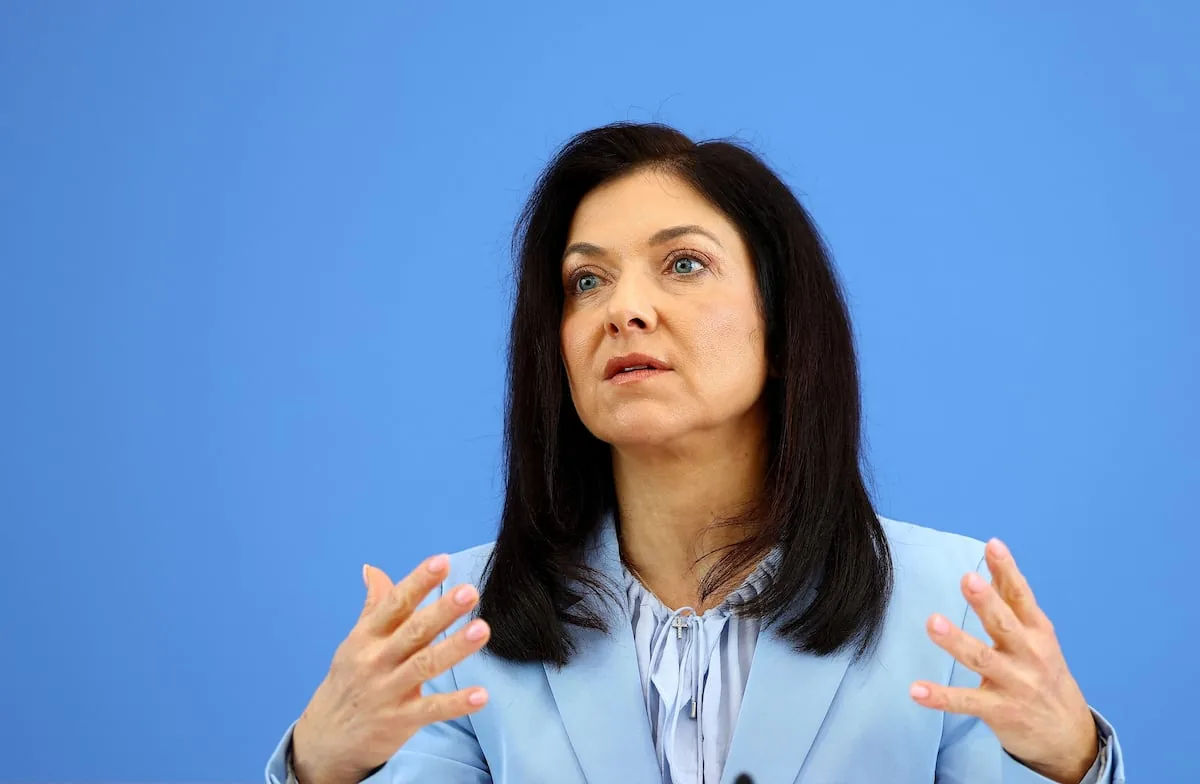
The German economy is struggling to get off the ground. The German government on Wednesday halved its economic forecasts, and now expects growth of only 0.5% this year, compared to the 1% forecast at the end of January. The cut is due, essentially, to the energy crisis generated by the war in Iran.
Read more The PP and Vox reach a government pact in Aragon to invest the popular Jorge Azcón
“The economic recovery expected for this year has once again been hampered by external geopolitical disturbances,” admitted Economy Minister Katherina Reiche during the presentation of the government’s new spring forecasts. “The German economy is on a slight recovery path, but headwinds have increased. The war has caused a crisis in energy prices that we have not been able to avoid and that represents a real burden for the population and the economy,” she warned.
Likewise, the Executive revised down the forecast for next year and expects GDP to grow by only 0.9%, instead of the 1.3% that was expected three months ago. This prediction also comes with an asterisk: it would only happen if the supply of oil and gas does not deteriorate further as a result of the war with Iran. “I don’t see a recession, but we are considering all scenarios,” Reiche said. “It would be desirable for this crisis to pass quickly.”
As for inflation, it is expected to stand at 2.7% this year, compared to 2.1% in the previous forecast, and to rise slightly in 2027, to 2.8%. “The rise in energy prices has an immediate impact,” Reiche said. This is expected to gradually make products more expensive also in economic sectors such as food production or the building materials industry.
Experts from the Ministry of Economy have developed their metrics under the hypothesis that energy prices will fall again throughout the year, “but not to pre-crisis levels,” as Reiche emphasized. Inflation primarily affects households, which, according to forecasts, will increase their consumer spending by only 0.4% in 2026 and 0.5% in 2027, a key factor in the weak growth prospects.
Since the US and Israel attack on Iran, the global economy is weakening due to the blockade of the Strait of Hormuz, a fundamental maritime route for the transport of oil and gas, but also for goods. Since the beginning of the war, it has been practically impassable for ships, which limits the global energy supply and drives up prices. In turn, the increase in energy prices affects all other prices, and this also affects Germany, which is highly dependent on exports.
The enormous uncertainty about how the conflict will evolve remains. Experts are not only concerned about the supply of aviation kerosene. Helium could also become scarce and cause disruptions in industrial supply chains. It is a byproduct of gas extraction and is necessary, among other things, for chip production.
In this context, foreign trade also provides little impetus. The government forecasts a stagnation of exports in the current year and a growth of 1.3% next year. In addition to the geopolitical crisis, this is also due to the fact that German industry is increasingly struggling to compete internationally and is progressively reducing its capacities. This is the case of Volkswagen, which this week announced that it is preparing a tough austerity policy and expects to eliminate some 50,000 jobs across the group by 2030, of which about 35,000 would be in Germany.
Debt-funded spending programs aimed at improving infrastructure and defense are sustaining growth in this war-damaged economic atmosphere. According to forecasts, public consumption will increase by 2% this year, and 1.3% next year. “The state invests, while the private sector remains on hold,” Reiche explained. In addition, several public holidays fall on weekends this year.
The recent track record of activity has been mediocre. In 2023 and 2024, Germany’s economic performance contracted, and in 2025 it grew slightly, by 0.2%. In general, the German economy has been performing much worse than that of other major industrialized countries for years. The country’s leading economists warn whenever they can of the urgency of implementing a package of reforms as soon as possible to address the structural crisis the country is suffering. However, this package has become a source of tension between the partners of the conservative and social democratic coalition government. “We must address the tax burden, which is too high compared to other countries, reduce energy costs, and eliminate bureaucracy,” Reiche demanded regarding the “deep” structural reforms Germany needs.