





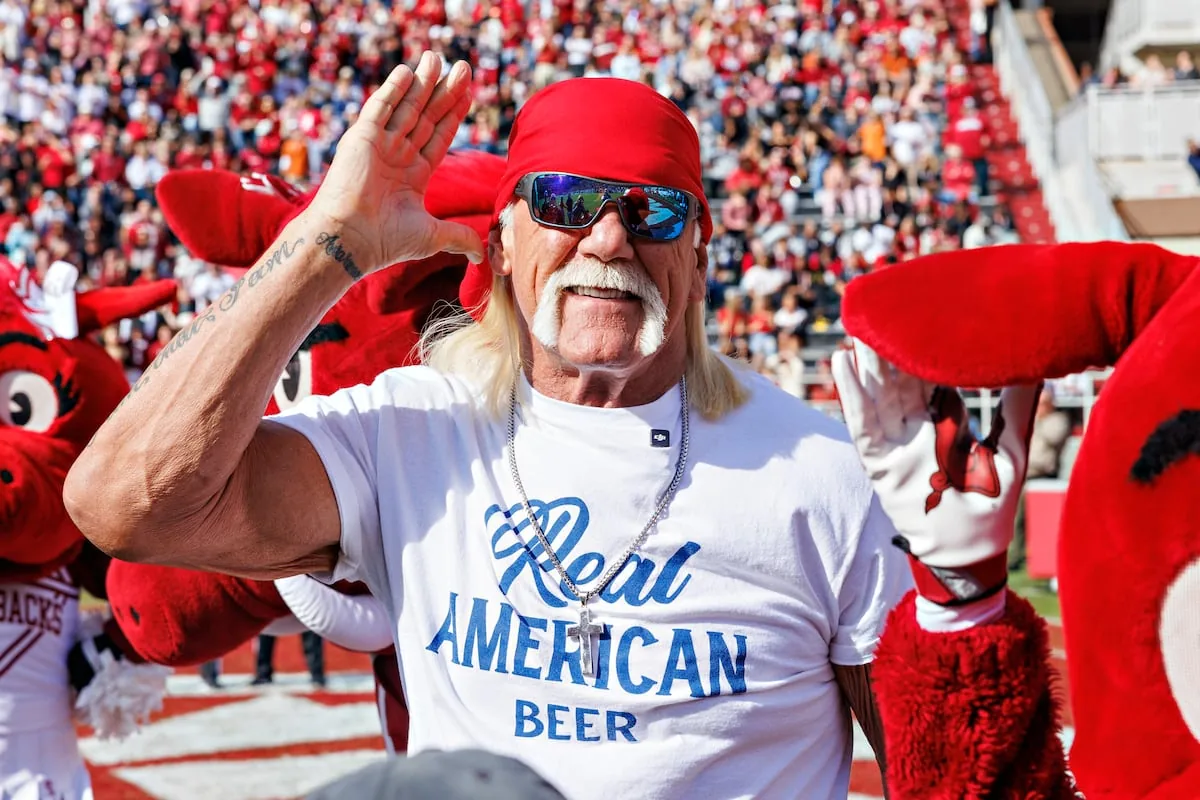
This Wednesday, April 22, Netflix premiered the anticipated documentary about American wrestling legend Hulk Hogan, who passed away on July 24, 2025, at the age of 71, from a heart attack. Directed by Bryan Storkel, Hulk Hogan: Real American is a four-part miniseries. It was filmed when Terry Bollea —Hogan’s real name— was still alive, with access to the wrestler, even in his final days. But far from showing the truth behind that media-savvy and controversial character, who became so popular in US culture and then made his way to Spanish televisions in the eighties through Saturday morning pressing catch, specialized Anglo-Saxon critics agree that the title is not the only patriotic and exaggerated thing about this production. They also make it clear that little is revealed about that Californian bassist with a singular physique who ended up being a wrestling icon only to fall from that Olympus due to, among other controversies, his racist comments.
“Discover the man behind the legend in this uncensored documentary that includes his last interview,” reads the promotion launched by the platform. Meanwhile, the specialized media outlet The Hollywood Reporter (THR) describes it as “a four-hour promotional report.” From the first lines of his review, critic Daniel Fienberg asks anyone who watches Storkel’s four episodes about the wrestler not to expect a great revelation about Hulk Hogan, but rather a “mediocre documentary” that offers more facade than “substance or depth.” He assures that, despite the title, watching it is no guarantee of knowing what it means, “for better or worse, to be a ‘real American’.” Regarding one of the most juicy aspects of the production, the appearance of President Donald Trump, of whom Hogan was a declared follower, he warns that it is “an appearance without energy,” although the American leader appears “extensively and without saying anything substantial.”
For Chris Bennion, who signs the review of Hulk Hogan: Real American in the English newspaper The Telegraph, Storkel’s footage is an “absorbing and frantic documentary series.” The critic writes that, like its protagonist, it is “full of steroids,” as well as “obsessed and fascinated by the image and impact of the wrestler dressed in red and yellow lycra; it is confused and disgusted by his failures; and has no idea where Bollea ends and Hogan begins.” Regarding all the controversies recounted in the documentary, which marked Hogan’s public life, he assures that “they are so numerous that the series does not have time to address them all.” But it does show what is, perhaps, “the most important,” or, at least, “his first fall from grace, when, in the early 1990s, it was revealed that he had been consuming steroids throughout his career.”
View this post on Instagram
Regarding the consumption of these substances, and as reported by the American magazine People, Hogan admits in the documentary: “Of course I lied.” Despite having vehemently denied it in the past —he only admitted minimal use during the 1994 federal trial against the former WWE CEO—, he reveals in the series that he started using steroids two years after finishing high school, assuring that his “mindset back then” was that “steroids were safer than sugar.” But these were not the only substances the wrestler confesses to having consumed: in 2009, after divorcing Linda —his first wife, whom he married in 1983— and being left “penniless” by her, he consumed a significant amount of fentanyl while competing in TNA Wrestling (another wrestling company), as he declares in Real American: “My body couldn’t take it anymore. I was taking 80 milligrams of fentanyl, two in the morning, putting them under my gums; I had two 300 mg fentanyl patches on my legs and they gave me six 1,500 mg fentanyl lollipops to eat,” he recounts, before recalling: “At the pharmacy they told me: ‘You should be dead. We’ve never seen a human being take so much fentanyl’.”
Read more Surviving a heart attack in the best conditions
The film also features other voices close to the athlete, such as his widow, Sky Daily Hogan, who has revealed that she and her husband received death threats after he showed his support for Trump at a Republican National Committee rally: “We received some death threat letters, but, honestly, for the overall patriot image, it was great,” she assures in the documentary. “I met Donald Trump back in the 80s and he’s my friend,” Hogan says in one of the episodes: “Many people would say I’m completely crazy [for supporting him], but I know the person. I know him very well. I’m not saying I agree with everything he does, but at least he’s honest about who he is,” he continues.
On Hulk Hogan’s Instagram account, still active even almost a year after his death, and where 2.6 million followers are still subscribed to updates and memories, the series poster was published on April 6. In it, he can be seen against a very strong yellow background, with his characteristic blonde mustache and gleaming teeth, tearing off his shirt as in his best days in the ring, when he was the Hogan everyone remembers.
Read more The German government halves its growth forecast for this year due to the war in Iran