






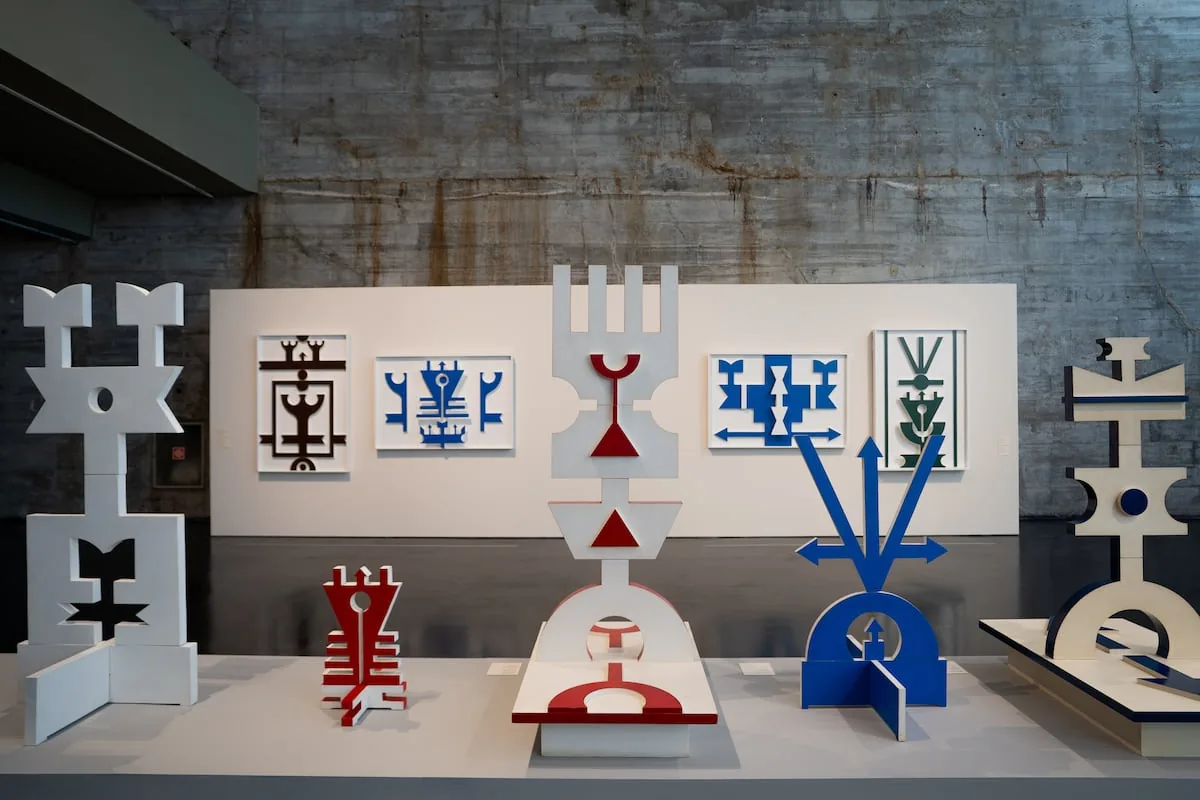
First, he earned his dentistry degree. Later, he wanted to be a journalist. But the destiny of Brazilian Rubem Valentim (1922-1991), one of the greatest names in 20th-century Brazilian art, was not to be linked to toothaches or newspaper headlines, but to geometry. And not just any geometry. Many of the forms that populate his paintings and sculptures, almost always in vibrant colors, are an artistic mutation of some of the most well-known symbols in Afro-Brazilian religious rituals. Now, the exhibition Rubem Valentim, a ordem do sensível (the order of the sensible), at the Rio de Janeiro Art Museum, brings together almost 180 pieces until August, many from private collections and rarely seen by the general public, to review his entire career.
24 hours remain until the inauguration of one of the year’s exhibitions at the Rio museum, and its monumental hall is a swarm of technicians putting the finishing touches: a final brushstroke, the definitive decision on the ideal placement of one painting or another.
The hustle and bustle of this controlled chaos contrasts with the peace conveyed by the artist’s works, with almost always symmetrical forms painted with millimeter precision. To an eye unfamiliar with Brazil’s immense religious richness, they might appear to be merely a balanced play of polygons. Others, however, will recognize Xangó’s axe, Oxóssi’s bow and arrow, or Oxum’s circular forms, some of the main orixás (divinities) in Candomblé, an Afro-Brazilian animist religion. The references, however, are subtle, deliberately ambiguous, and always filtered through the artist’s sensibility.
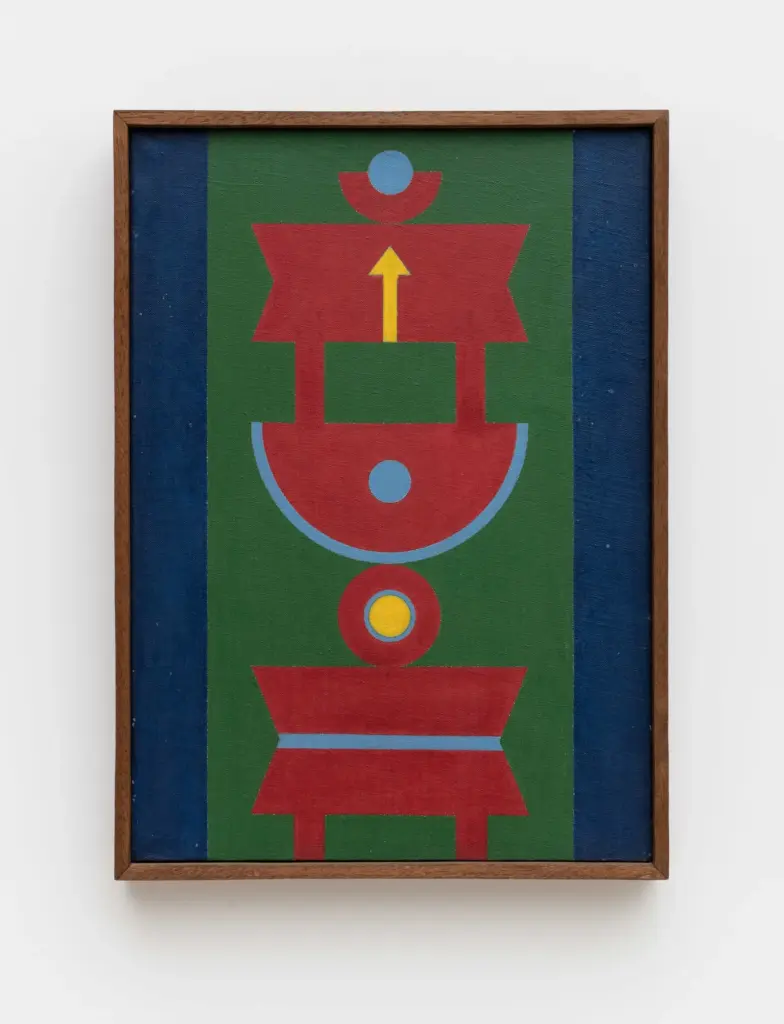
“Valentim did not make a literal transposition of what he saw in the candomblé terreiros [temples]; he does not want to faithfully represent an orixá. He seeks in these spaces the languages that interest him to create his art, which is art with Afro-Brazilian and indigenous roots, but which transcends. It is a universal art,” explains Raquel Barreto, the exhibition’s curator alongside Phelipe Rezende. Beyond the labels in which critics tried to confine him for a time, his works now hang in museums around the world, from the Reina Sofía in Madrid to MoMA in New York.
In Rio, the two curators decided to organize the exhibition based on the cities that marked his life. In his early years in Salvador, the capital of Bahia, where he was born, an attachment to the figurative is evident, which soon fades in favor of abstraction, especially when in 1955, already an established artist, he moved to Rio de Janeiro.
Read more Chile faces the challenge of converting its mining waste into a new source of critical minerals
Brazil’s then-capital was the place to be if one wanted to be an artist. His visual identity increasingly diverged from that proposed by his contemporaries of the Concrete and Neoconcrete movements. His geometry was not neutral and mathematically cold, nor was it experienced through the body and experience, but rather symbolic and linked to spirituality, though at the same time “secular,” as the curator emphasizes.
He then spent two years in Rome, where, far from being swayed by the influence of canonical European artists, he reaffirmed his connection with the religions of the African continent. It was then, in 1966, that he participated in the first World Festival of Black Arts, held in Dakar (Senegal). That same year, in the midst of the military dictatorship, he returned to Brazil to settle in Brasília, the young capital, inaugurated just six years earlier. The white of Oscar Niemeyer’s elegant buildings ended up dialoguing with his works in some of the State’s best showcases, such as the Itamaraty Palace, headquarters of the Ministry of Foreign Affairs, and who knows if that sought-after monumentality of the new capital inspired him to create increasingly larger sculptures designed for public spaces.
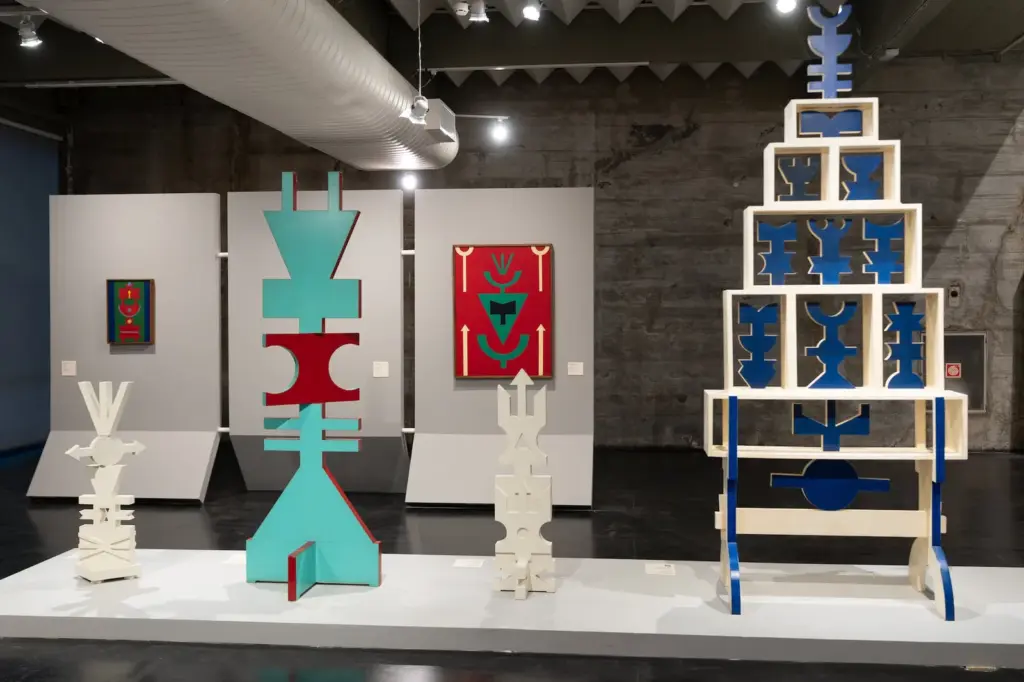
The exhibition concludes with The Temple of Oxalá, the only known work in which Valentim explicitly dedicated one of his pieces to a divinity. It is a set of 20 sculptures ranging from 1.27 to 2.78 meters in height, in which the artist combines symbols and tools of various orixás, all bathed in white, the color of Oxalá, considered in Candomblé the father of creation and lord of peace.
Valentim created what is his most monumental work in 1977, for the XIV São Paulo Biennial. A year earlier, he gave birth to a much lesser-known but equally emphatic work: his Manifesto ainda que tardio (manifesto, albeit late), the text in which he tried to clear up doubts about his work, even though, as the title suggests, it was already somewhat late. “By creating my sign symbols, I seek to transform into visual language the enchanted, magical, probably mystical world that continuously flows within me.”
Read more Tech magnate Peter Thiel strengthens ties with Milei in Buenos Aires