


The live music market has soared. Its annual turnover has doubled compared to the years before the coronavirus pandemic. Keeping a distance, the live podcast industry has also grown, and although it sells tickets for between 15 and 20 euros instead of the hundreds of euros it costs to see Shakira, Bad Bunny, or Rosalía, and fills more modest venues, its tickets also sell out in a matter of minutes. Instead of stadiums, they occupy cultural spaces or small theaters. And that’s fine, say those who are dedicated to bringing the great voices of the sound industry to live events.
Read more Sant Jordi starts with a vigorous defense of public libraries
“We are promoters as if we were for concerts. We rent a hall, do the production, and sell the tickets ourselves,” Clara Narvión, who directs Radio Primavera Sound with Izaro Bo, tells EL PAÍS in a telematics conversation. As its name reveals, the project was born under the wing of the famous music festival. Soon, this sound arm began producing podcasts. From the beginning, it opened a space in Barcelona, “a mini-theater that was designed to build community, rather than to monetize,” Narvión points out.
The second way to offer podcasts, they explain from this label, is to be requested by a brand, private festival, or public body and receive a fee in return. “They hire podcasters like someone hires a rock band; there’s no investment risk on our part, and we get to wonderful places. From the Cartuja de Sevilla, to the Marpoética poetry festival in Marbella, the Grec in Barcelona, the Miró Foundation…”, comments Narvión. Between self-produced and contracted podcasts, in 2025 Radio Primavera Sound offered more than a hundred live podcasts. “Anyway, for now, we couldn’t live on live shows alone,” confesses its manager.
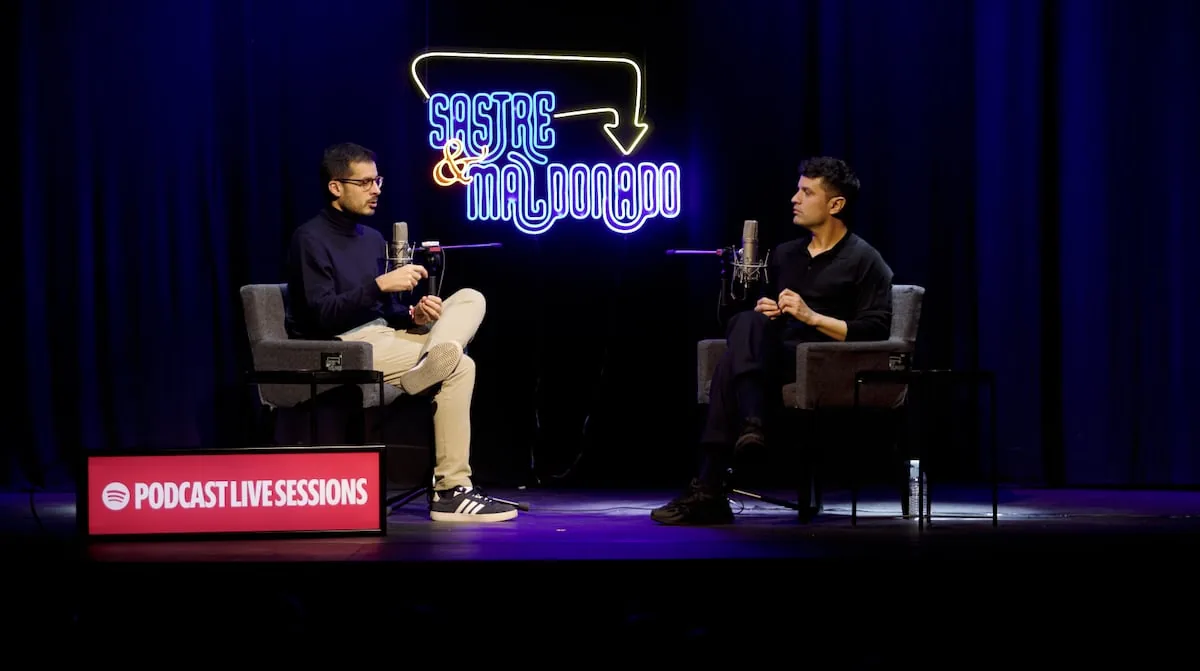
Podium Podcast also diversifies its live offering. In December 2025, Sastre and Maldonado successfully held a one-off recording of one of their episodes at the Teatro Fígaro in Madrid in collaboration with SMedia, a leading company in stage production. It was the most consumed in its history, with over 300,000 listens. While other titles, such as Delirios de España, allow for a spin-off show based on the original content created to tour Spain, explains Alejandro Rodríguez, audiovisual radio director at Prisa Media. “Now, when we propose new products, we do imagine how we can bring that to an event format, a physical format. But not all titles are scalable to live, no matter how successful they are. For example, Vicky Martín Berrocal’s is very popular, but it consists of creating an intimate conversation with her guests, something that would be lost in a room full of people,” he explains.
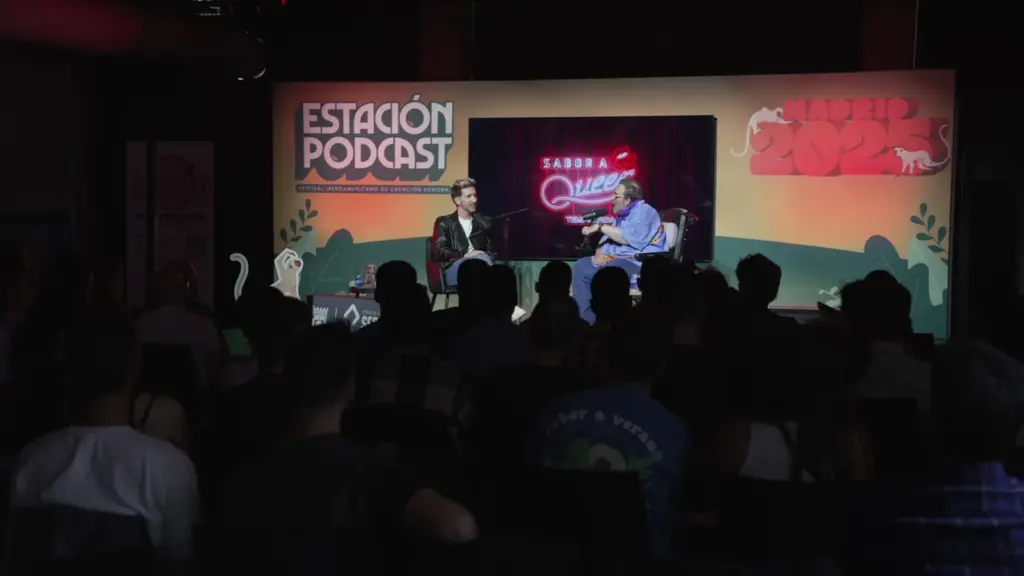
Another clear example of this parallel evolution of the music industry and the conversational podcast industry has a name: Carlos Galán. The music promoter and founder of the independent music label Subterfuge Records, who at one point also diversified his activity to launch podcasts, is responsible for the Estación Podcast festival, whose next edition will be held this May. It joins other initiatives such as Podcasts Days to bring together the sound industry and its followers at least once a year.
“Around 2008, the music business suddenly broke. Format sales practically disappeared, and digital at that time yielded absolutely nothing. I always say that the first invoice we sent to Spotify for our musical artists was for one euro,” Galán recalls. The record label jumped into podcasts in 2019 with Subterfuge Radio, and shortly after, a pandemic arrived that put this industry in check. On the one hand, listens soared due to lockdown, but it wasn’t monetized. From 2021, live shows, as had happened a decade earlier with its musicians, became a way to solve that problem.
“These are events that create a connection between the audience and the content creator, as happens with music groups. For example, Galicians like Coral do Rego and Yayo Freijo (creators of Sofá, manta y crimen) succeed every time they pass through Madrid,” Galán argues. They first arrived at the Palacio de la Prensa in Madrid on Halloween night and filled the venue, to which they return in May as part of the Estación Podcast program. The festival usually brings stars of the Latin American sound industry to the Círculo de Bellas Artes in Madrid, which is often their first direct contact with the Spanish audience. This was the case with Se regalan dudas, by Mexicans Leticia Sahagún and Ashley Frangie.
View this post on Instagram
“One-off live shows require more production work and are usually less profitable than those that tour Spain, but they are held to celebrate that sense of community,” reveals Alejandro Rodríguez.
Galán brings this new industry back to earth: “Podcasts already have more memes and viral content than anyone, everyone has one, but it’s still a very small and developing market,” he states. Some of these podcast have reached large venues. “Who doesn’t want to brag about having been to the Wizink Center? Even so, it’s quite likely that these types of events work much better in more cultural, smaller venues. In the end, that closeness it has, like on the radio, cannot be lost,” points out the promoter.
Creating community and unique experiences
Radio Primavera Sound’s niche works for them. In their case, it’s brilliant and critical female voices. One of their podcasts with which Radio Primavera Sound regularly does paid live shows is Salsa Romesco, an LGTBIQ+ advice column that serves as a starting point to talk about sexual health, power roles, and types of sex-affective relationships. Ciberlocutorio also often tours, in which Andrea Gumes and Anna Pacheco address their obsessions and fears alongside other guests, with an eye on the virtual world of the Internet. Journalists Begoña Gómez and Noelia Ramírez direct and present Amiga, date cuenta, in which they analyze and name pop phenomena through sociology.
And one of their great live successes is Las hijas de Felipe, a pop look at the Baroque that was one of the first proposals in the Spanish market to succeed live. Carmen Urbita and Ana Garriga, 34-year-olds from Madrid and Salamanca, hold doctorates in Baroque Literature from Brown University. Their common passion is Saint Teresa of Ávila and the other women of the Baroque. Their podcast revolves around gossip, anecdotes from the era, as well as feminist vindication, with multiple social nuances in a little-explored part of history.
Estación Podcast also tries to promote the live audio industry beyond its annual May event with local events. It has already organized several editions of the Madrid al Habla cycle and has launched Podstars in collaboration with Ámbito Cultural, where creators of different themes compete to become the podcast breakthrough of the Madrid scene. “Having a defined audience helps. And some of our creators have developed a formula that is to conceive content that is solely for live performance, not uploaded to the Internet, and that has more extensive production and a scenic element,” points out Izaro Bo, who also directs Radio Primavera Sound. “In our case, most of the audience are girls, who come to meet the voices they listen to but also to meet each other. They form a community in the stalls,” Narvión continues, celebrating that her different content creators sometimes join forces to merge their different podcasts into a single live show. It’s another way to offer exclusive content to their followers. For example, Punziber united Punzadas Sonoras with Ciberlocutorio.