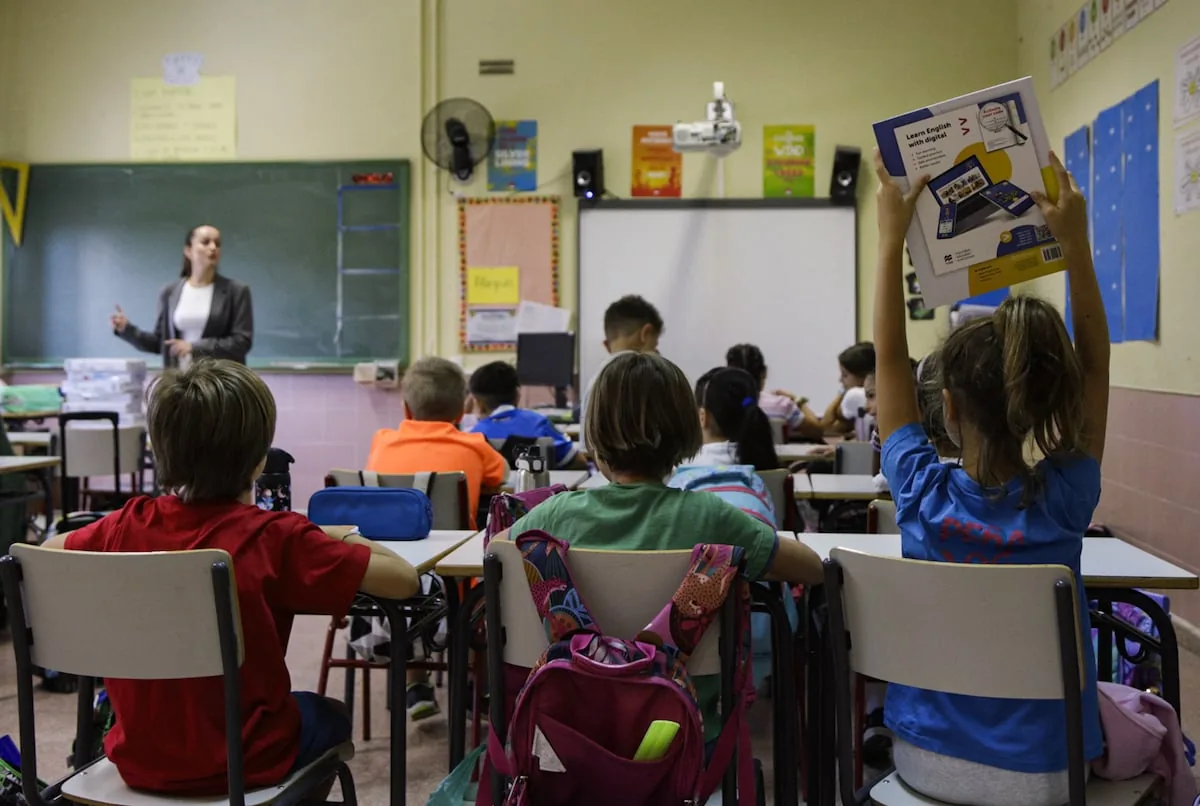








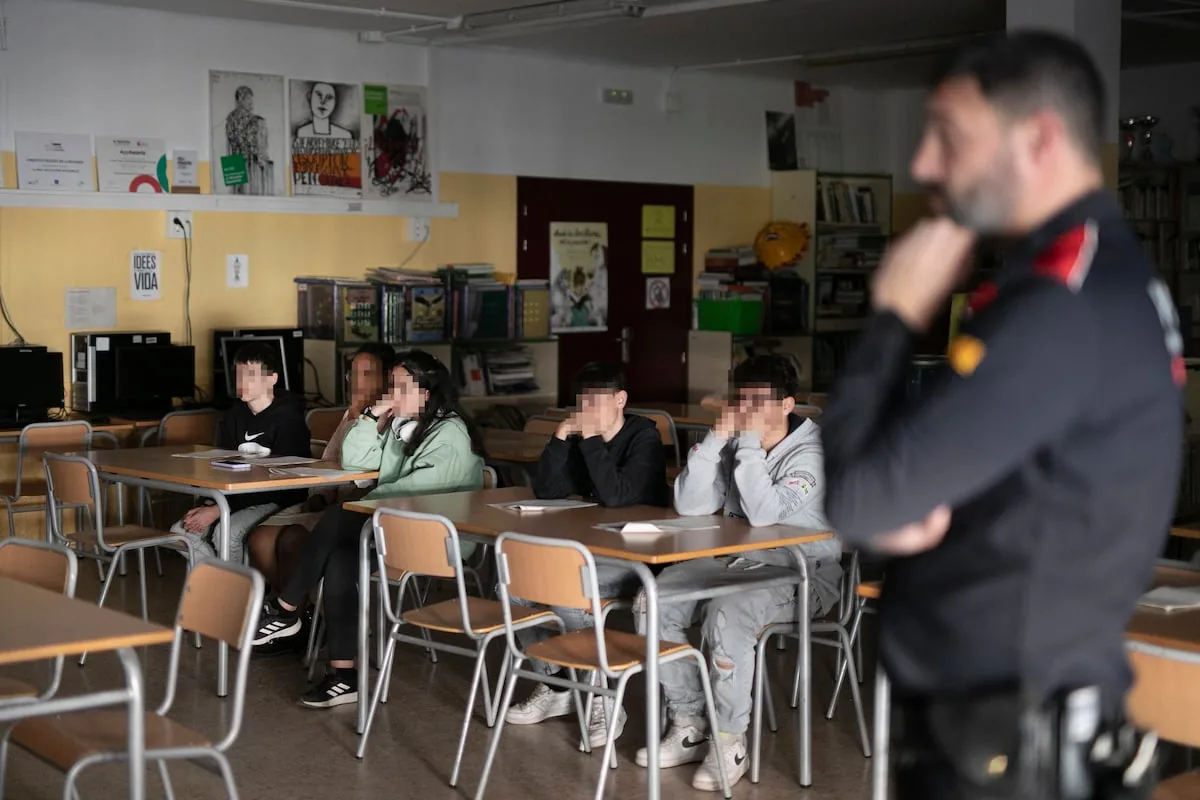
The pilot plan by the Generalitat de Catalunya to permanently deploy Mossos d’Esquadra officers in problematic secondary schools, as reported by EL PAÍS, has met with clear rejection this Thursday, with hardly any exceptions, from representatives of the educational community, both Catalan and across Spain. Teaching unions, student family federations, and student associations believe that the Govern is mistaken in its approach and should direct resources to strengthen the staff of educational centers. They add that the Generalitat is launching the plan after having cut staff dedicated to social integration tasks in Catalan educational centers. From the 420 social profile professionals in Catalan centers last academic year, they estimate, the number has dropped to about 300 this year, according to estimates from the Bofill Foundation.
“We completely disagree. It goes in the opposite direction of what is needed in high schools,” states Lidón Gasull, director of the Catalan family federation Affac. “The centers with the most conflict are those where a higher proportion of students in vulnerable socioeconomic situations are concentrated. And the Department of Education decided at the beginning of the academic year to reduce the number of social integrators and educators in the centers, who were achieving very positive results. They said they were reducing them for budgetary reasons, when having mossos distributed throughout the territory is much more expensive,” adds Gasull.
The USTEC-STES union, which is the majority union in Catalan education, considers the measure “unacceptable” and that it “will generate a feeling of surveillance and repression.” “Instead of providing more resources to centers, reducing ratios, allocating more social integrators or psycho-pedagogues to redirect attitudes, they decide to put police in high schools,” states its spokesperson Iolanda Segura. “We have asked for school nurses because there are students with health problems and they don’t give them to us. In contrast, it has never been requested that the Mossos enter the centers,” she adds. CC OO also disagrees. Edu Núñez, head of Education in Catalonia, calls for an increase in resources for educational centers, and, in general, for public policies. “More social policies are needed in housing, mental health, stronger community action to reinforce youth facilities and, of course, more decisive investment in education.”
Jordi Satorra, president of Axia, the main association of directors of Catalan public centers, has a similar view. “It is an excessive and economically unviable measure in practice. Agile police presence when required, and prevention and support activities are sufficient. Nurses are needed on-site in educational centers, not mossos,” Satorra agrees.
His opinions are in line with what Miquel Alegre, project manager at Equidad.org (as the former Fundació Bofill, an entity dedicated to the analysis of educational policies based in Barcelona, is now called), proposes. Without denying “the existence of increasing indices of insecurity, both real and perceived, by students and especially by teachers,” and that police intervention is necessary if the situation arises, the sociologist believes that police officers are not the most suitable figures to carry out the prevention and mediation functions advocated by the Generalitat’s own plan. “There are other figures in the field of social professions, social integration technicians, counselors, and social educators, who are much more appropriate to perform these functions of prevention, guidance, and support for students and their families, mediation, and conflict resolution. And precisely these types of figures are currently being withdrawn from high schools and schools. In Catalonia, the number of social professionals within educational centers as part of the staff has decreased from 420 to 300 in the last academic year.”
1 per 1,000
The ratio of these types of professionals has been reduced to practically 1 per 1,000 students with educational needs due to socioeconomic reasons, Alegre points out.
One of the few favorable positions is that of the Public Education Trade Union Association of Catalonia (ASPEC), which is the second most representative union in education in Catalonia, but the first in public secondary schools, which is where the plan is focused and where there is greater discomfort due to aggressions and the worsening of the school climate. Its general secretary, Ignasi Fernández, believes that the incorporation of the Mossos “will help reduce conflict, although there should first be student expulsion protocols.” The initiative, he continues, is “an indicator of the atmosphere” that exists in Catalan high schools. “Verbal aggressions are daily. And not only from students but also from parents. Seven out of ten teachers have been victims of some type of aggression. Meanwhile, current protocols lead to nothing, when there are students who, at a certain point, should not be allowed in the classroom. There must be strong disciplinary regimes. Police entering high schools should be the last option, but, for now, the protocols are not working,” he adds.
Student unions also oppose it. José Luis L. Hernández, spokesperson for the Front d’Estudiants, criticizes that the initiative does not act on the causes, but on the consequences of the problems suffered by students. “Students want sex education to prevent aggressions, but in no case a constant police presence, treating schools as if they were penitentiaries. It is another measure that criminalizes poverty and precariousness,” he states.
The measure also fails to convince CEAPA, the main federation of public education families, at the state level. Its president, María Sánchez, sees it as positive that the focus is placed on coexistence problems in schools, “because they are a real concern for students, families, and teachers given the data on violence and bullying in classrooms.” But she believes that the solution lies in “a more educational and community-based approach.” Francisco Venzalá, president of the ANPE teachers’ union, warns that the permanent incorporation of police into educational centers can stigmatize them in the eyes of families and teachers, worsening their situation. And a CSIF spokesperson, Juanjo Sanmiguel, defines the plan as a “measure for show.” “Given coexistence problems, teachers must be supported with legal backing measures, clear and immediately executable protocols, and centers must be provided with the necessary support and reinforcements to address the new realities of the centers,” he points out.
Read more Lamine Yamal, with a muscle injury, is out for the season, but not for the World Cup