







Lebanon remains in shock this Thursday after an episode that began the previous day, and which agonizingly stretched into the early hours of the morning, in which Israel first bombed two journalists in southern Lebanon and then the rescuers who were trying to find them among the rubble. The offensive, which killed one of the two reporters, has led to strong condemnation from the highest Lebanese authorities, who describe the aggression as a “war crime” and announce that they will turn to international bodies to seek accountability.
Lebanese Prime Minister Nawaf Salam and President Joseph Aoun have both condemned Israel for what they describe as “deliberate attacks” against journalists, and even denounce the existence of a modus operandi. “Israeli attacks against reporters in southern Lebanon while they carry out their professional work is not an isolated incident,” said Salam, who presided over the International Court of Justice (ICJ) until 2025. “[It is] a proven pattern that we condemn and reject, as do all international laws and conventions.”
Despite the existence of a temporary truce that expires on Sunday, and whose extension Israeli and Lebanese ambassadors in Washington will negotiate this Thursday, Israeli troops launched two bombings on Wednesday over the southern municipality of Tiri. The first killed two people, including the mokhtar (notable) of the village. The second, according to the Lebanese Ministry of Health and acknowledged by the Israeli army, directly targeted Amal Khalil, a reporter for the newspaper Al Akhbar, and Zeinab Faraj, the photographer accompanying her. Khalil, who during the 2024 military escalation reported receiving death threats from Israel, lost her life under the rubble.
Rescuers, however, could not reach Khalil, 42 years old, until midnight. After bombing the municipality, the Israeli army denied access to the Lebanese army and the Lebanese Red Cross for hours. The Lebanese state news agency stated that Israel was “besieging” the journalists.
The Government of Lebanon sought to lift the Israeli blockade through all available means. It appealed to the Mechanism, as the US-led committee that oversees the truce signed in 2024 between Israel and Hezbollah, and which serves as a liaison with Israeli authorities, is known. It also turned to the United Nations peace mission in Lebanon, another usual mediator between two countries without diplomatic relations.
The efforts were in vain. An Israeli drone fired a stun grenade at civil defense members as they searched for the reporters among the rubble, causing an emergency retreat during which ambulances were shot at. Paramedics were able to take away the two fatalities from the first attack and Faraj in serious condition — now stable, after a head intervention — at that moment. The escape left behind Khalil’s body, whose search could not be resumed until late at night.
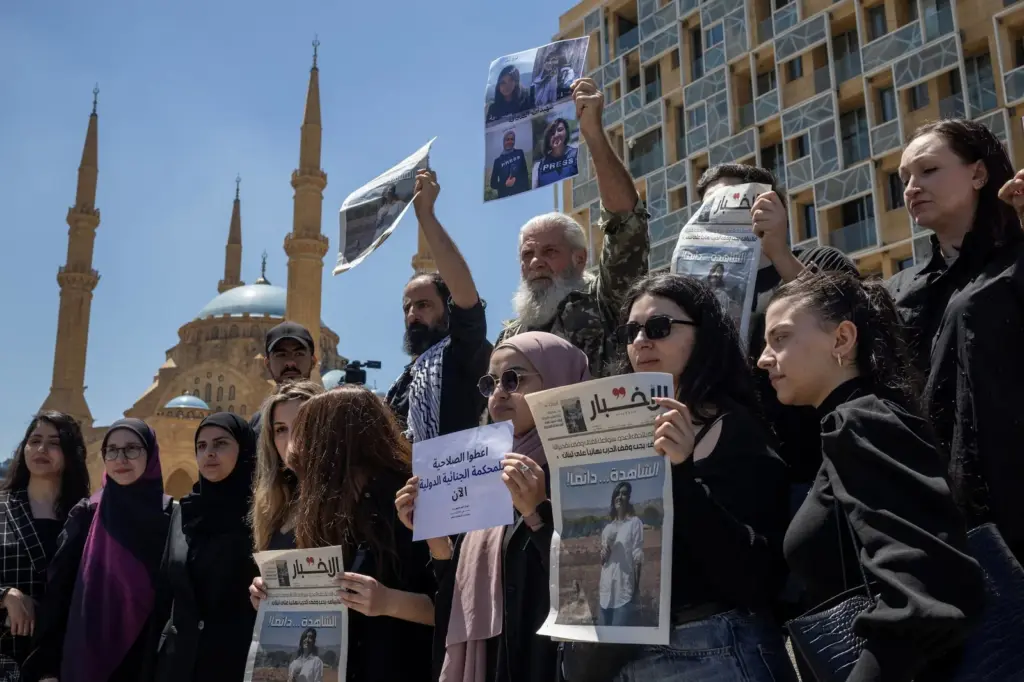
“Attacking journalists, preventing access for humanitarian aid teams, and even attacking that location again when these teams have arrived constitutes war crimes,” Salam protested in a statement issued in the early hours of the morning, minutes after Al Akhbar confirmed the death of its journalist. While extending condolences “to the entire Lebanese journalistic community,” the prime minister warned that Lebanon “will spare no effort” to pursue these crimes before international justice.
“The crime of the Zionist enemy did not surprise us at all,” denounced the leader of the parliamentary committee for press and communications, Ibrahim Moussawi. The deputy is a member of Hezbollah’s parliamentary bloc, a political formation that participates in national authorities while its armed wing wages a war against Israel whose launch was not consulted with the rest of the country. “It is a new black mark on the enemy’s record, which has become accustomed to assassinating journalists and destroying their offices and equipment to prevent them from disseminating images of their crimes against civilians in Lebanon and Palestine,” the parliamentarian added.
“We know where you are”
The death of Khalil, mourned by a gathering of citizens and journalists this Thursday at a vigil in Beirut’s Martyrs’ Square, is in some ways a foretold death. In September 2024, amidst the worst part of the offensive Israel launched on Lebanon after Hezbollah initiated a low-intensity conflict the previous year in support of Gaza, this Lebanese journalist — known for her war coverage in southern Lebanon — reported receiving Israeli death threats on her mobile phone.
According to Khalil’s account, the message — whose existence this newspaper cannot immediately corroborate — described her usual movements, warned her that they would reach her “when the time comes,” and suggested exile if she wanted to keep “her head on her shoulders.”
On Wednesday, the spokesperson for Israeli troops in Arabic, Ella Waweya, stated that the army had fired at two vehicles in Tiri “that had left a military building used by Hezbollah.” The military note reinforced the justification for the attack by specifying that the cars “had crossed the advanced defense line and were approaching Israeli forces in a manner that constituted a deadly threat.”
Although Israel links the attack to the vehicle’s penetration of the Yellow Line — the internal border it has drawn in southern Lebanon around the villages it occupies, and which it calls “advanced defensive line” — Israeli shrapnel has killed a total of 27 reporters in Lebanon since October 2023, according to the Lebanese Press Editors’ Syndicate.
The first of these deadly incidents occurred on October 13 of that year, just five days after Hezbollah had opened the front against Israel. A missile strike on a hill in Alma el Shaab, a border municipality now devastated, from where a group of journalists was covering the war, killed Issam Abdallah, a Lebanese journalist working for Reuters, and injured six others — one of them American — causing injuries of varying severity, including amputations. The latest took place on March 30. A double missile killed three Lebanese journalists traveling in a vehicle near Jezzine, in southern Lebanon. They were Ali Shoei, from Al Manar television, affiliated with Hezbollah; Fatima Ftoumi, a reporter for the pro-Iranian channel Al Mayadeen; and her brother Mohamed Ftoumi, from the same channel. In a statement, the Israeli army described Shoei and Ftoumi as “terrorists” from Hezbollah’s armed wing, although it provided no evidence to prove it.
Khalil will be buried on Thursday afternoon in Basariye, her hometown in southern Lebanon, after having died in Lebanese territory occupied by Israel, just as she was born in 1984.
Read more Taylor Swift and Bad Bunny, the most streamed in 20 years of Spotify history