






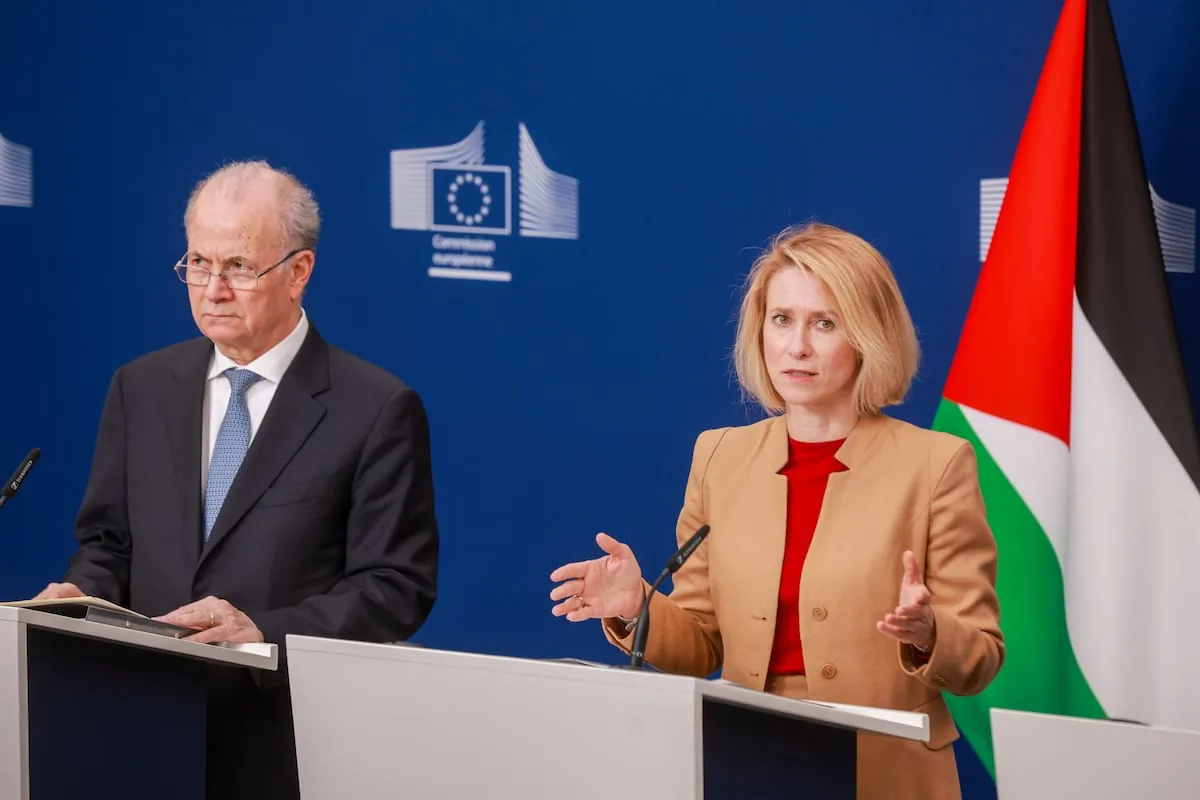
The escalation of tensions in the Middle East and widespread indignation in Europe over the approval of the death penalty against Palestinians in Israel, in addition to its offensive in southern Lebanon and the continued violence of extremist settlers in the West Bank, have deeply eroded the patience of the Twenty-Seven with Benjamin Netanyahu’s government. The question is whether this weariness is enough to finally take a step towards suspending the EU-Israel Association Agreement, as Spain, Ireland, and Slovenia have once again requested ahead of the EU foreign ministers’ meeting this Tuesday in Luxembourg.
Read more Elon Musk snubs French justice investigating the manipulation of X’s algorithm
On the eve of the meeting where the debate will be raised, the EU High Representative for Foreign Policy, Kaja Kallas, advocated on Monday for starting to sound out the will of the Member States to “pressure” Israel. And she recalled that a more modest proposal, a partial suspension only of the commercial part of the Agreement, has been on the table since September, which, despite being limited, still weighs as a threat against the Netanyahu government, which has constantly criticized it.
“We already have some measures on the table that require a qualified majority. I believe it should be analyzed whether it is possible to move forward with them, if Member States want to do so to pressure Israel, and that is what we are going to discuss tomorrow,” Kallas said in statements to the press alongside Palestinian Prime Minister Mohamed Mustafa, who is participating in several meetings in Brussels on Monday about the situation of Palestinians.
While a total suspension of the agreement requires unanimity, something that is still very far from happening because there are countries like Germany, Hungary, or the Czech Republic that are not willing to support such a measure, a partial suspension needs a qualified majority, meaning at least 55% of the Member States (15 out of 27) vote in favor and they represent at least 65% of the total EU population. So far, not even this margin has been achieved, because it requires one of the Union’s big players, Germany, Italy, or Poland, to make a move. While Berlin remains reluctant to take that step — although its chancellor, Friedrich Merz, has also significantly hardened his tone against Israel in recent weeks — the recent clashes between Giorgia Meloni’s Italian government and Netanyahu’s have led to speculation about a possible change of stance, although Rome has not yet commented on the matter and not even the countries in favor of taking the step are confident that it will change its position.
At the end of last week, the foreign ministers of Spain, Ireland, and Slovenia formally asked Kallas, in a letter, that the Association Agreement be discussed at Tuesday’s meeting and that the EU “assume its moral and political responsibility, and defend the fundamental values that have underpinned the European project since its foundation.” On Sunday, Spanish Prime Minister Pedro Sánchez went even further and announced that Spain would formally request in Luxembourg “to break the association agreement with Israel.” “A government that violates international law or EU principles cannot be its partner,” he declared during the opening of the pre-campaign for the Andalusian elections, at an event in Gibraleón, Huelva.
The Minister of Foreign Affairs, José Manuel Albares, who will defend the initiative this Tuesday, stated in an interview on RNE that “courage” is required from community partners to defend the values it promotes.
Read more Chess videos | Alekhine produces art blindfolded
“We have to step up, because otherwise, the EU will be denying itself and our voice will be weakened when we denounce those same flagrant violations of international law and human rights in other scenarios like Ukraine, where we do have unanimity,” he warned.
Restore tariffs
But Kallas is not the only one being cautious. European diplomatic sources, even from those countries favorable to some pressure measure on Israel, call for caution. “It will be important to hear from the ministers [in Luxembourg] if there is any change and if they support the measures on the table or if they are willing to go further,” says a diplomatic source on condition of anonymity.
The demand for a suspension of the Association Agreement with Israel has been long-standing. Spain and Ireland already requested it at the beginning of 2024. Last September, and after several countries joined the demands, the European Commission finally made a move and presented a plan to suspend certain aspects of the trade agreement between the EU and Israel — the Twenty-Seven are Israel’s main trading partner in the world — and restore tariffs on goods from that country, which until now enjoy preferential treatment in the community club. The proposal, however, has not advanced in the Council since then, in view of the reluctance of several states to even minimally censure the Israeli government. Nevertheless, criticism of the Netanyahu government’s actions in Palestinian territories and southern Lebanon, especially after the start of the war with Iran, has led to a harsher tone from the Old Continent.
Political pressure is joined by social pressure: also last week, it was learned that a European Citizens’ Initiative demanding that the “EU must immediately use all available legal, diplomatic and economic means, including the suspension of the EU-Israel Association Agreement, to force the Israeli government to cease its human rights violations, respect international law and alleviate the suffering of Palestinians,” has gathered in just three months the minimum of one million signatures needed for the Commission to accept and analyze the demand. More than 60 NGOs, including Amnesty International, and social platforms also demand that ministers support the suspension of the agreement this Tuesday and also back new measures, such as coordinated action to prohibit all transfers and transit of weapons and dual-use goods through European territory bound for Israel.
Read more An electric pistol shot every 57 hours