










The Labour Force Survey (EPA) prepared by the National Institute of Statistics (INE) indicates that the unemployment rate in Spain grew in the first quarter of the year to 10.83%, nine tenths more than in the previous record. Spain once again exceeds the psychological barrier of 10% unemployment, which it managed to abandon in the last quarter of last year for the first time in 17 years. This percentage connects with the evolution of employment, which lost 170,300 employees in the first quarter —almost double that in 2025—, and with a surge of 231,500 unemployed —the worst figure for this variable since 2013—.
Read more Morante and David de Miranda win the main awards of the April Fair
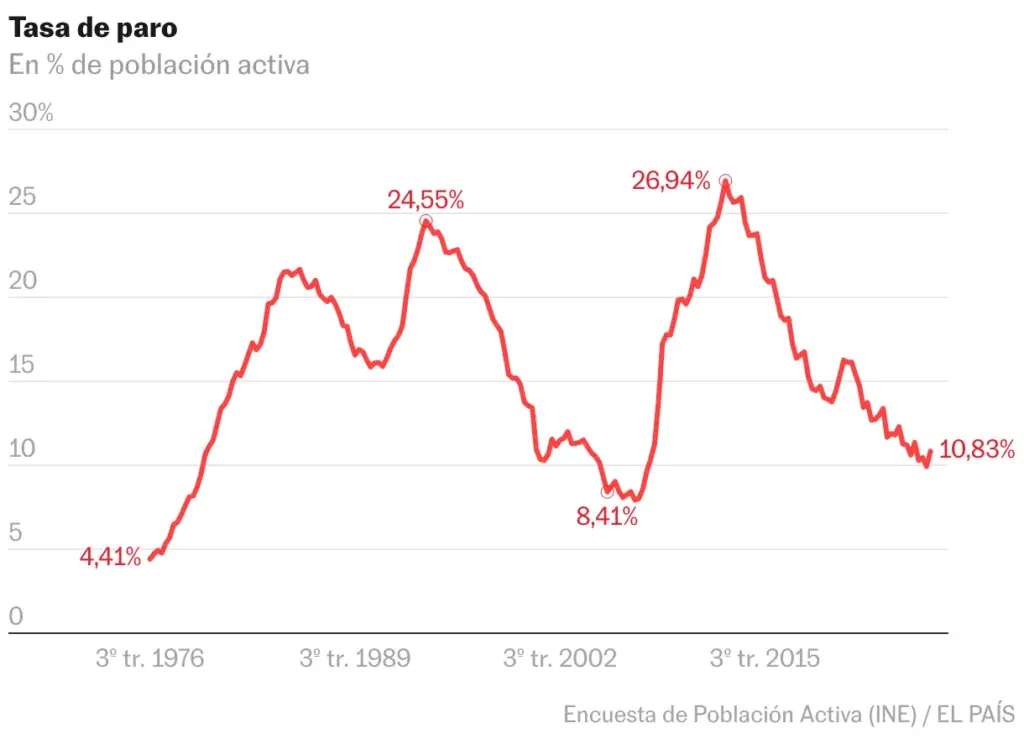
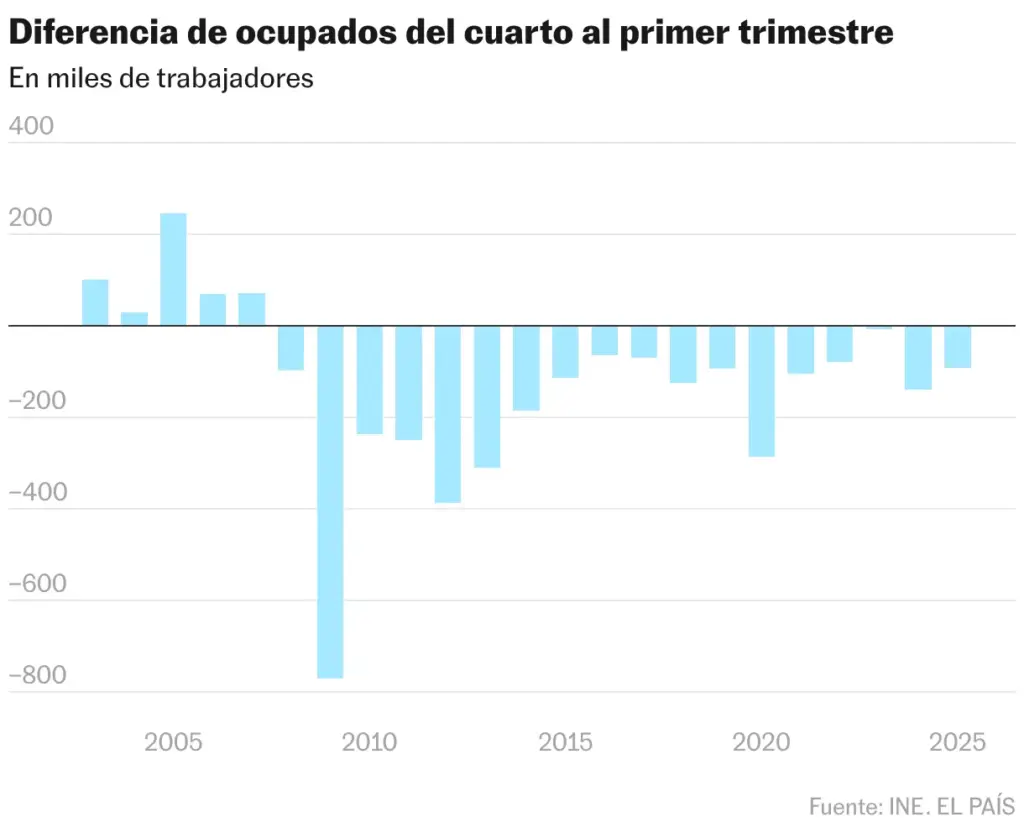
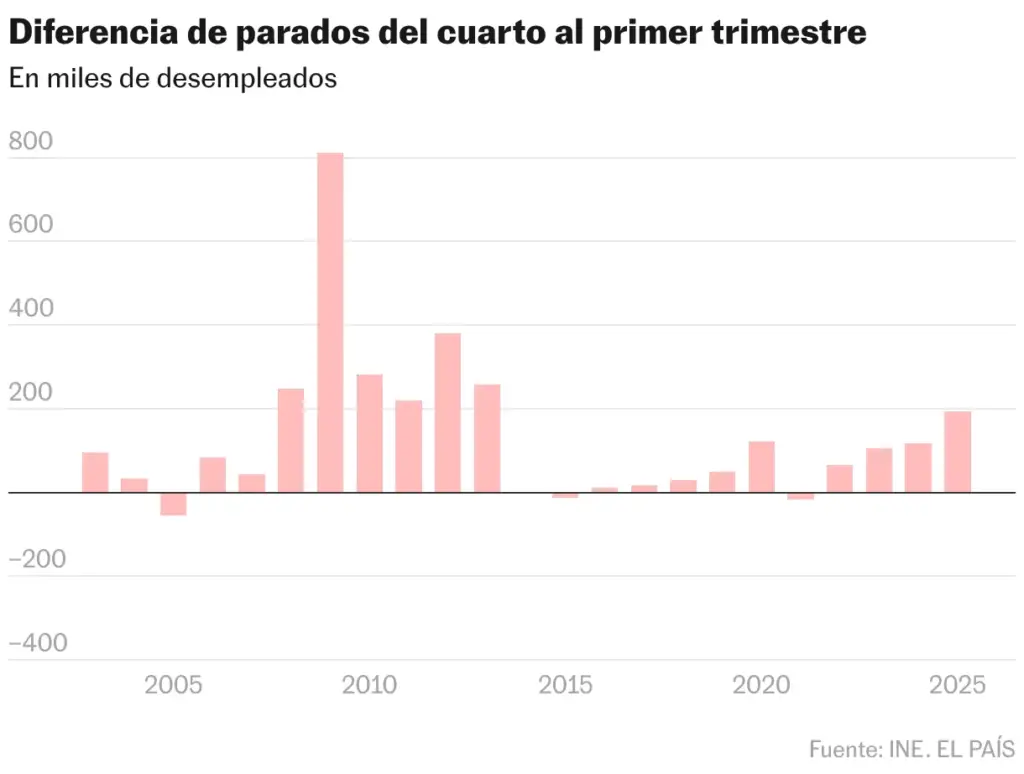
The first quarter is, on average, when employment falls the most and unemployment grows in Spain. This is due to the seasonal factor of the economy, whereby tourist campaigns greatly influence the data. The second quarter sees an increase with the arrival of good weather, the third concentrates the summer months, and the fourth holds up due to Christmas. Negative trends usually dominate in the first, although this year they are deepening with greater intensity than in previous years.
This is the first EPA to reflect the possible effects of the US and Israel’s attack on Iran and the price surge it has triggered. Social Security affiliation already provided an initial balance in March (the conflict began on February 28) which was positive, with strong job creation in the third month. The INE’s labor survey offers a worse diagnosis, but we will have to wait for future editions of both statistics to see what the underlying trends are.
Nevertheless, the unemployment rate reported by the INE is the lowest in the first three months of the year since 2008 (then it was 9.6%, at the beginning of the Great Recession) and the total number of workers (22.29 million) is at a maximum for this time of year, thanks to an annual job creation that remains around half a million. This performance made Spain the country that contributed the most new employment to the European Union last year, around 40% of the total.
Last year, employment contracted by 92,500 people in the first quarter, almost half of this year’s setback (-170,300). The figure is also worse than that of 2024 (-139,700), and one has to go back to 2020, at the beginning of the coronavirus crisis, to find a worse performance. Then Spain lost 285,600 employed people. Excluding that anomalous year, on average over the last decade, employment contracted by 0.43% in the first quarter, compared to the 0.76% drop in the current year.
The unemployment figure is even worse: the first quarter ends with 231,500 more unemployed, reaching 2.7 million, the worst balance for this time of year since 2013, still in the midst of the economic crisis after the bursting of the housing bubble. This is a slightly higher increase than last year (+193,700), a year that ended up being very good for the Spanish labor market. However, that year had a better tailwind, and the annual contraction in unemployed people was 188,700. This time, that annual balance is limited to a contraction of 80,600, again the worst figure since the pandemic.
The extraordinary regularization of foreigners promoted by the Government does not influence these INE figures. Firstly, due to timing, as the procedure was activated two weeks ago and this edition of the EPA covers up to March. At the same time, this labor statistic already captures irregular employment (unlike Social Security affiliation, an administrative record), so those foreigners employed informally (“en B”) who transition to formal employment (“en A”) will count as employed in the same way. Specialists have been emphasizing that it is possible that employment in the EPA will grow anyway because a portion of migrants who remained outside employment due to lack of papers will now take the opportunity to work through regular channels.
Nevertheless, and although the figure has improved significantly in recent years, the Spanish unemployment rate remains very negative compared to the rest of the European Union. The latest available Eurostat data (from January) places Finland in the worst position (10%), very close to Spain (which then registered 9.9%) and with Sweden (8.1%) further away. The best figures are those for Bulgaria (3.1%), Poland (3.2%), and the Czech Republic (3.3%), while the average for the Twenty-Seven is 5.9%.