









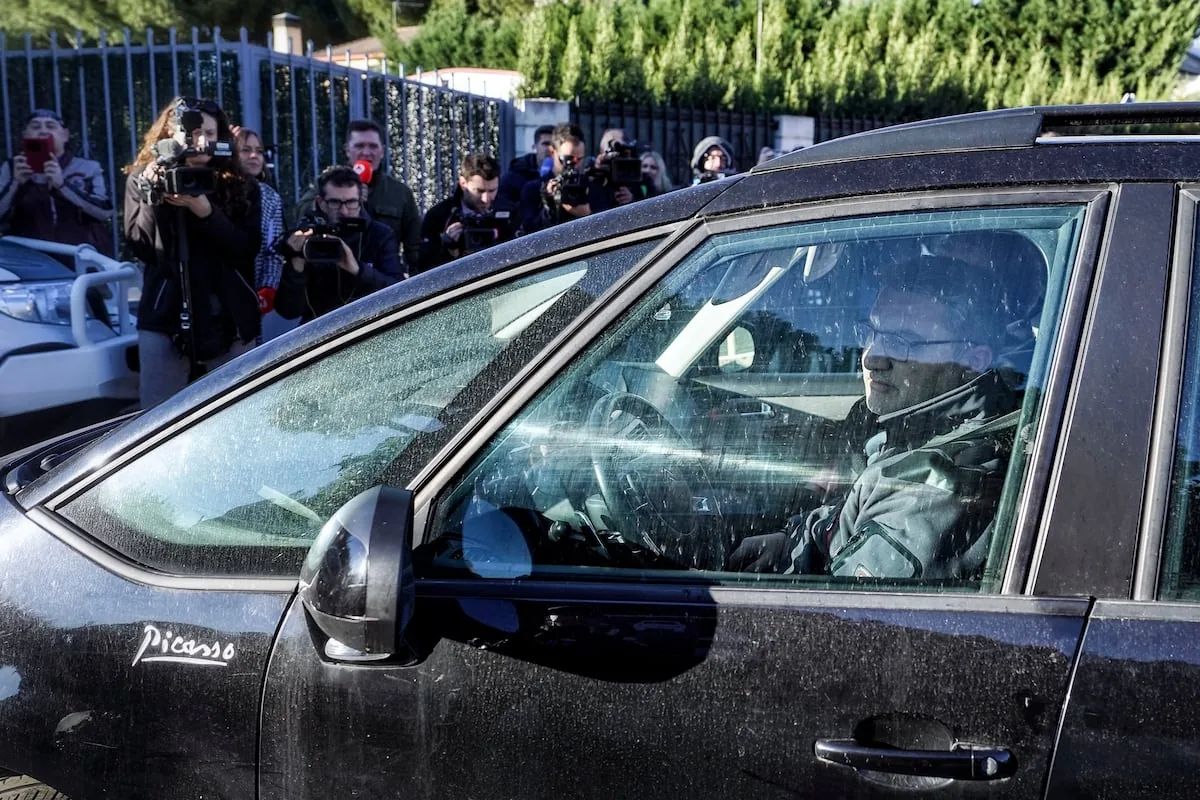
A crowd of civil guards and journalists is blocking access to Uno Street in the El Romeral housing development in Traspinedo (Valladolid, 1,300 inhabitants) this Thursday, as in 2022. More than four years have passed since the disappearance and death of Esther López, a 35-year-old resident of the town, and the investigation is restarting after a hidden hideout was discovered under a bunk bed in the former house of the accused of killing the woman. Óscar Sanz, 40, never revealed the existence of that compartment, nor did his family. This Thursday he returned to the property after the judge authorized the agents and the former owner, who had recently sold the chalet, to access it.
The police operation has kept the media away to try to replicate as closely as possible the conditions of that night, without so many mobile phones connected to the repeaters. Before the search, the client and his lawyer “argued and gestured.” The agents have 72 hours, which can be extended, for their tasks. Sources close to the case have assured that “today they are going to make him suffer.”
The inspectors will try to clarify the biggest doubt they had after the alleged crime: why the subject’s smartwatch showed “descents and ascents in a house without stairs.” Meanwhile, other specialists will look for blood or DNA traces in the hideout and more experts will focus on finding out when and how the trapdoor that gave access to the compartment was sealed, according to police sources.
Sanz arrived in Traspinedo with his lawyer minutes before nine in the morning and got out of his car at 10:05, wearing gray pants and a blue sweater, accompanied by agents from an elite unit of the Civil Guard, active from early on. The area is full of posters with the photo of the deceased and the words “Justice for Esther.” The goal is to analyze in his presence the room where, under tiles hidden beneath a bunk bed, there was a “trapdoor” leading to that compartment.
The Civil Guard report, accessed by EL PAÍS, reveals that the new owner who bought the house from Sanz “detected dampness in the house, started to chip a tile on the floor and, after removing the tile and the polyurethane foam, found a trapdoor leading to a basement that did not appear on the house plans.” The buyer alerted the authorities and they saw a space “about 2.5 meters high and about four meters by three wide and long” and “with a water level of about 30 centimeters alongside remains of rebar, two jerry cans, floating wood and what appears to be a water extraction pump; access to the compartment is via a rusty ladder in poor condition and missing some rungs.”
The space fits the investigators’ theories, who always believed that López was hidden in another place before being deposited in the ditch where she was found weeks after the early hours of January 12 to 13 when she disappeared. The corpse showed fungi incompatible with the terrain next to the road where she was found, sandstone also not present at that point, and had “washerwoman’s hands,” that is, wrinkles related to having been in contact with liquids before dying.
Another piece of evidence collected was the accused’s smartwatch, which revealed that that night he made “descents and ascents in a house without stairs.” Neither he nor his family revealed, either in the investigation or to friends before the event, that there was ever a cellar or basement there, as they now claim to defend themselves. Civil Guard sources explain that the main objective is to verify if the technological device reacts the same if they go down with Sanz to the hideout and records the same data as at quarter to four that January 13.
Read more Knowing religion to be able to know ourselves
In addition, they will begin to apply technologies to try to find traces of blood or DNA of the deceased in that confined space and will also seek to find out “when the compartment was sealed” to calculate if there is a connection with the possible events of 2022.
López’s family has reacted to the new phase of the investigation with a statement accepting that the Valladolid Provincial Court has returned the case, which was awaiting a date to try Sanz with the facts known until then, to the instruction phase to incorporate the findings and inquiries related to the hideout. The deceased’s relatives thank the police work that has led the Prosecutor’s Office to charge him with murder and demand 18 years in prison.
The statement recalls that, according to investigators, Sanz and López argued and he ran her over with his car at 40 kilometers per hour “with the intention to kill her.” It also clarifies that the blow was not fatal, as the autopsy showed, but that the suspect did not help her “letting her die.” It is in this interval where, according to the inspectors, Sanz could have left the dying victim in the hideout, where she would have died before being moved to the ditch the following night.
The family condemns the “obstructive, deceitful and lying attitude” of what was Esther López’s friend, because he never revealed the existence of that hidden space even though he was asked several times if there were rooms at different levels in the house. “The delay that this new finding could cause in the trial only increases a pain that this family has already paid for many times over,” they lament, and repeat that they have requested that the individual be placed in provisional detention, which the judges in the case have not considered so far. “At large he only hinders, lies and attacks an excellent investigation,” they conclude.
Relatives and investigators agree in not understanding why the suspect decided to sell the Traspinedo chalet in December knowing that the agents had not found the hideout that could incriminate the Sanz family. The theories point to a possible “excess of confidence,” with the accused believing himself superior to the investigators, or the mistaken “strategy” to try to dissociate himself from the house if one day, as has happened now, the trapdoor was found with other owners.
Read more Tribulete 7 rhymes with article 47