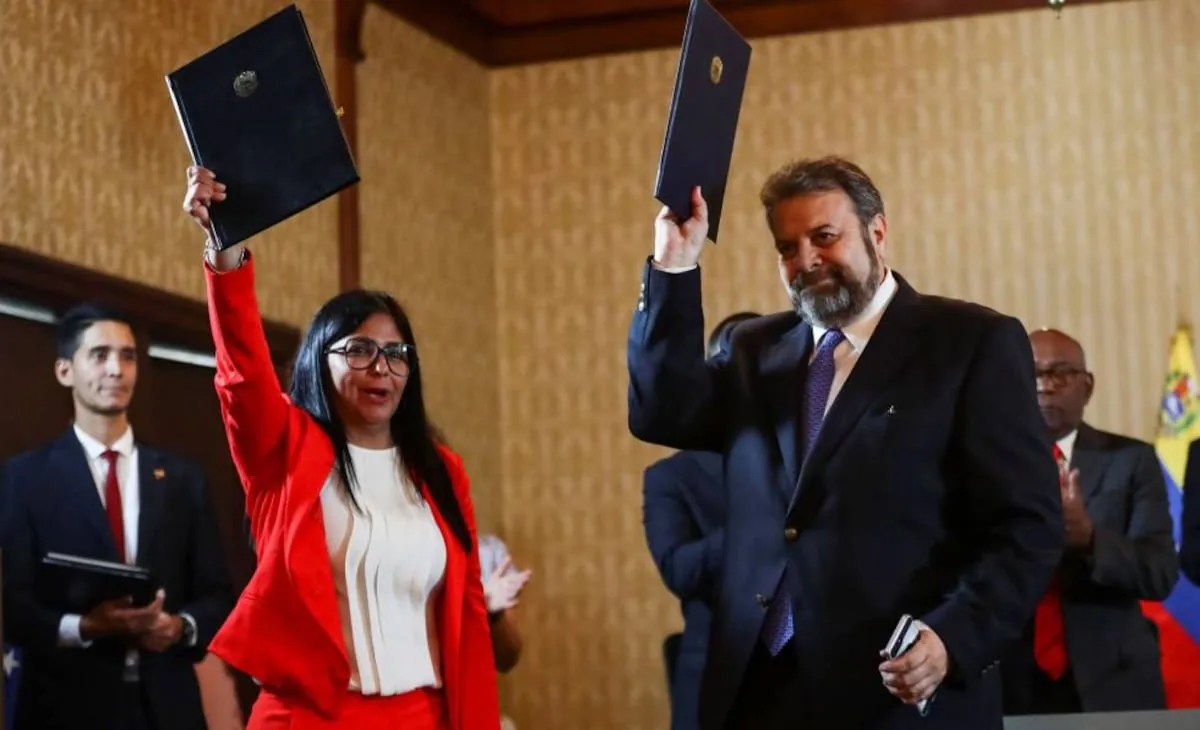






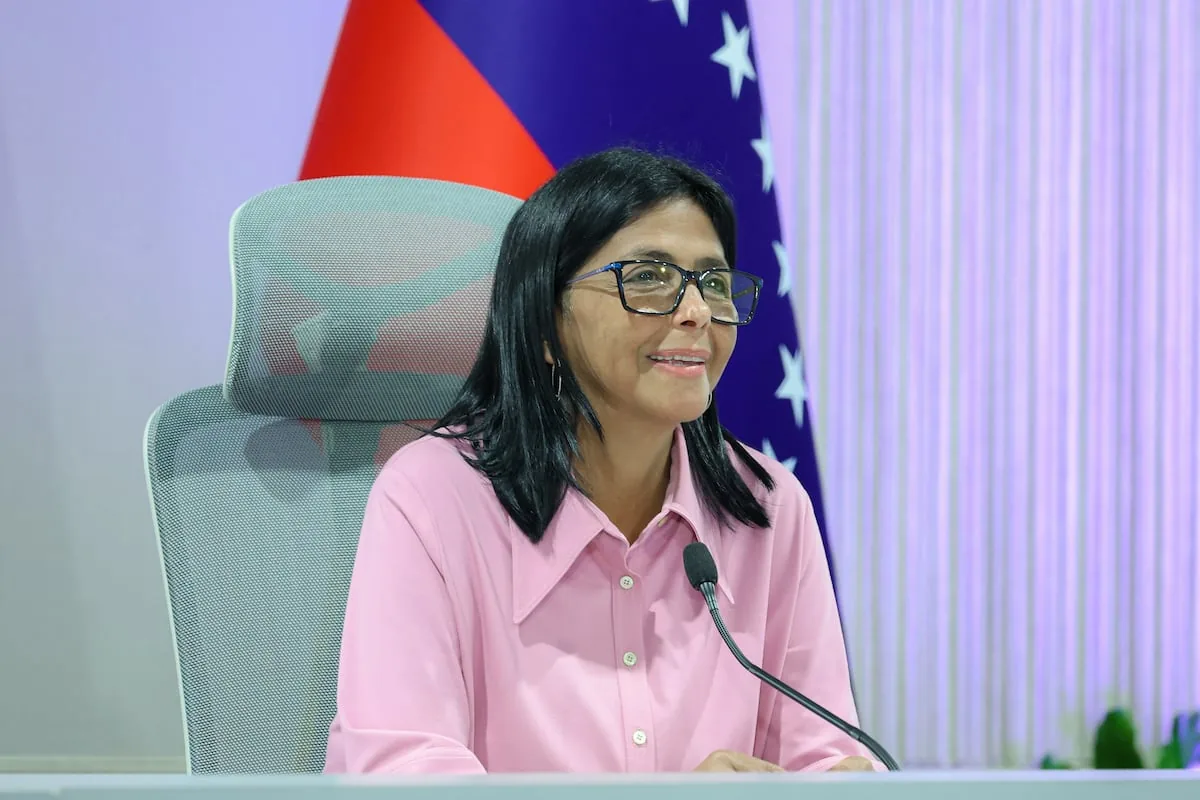
Venezuela’s acting president, Delcy Rodríguez, will travel to The Hague (Netherlands), where hearings are being held before the International Court of Justice (ICJ) regarding the dispute the country has with Guyana over the Esequibo border region. The president will personally take on the defense of Venezuela’s position before the court. Initially, Rodríguez announced her trip mysteriously, without saying where she would go in the “next few hours” to “defend” her country’s rights, until sources familiar with the mission confirmed the final destination.
Venezuela’s acting president is sanctioned by the EU and is banned from traveling to its territory, but Rodríguez has an exemption, the so-called waiver. This is an exceptional authorization to carry out an activity that would normally be prohibited by sanctions. This will be her first international trip — outside the Caribbean — since she took power following Nicolás Maduro’s capture by the US in January 2026.
“I have to travel in the next few hours to defend our homeland, and when I have had to do it, you don’t know the pride it gives me, the deep pride of defending Venezuela’s inalienable rights, defending them tirelessly, because it is honoring our history,” Rodríguez said this Saturday. Although Venezuela has rejected resolving the controversy under the jurisdiction of the International Court of Justice, it maintains its defense in that instance. In 2024, Rodríguez was last in The Hague when she delivered boxes of papers presenting Venezuela’s arguments to defend the territory as its own.
Venezuela maintains a historic dispute with Guyana to determine the border limit between the two countries. The conflict concerns the Esequibo region, a territory of about 160,000 square kilometers that represents nearly two-thirds of current Guyana territory. Venezuela claims this area, rich in oil and other natural resources, which has been under Guyanese administration for over a century.
A portion of the Esequibo was part of Venezuelan territory during the 19th century, but Guyana — then under British rule — progressively expanded its borders, attracted by the wealth of its gold and bauxite deposits, until it absorbed the entire region. Venezuela exhausted international avenues without any result: an arbitration held in 1899 ruled in favor of the British. Various Venezuelan historians have argued that decision was fraudulent, the result of cartographic manipulation perpetrated by an explorer.
Between May 4 and 11, the ICJ holds hearings to study the validity of that Arbitration Award of October 3, 1899, which set the boundaries between then British Guiana and Venezuela.
Read more La Oreja de Van Gogh reactivates its most intergenerational classics with Amaia Montero
The Esequibo issue became one of chavismo’s great banners, a dispute it has always threatened to take to the end. In 2023, Venezuela created an administrative entity over the disputed strip with a capital in Venezuelan territory. It did so after holding a referendum whose results and participation level were questioned. But the move almost triggered a regional conflict, in which Brazil and Caricom, the Caribbean Community, had to intervene.
After the creation of the state of Esequibo in 2023, Venezuela updated its official cartography incorporating that territory into its maps, despite the dispute continuing to be resolved before international courts. The measure raised alarms in Guyana and since then tensions between the two countries have only escalated. The tension has reached striking extremes: just a few weeks ago, Guyanese president Irfaan Ali expressed his displeasure over the brooch worn on the lapel by Venezuela’s acting president, a golden brooch with the silhouette of the country including the Esequibo as its own.
Today the battle is fought with different allies of Venezuela, which have changed since January 3. The position of the United States is now key, which exercises a kind of guardianship over Delcy Rodríguez’s government, and which will be tested in this new chapter. Historically, the United States has supported Guyana’s position and has even offered military support when tensions between the two countries escalated. Guyana was one of the countries that supported the US military deployment in the Caribbean, which preceded the capture of Nicolás Maduro and Cilia Flores.
Last Friday, Venezuelan Foreign Minister Yván Gil, who is part of the delegation that traveled to The Hague, considered that the dispute will end with direct negotiation without third-party intervention, and rejected Guyana’s final arguments presented at the ICJ, calling them “denialist” and “repetitive.” The Foreign Minister insisted that the only way to resolve the dispute is the 1966 Geneva Agreement, a legal instrument to reach a mutually acceptable solution, reports EFE.
Read more Real salvages a point against Betis after coming back from 0-2 at Anoeta