






Public opinion is sometimes a perfect human meat grinder: lacking awareness at times, and without a hint of empathy at others. The direct consequence of artistic professions (with public relevance) is becoming someone close to thousands of strangers and involuntarily lending oneself to others’ viewpoints being expressed as judgments to be spread on social networks at the speed of light. Both constructive criticism (positive or negative) and public lynching contribute to the architecture of reputation.
This happened this week with the start of La Oreja de Van Gogh’s tour. The two opening concerts of the reunion tour — called Tantas cosas que contar— by the original lineup of the San Sebastián group (except for guitarist Pablo Benegas, who dropped out), led by Amaia Montero, took place on May 9 and 10 at the Bizkaia Arena Bilbao before 30,000 people. Both shows have revived questions about how public opinion and the press react when a human error occurs in live music performances.
The group itself implicitly acknowledged some kind of vocal mismatch on the first day, as the repertoire was modified for the second, removing four songs (some were replaced by others), curiously quite demanding vocally. Marta Pallarés (46 years old, Barcelona), music journalist and member of Women in the Music Industry, shares her experience by phone: “Adjusting the repertoire is exactly what a professional team has to do to protect the artist just as they protect the audience’s experience. It’s the same as when a footballer returns to the field after an injury. It’s common, they also do it on big tours.”
With male performers, there is generally some leniency regarding how their lifestyle, aging, or loss of vocal faculties affect them. Therefore, their off-key moments or severe vocal cord deterioration (especially in genres like rock, singer-songwriter, folk, or urban music subgenres) are coded as artistically identity-signifying signs that give personality to the songs and the stories told in them. Something that writer Vivian Gornick perfectly describes in her essay Towards a Definition of Female Sensibility: “Male sensibility is the one that has captured and described our life. Male experience has functioned as the metaphor for human existence […] It seems to permeate even the air we breathe.”
Pablo Parser (46 years old, Madrid), composer for advertising and fiction, goes into detail: “Pop is the genre of neatness unlike rock or urban, where charisma or phrasing, as in the case of Bad Bunny [who was criticized for the supposed vocal detuning he carried out at several moments during his Tiny Desk performance in April 2025], allow tonal licenses. Men like Joaquín Sabina or Iggy Pop are allowed to tell the song instead of singing it. A media female singer is required to be a time machine. We want her voice to sound exactly like the album she released 25 years ago. The female artist, especially in pop, is not allowed to age, be nervous, or have a bad night.”

Pallarés, who in 2023 was invited by the Women and Equality committee of the British Parliament to analyze part of the report Misogyny in Music, does not hesitate to indicate that more than talking about the type of performance, what is really being discussed is validation: “What we are seeing with Amaia Montero is not a conversation about tuning, but about permissions. There is a collective cost in all this that is not calculated and it is a signal to all other female artists. It is a way of saying: if you stumble here, there are many people willing to destroy you. As long as this keeps happening, institutional statements about well-being and mental health in the industry will remain meaningless.”
Read more TVE and ‘La hora de la 1’ go off air for 20 minutes: “A power outage of an unknown nature”
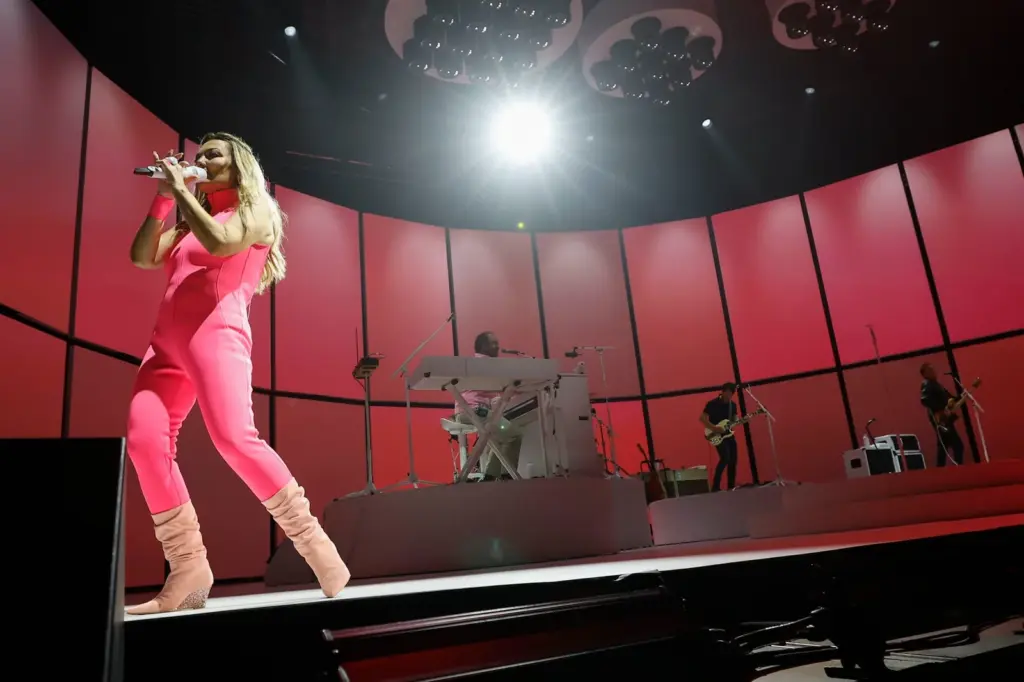
After almost two decades without performing together, the San Sebastián group, which offers 35 concerts for this tour, opted for a large white and minimalist stage with a futuristic look. At the rear, arranged in a semicircle and each on a podium, were Xabi San Martín (keyboard and backing vocals), Haritz Garde (drums), Álvaro Fuentes (bass), and Imanol Goikoetxea (guitar), substitute for Pablo Benegas. At the forefront, and also on her own platform, Amaia Montero. In semiotic terms, this stage design gives much of the spotlight to the Basque performer but also leaves her alone, more exposed to the audience and less connected with her bandmates. Perhaps a somewhat risky decision considering that the original band had not shared a live stage for nearly two decades and Montero had seven years without performing solo on stage.
As explained by professor and vocal rehabilitator Cristina López (50 years old, Madrid), “we are not only facing a unique tuning problem, but a combination of vocal readaptation after years without continuous stage presence, evident psychological pressure from the return, very exposed repertoire selection in the first stretch, and progressive adjustment of the show. That is why it is difficult to attribute a specific result to a single cause,” she assures.
If to the stage arrangement and the artistic or sociocultural context possible technical sound problems are added — for example, that the signal from the in-ear monitors (the earphone listening system that artists wear and that replace stage monitors) does not arrive with quality and precision — the perfect storm occurs, as happened during the performance of Prince’s song popularized by Sinéad O’Connor, Nothing Compares 2 U. A detail that for composer Pablo Parser could explain the tonal mismatch during the song: “In the videos where Amaia Montero is seen singing this song, the instrumentation seems softer or more dispersed. It must be taken into account that it is not the same to run through the repertoire in a rehearsal room as to play it live.”
Something López corroborates: “From a speech therapy perspective, listening to the videos of the Bilbao concerts, what is perceived is not a global tuning problem, but some passages of instability in specific songs, especially in very exposed tracks and maintaining the original keys in a context of great acoustic and vocal demand. Changing keys or adjusting the repertoire in a concert is quite smart. The voice does not respond the same every day, it is not a static instrument.”
The next La Oreja de Van Gogh concert is on May 28 at Movistar Arena in Madrid. For better or worse, the debate will continue…
Read more Ayuso’s trip to Mexico confuses the PP: “With so much ‘show,’ she devalues herself”