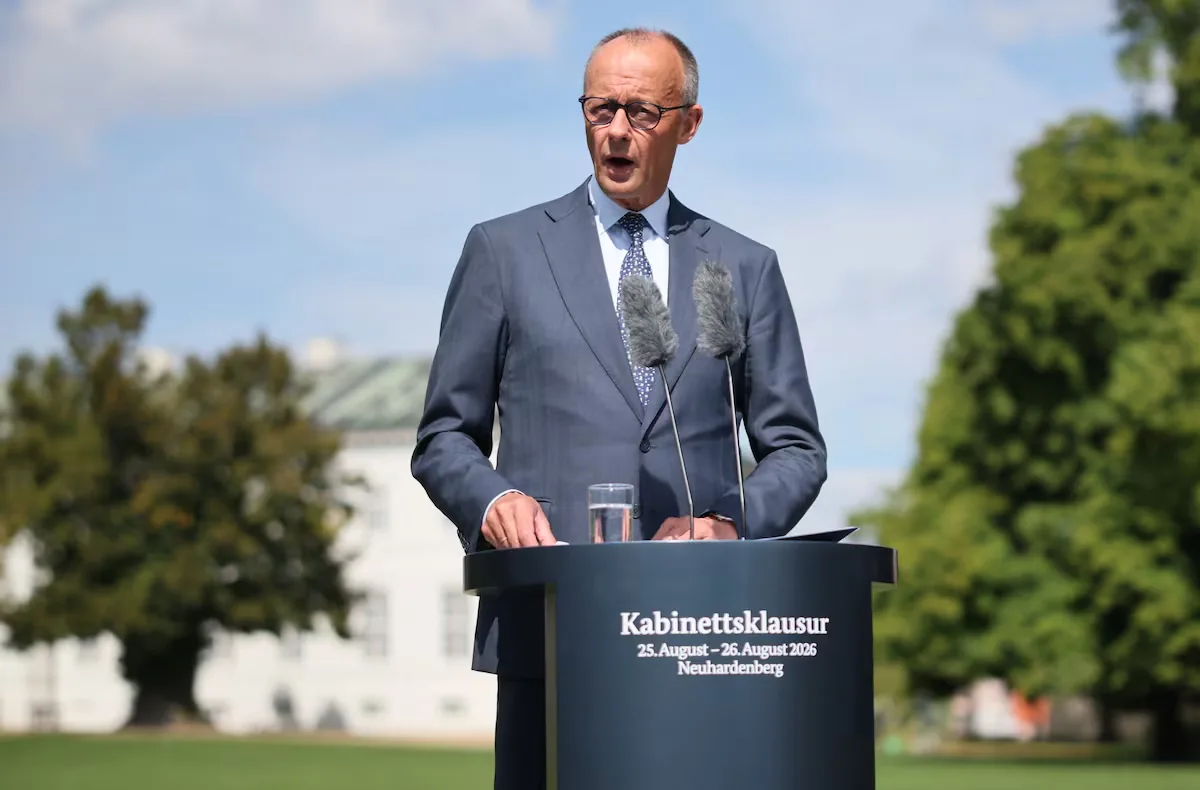









Just weeks after saying that the United States was being humiliated in the war with Iran, which sparked Donald Trump’s anger and led him to announce the withdrawal of soldiers from Germany, German Chancellor Friedrich Merz once again opened up to a group of young people, admitting that his admiration for the United States is not growing and that at this moment he would not advise his children to spend time in that country.
“I am a great admirer of the United States, but my admiration is not increasing at this time,” he said on Friday in a debate with young people during the Catholic Day in the Bavarian city of Würzburg, provoking laughter from the audience. In his opinion, the social climate there has changed rapidly.
“Nowadays I would not recommend my children to go to the US, to study there and to work there, simply because suddenly a certain social climate has developed there,” said the conservative leader, 70 years old and father of three children. “And, by the way, the question of what well-educated young people can achieve was answered in the United States, until very recently, in a very different way than it is answered today. Currently, the best educated in the United States have great difficulties finding work.”
Merz also stated that he wanted to try to take away people’s fear about the future and the state of the world and urged Germans to feel more optimistic about the potential of their own country, since, as he said, there are few countries in the world like Germany that “offer such magnificent opportunities, especially for young people.” “We are living through such a profound turning point that maybe only in a few years will we really understand what we are experiencing,” he said. He also reminded that peace and freedom in Europe are not something to be taken for granted.
NATO Partners
Paradoxically, shortly after his statements to the young people, he posted on the social network X that he had spoken by phone with the US president, Donald Trump. “I had a good phone conversation with Donald Trump during his return trip from China. We agreed: Iran must now sit at the negotiating table. The Strait of Hormuz must remain open. Tehran must not have nuclear weapons,” he wrote. “We also talked about a peaceful solution for Ukraine and coordinated our positions ahead of the NATO summit in Ankara. The United States and Germany are strong partners within a strong NATO.”
The German chancellor’s relations with the US leader are not at their best. At the end of April, he provoked Trump’s anger by stating in a talk with students at a German high school that Iranian leaders were humiliating “an entire nation” referring to the US. He also pointed out that it is “obvious” they have no strategy in the war with Iran and reminded that it is easy to enter a conflict, but complicated to get out of it.
This caused Trump to lash out at him saying he “doesn’t know what he’s talking about” and shortly after announcing the withdrawal of at least 5,000 US soldiers from German soil. The threat of US troop withdrawal was not new, but it has further strained relations between the two countries at a time when the European Union is also engaged in a trade war with Trump.
Former German Chancellor Angela Merkel – who had to deal with Trump in his first term in the White House – advocates a calm attitude. “You have to look for common ground and, at the same time, act without fear,” she recommended this week in an interview with the German publication Focus.
She describes her own strategy as follows: “Not wanting to be especially liked – in any case, I never had illusions about that when things were going well – nor wanting to be especially provocative: that’s how I have handled it.” At the same time, Merkel, who governed Germany from 2005 to 2021, warns about the power of the great heads of state worldwide: “Those who have reached those positions simply have incredible power. And that is why it must be taken very, very seriously.”