







I observe writers who only show progress of their books on social media —if it has already appeared in such magazine, if it is in the top 100 (or in the 10,000) most read of the week— like those mothers (or fathers) who cannot talk about any other topic than the supposed high abilities of their children.
Read more ‘Separation’, lovelessness as a journey
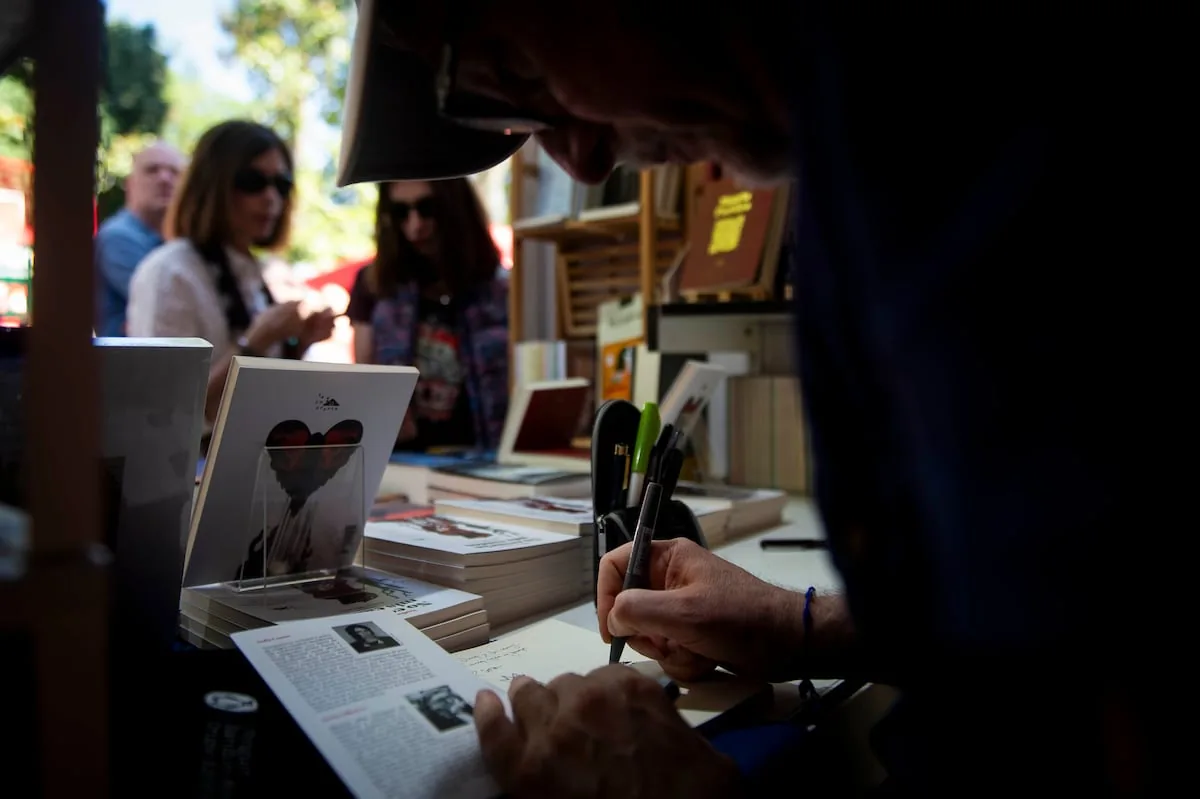
Then I imagine what might happen when two of those writers meet outside the Internet; for example, at the Madrid Book Fair and, sitting next to each other during the signings, they cannot manage to sign more than six copies during the first hour, while they look, salivating, at the endless line that another from the guild has.
“How many copies could he have signed already? Fifty? A hundred?” they wonder, unable to conceive higher numbers. On several occasions, someone stops in front of their booth to ask one of them, mistaking him for a bookseller or a book vendor, if he has the latest novel by… “I can’t remember the name right now, but yes, you know, that book everyone is talking about.”
The writer mistaken for a bookseller ignores these situations, but the other, who takes life less seriously, doesn’t mind shortening his day by pointing to the first book of an almost empty pile right in front of his nose. “That one, that one!” says the passerby, “I’ll take it.” Then the real bookseller appears, card reader in hand, and once he charges, he clarifies to the buyer that those two do not work at the fair: they are writers. The passerby, as if he had committed a crime, apologizes; he even leafs through one of their books, opening the flap where the biography and a black and white photo are found. Then he looks at the author, then the photo, and then the author again, searching for the resemblance or perhaps the seven differences, like in puzzle books. The writer smiles kindly, thinking he has before him a reader about to ask for a signature before also taking his book, but in the end he leaves it in the same place and says goodbye with a “Take care.” It also happens that sometimes they don’t leave the book where it was and it is the author himself who has to put it back.
The writer smiles kindly, thinking he has before him a reader about to ask for a signature, but in the end leaves the book in its place
The bookseller, who has been enduring egos and vanities for a long time, could gloat aloud about how well such author and such author did yesterday, but instead he starts encouraging them by telling them how much he liked their respective books and that he keeps recommending them in his bookstore; but soon readers arrive asking what time so-and-so signs, and he leaves them to their things.
That’s how they spend Saturday morning. Bored, they start talking among themselves like those other mothers (or fathers) who take their children to the doctor and entertain themselves chatting in the waiting room.
—What does yours have?
—Five hundred pages.
—Well, but So-and-so wrote a novel of 600 and look at how many people have come to see him.
—Yeah, yeah. And what’s wrong with yours?
—We don’t know. It seems he can’t make friends and gets stuck in public. An expert told us he might be between genres.
—Wow. We were already warned it wasn’t magical realism.
—I don’t understand. He seemed so smart when he was at the printer’s.
—Don’t worry. Look, do you remember that one by So-and-so who was great? Well, it has been ten years without even a second edition.
At that moment, another bookseller, who has been listening for a while, tells them an anecdote from her early years at the El Retiro booths: on one occasion, a trendy author came to the fair to present his latest bestseller. After having signed more than 500 copies that day —or rather, fed up seeing the new line that was coming— he claimed to feel unwell and offered his chair, his hat, and his sunglasses to the writer who had preceded him, one of those who complained about the glory of others and who was about to go home after two hours without having scribbled a single mark. Besides writing, they had two things in common: the beard and the wit.
The writer disguised as that author signed the copies one by one —with affection— while listening to some readers of the famous one express what they liked most about the previous book, the emotions it awakened, their admiration; to others, who also wrote, who had a self-published poetry book, asking if he wouldn’t mind giving them his email to send it in PDF. The impostor nodded to everything, inventing answers on the spot, resting his hand without a pen on his own book, looking for the moment to slip it into the conversation and be able, if not to sign it, at least to sell it. However, on no occasion was he even able to mention the title.
When he signed the last copy of that novel that had such a long line, exhausted, the writer stayed a while looking at his own, silently read some pages and finally left it among the piles of new releases, caressing the cover, like someone buttoning up their jacket in front of the mirror a second before going out.
Rosario Villajos is a writer. Her latest book is ‘Cutting Hair’ (Seix Barral, 2026).