





Despite the overall decrease in violence since the announcement of the October ceasefire, Palestinians in Gaza continue to be killed, injured, and forcibly displaced by the Israeli Army. According to the Palestinian Ministry of Health, about 1,200 Palestinians have lost their lives and more than 3,800 have been injured since October 11. In June alone, 121 people lost their lives, making it the deadliest month of the year to date. The word “ceasefire” has lost all its meaning.
MSF staff in Gaza are not spared from the violence either. The organization’s workers have been shot at in their tents, witnessed family members being killed, fled their homes in panic, or seen them destroyed by airstrikes. In March, an MSF nurse witnessed her four-year-old cousin lose his life in an airstrike. In June, an MSF colleague was trapped with his wife and daughter in a vehicle targeted by Israeli forces’ gunfire. An MSF nurse had to evacuate and flee his shelter with his disabled brother, losing all his belongings. A widow whose husband, an MSF driver, was killed now lives near the yellow line, the demarcation marking the Gaza area under Israeli control, covering almost 60% of the Strip’s territory. On one occasion, she woke up to bullets hitting her mattress and every morning wakes up to the sound of projectiles.
These are not isolated incidents. They are part of a pattern where humanitarian workers and civilians are never truly safe in Gaza.
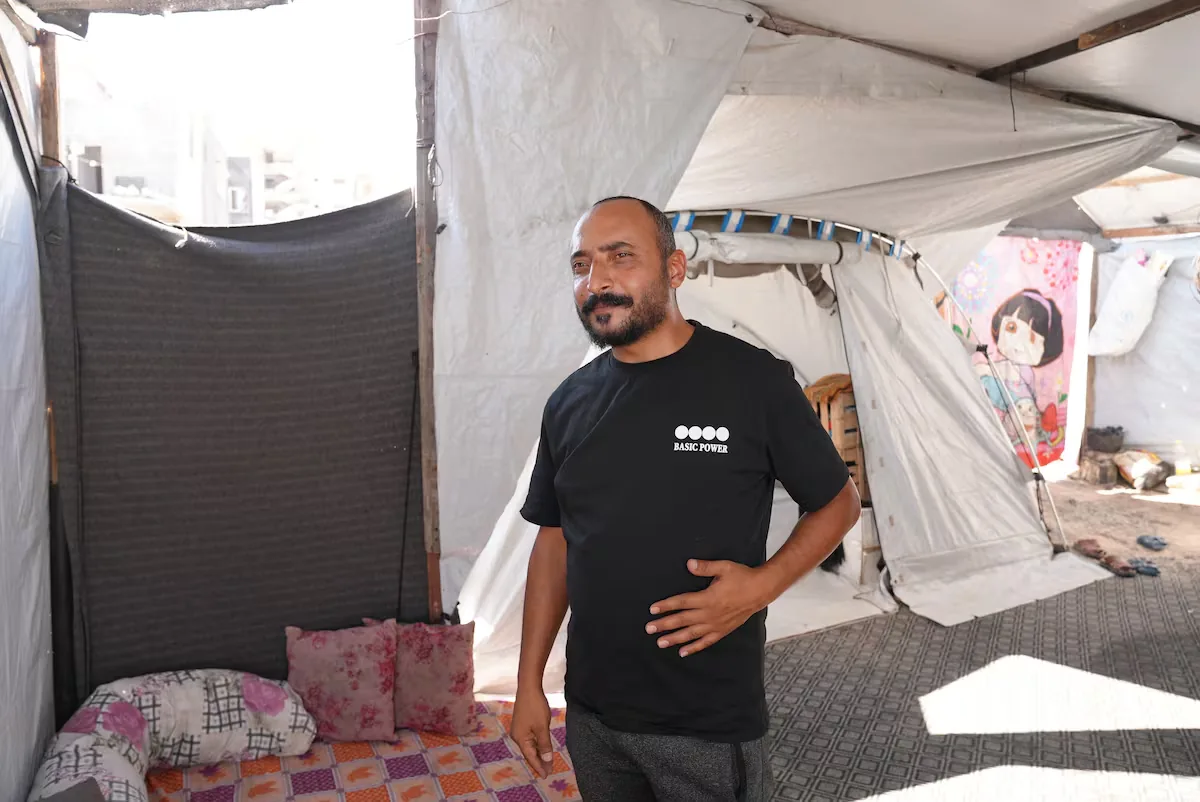
Ashraf Afifi, an MSF radio operator, recounts in this text how he was seriously injured by an Israeli quadcopter last month:
I was sitting in my tent, like any normal Friday, if such a thing as a normal day exists during this war. My son Adam was outside playing with a kite. Suddenly, he said to me: “Dad, bullets are falling next to us.” I didn’t believe him. I went out, but saw nothing unusual. I thought it was his imagination.
I didn’t pay much attention. I went back to my tent. Suddenly, I heard a dull noise, like someone hitting a wooden table with a hammer. I came out of the bathroom and saw my wife with a scared face.
I was looking inside the tent to see where the bullet had hit when suddenly I felt as if someone had hit me on the side with a wooden stick, and I heard the same noise again: like someone hitting a wooden table with a hammer. I immediately knew I had been hit. My wife was right beside me. She screamed loudly. I looked down; my side was covered in blood.
“A bullet hit… right there, in the tent,” she shouted. “Something hit and the tent shook.”
Since the start of the Israeli attacks, I had never ignored a danger signal. If I sensed a threat, even a kilometer away, I would move my children away from it, no matter the cost. But this time I was careless. For the first time, I was careless.
I went out to check if it really was a bullet. That’s when they hit me.
“If something happens and I feel like I’m about to lose consciousness, don’t let me faint. That’s the most important thing,” I told my brother as we drove with my hand over the wound. I called my friend, our colleague Bilal Abu Saada. “I’ve been shot, I’m on my way to Nasser Hospital.”
In my mind, I imagined it was simple: I saw two holes, side by side, which meant the bullet had entered on one side and exited on the other, easy, nothing to fear. But the pain was intense. Very intense.
All my courage vanished when I realized the bullet had entered through my back and exited the other side. I immediately understood it was serious; I started thinking about my kidney, my spleen, and other organs
My brother looked at me and said: “You have blood on your back. Turn around.” I lifted my shirt. “It’s at the back,” he said. “The bullet entered through your back.”
All my courage vanished when I realized the bullet had entered through my back and exited the other side. I immediately understood it was serious; I started thinking about my kidney, my spleen, and other organs. I began to feel numbness in my hands and face. After a while, I had difficulty breathing and everything started to darken around me. My brother was patting my face and telling me: “Don’t fall asleep.”
It was the longest journey of my life, like an endless road. Although I had traveled it dozens of times, that time it seemed endless, full of stops, traffic jams, and obstacles.
After a long journey with many obstacles, we arrived at the hospital’s main north entrance.
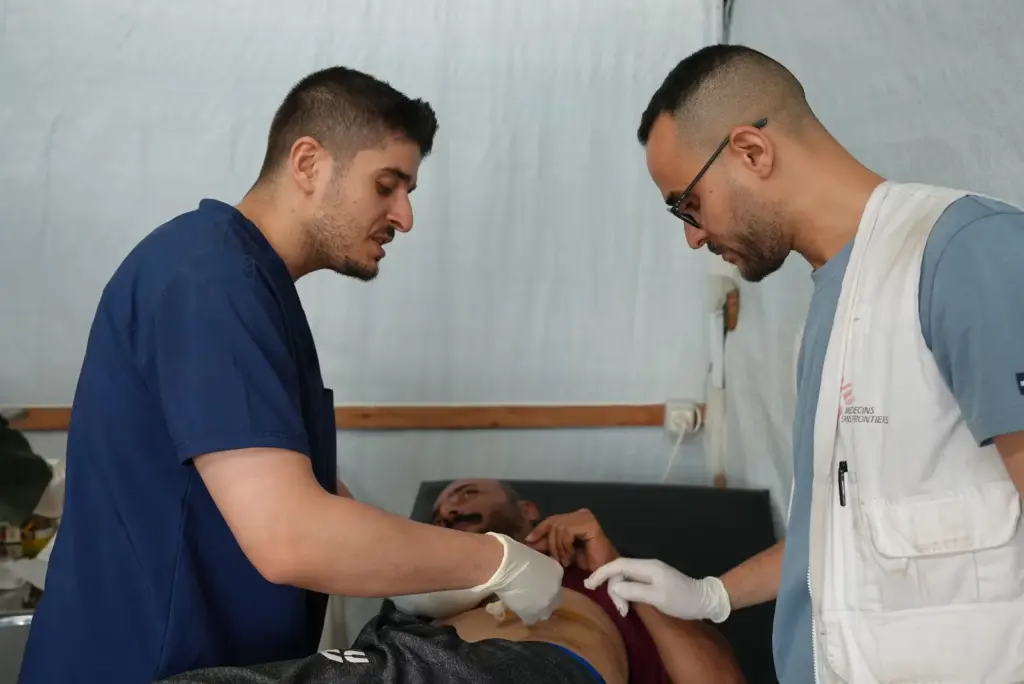
There was someone in front of the emergency door who told me: “Get out.” I tried to get out, but I couldn’t; the pain was horrible. “I can’t get out, I’m injured,” I told him. “There are no stretchers,” he replied. “Come on, try, I’ll hold you.” I wanted to shout: “What do you want, man? I can’t get out!” I tried. Suddenly, someone brought an emergency stretcher. I lay on it and they took me inside.
I remembered the scene seen in movies: the hero lying on his back, being carried on a stretcher down a hallway, looking at the ceiling lights. First, they took me to the X-ray room. Then they moved me to another place for an ultrasound. I had never had one before, but I remembered when my wife was pregnant with our first daughter and the doctor used the same machine to see if the baby was a boy or a girl. I joked: “Boy or girl?” The staff member said: “You’re injured and making jokes?” I replied: “You don’t know me, I joke at the worst moments.”
They did a CT scan. As soon as it finished, Bilal, who was right beside me, said: “Enough pampering, get up.” Hearing that filled me with joy. At that very moment, I understood there was no serious danger.
That same night, we returned to our tent. I sat about two meters from where I had been hit. I had imagined I would panic returning to the place where I had almost lost my life. When the doctor told me: “You don’t need to stay in the hospital.” At first, I responded: “Thank God, I don’t want to stay here.” But, to be honest, I was afraid to return to my tent.
However, three hours later, there I was, sitting in the same spot as if nothing had happened. No, I wouldn’t wish on anyone what I went through.
Read more The Prosecutor’s Office closes the last two cases regarding cancer screenings in Andalusia