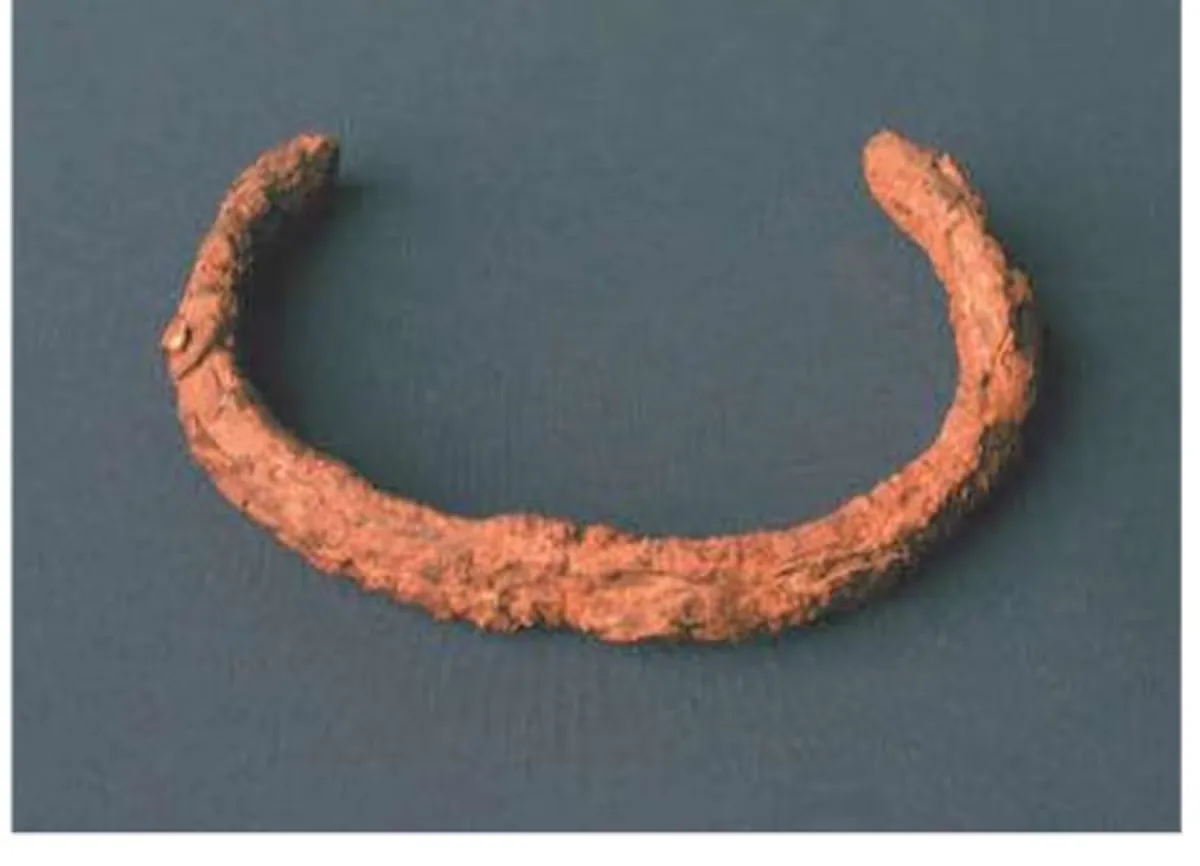
One of the two most important elements of the Villena Treasure —an iron bracelet made from the mineral of a meteorite— was saved from the robbery committed yesterday at the Villena archaeological museum, according to EL PAÍS. This piece, as well as a small hollow iron hemisphere covered with a gold sheet, are considered by experts to be the most important elements of this Bronze Age treasure (2200 to 750 BC). “They are the first objects found on the Iberian Peninsula made with iron from outside planet Earth,” according to the report Meteoric iron in the Villena Treasure? by Salvador Rovira-Llorens, Martina Renzi, and Ignacio Montero-Ruiz, researchers respectively from the National Archaeological Museum, the Diriyah Gate Development Authority (Saudi Arabia), and the Institute of History of the CSIC.
The bracelet was abandoned by the thieves, possibly because it is made of a metal of little value, something that was not the case with the hemisphere as it was covered with gold. It was discarded by the thieves along with three silver cups and another gold bracelet. The set consisted at the time of the robbery of 59 gold objects (including 27 bracelets and 11 bowls), as well as silver elements and the two mentioned iron pieces.
The bracelet is an open ring, with rounded and somewhat flattened ends. Its discoverer in 1963, archaeologist José María Soler, described it as “a dark leaden metal, shiny in some areas, and covered with a ferrous-looking oxide and cracked in most parts.”
Only its analysis, carried out in 2024, could determine that these were not pieces made with terrestrial iron — produced by the reduction of minerals existing in the mantle of planet Earth — “but extraterrestrial and made during the Late Bronze Age.”
“Meteoric iron,” the researchers state in their study, is found in certain types of aerolites that, coming from outer space, are composed of an iron-nickel alloy with a variable nickel composition above 5% by weight. They also contain other minor chemical elements and traces, cobalt being one of the most important. In contrast, terrestrial iron generally has low or very low nickel rates and is often not analytically detectable,” the study explains.
Read more Marlaska avoids self-criticism and accuses PP and Vox of “inciting hatred” in Ceuta
Researcher Ignacio Montero Ruiz, from the Institute of History of the CSIC and one of the experts who signed the report, told EL PAÍS in 2024: “These two iron pieces had enormous value. That is why they were considered in the Bronze Age worthy of becoming part of this spectacular set with numerous and delicate gold objects. Iron and gold together, but a very special iron. Who made them and where this material was obtained are still questions to be resolved.”
The exceptional value of the two iron pieces comes from the fact that at the time of their manufacture the inhabitants of the Iberian Peninsula did not know iron treatment. They only knew of it from what came from northern Europe and the East.
Iron was introduced to the peninsula by the Phoenicians who landed in what is now the Castillejos de Alcorrín (Málaga). They came into contact with the natives and created the first iron metallurgy of the Iberian Peninsula. Later, the Iberians improved the technique and forged the fearsome falcatas that caused terror among Roman troops.
It is assumed that the Villena Treasure could have been an accumulation of valuable objects by the natives to exchange them for others from the newly arrived Phoenicians. Now, with the robbery, and pending police investigations, it seems more difficult to find out.