








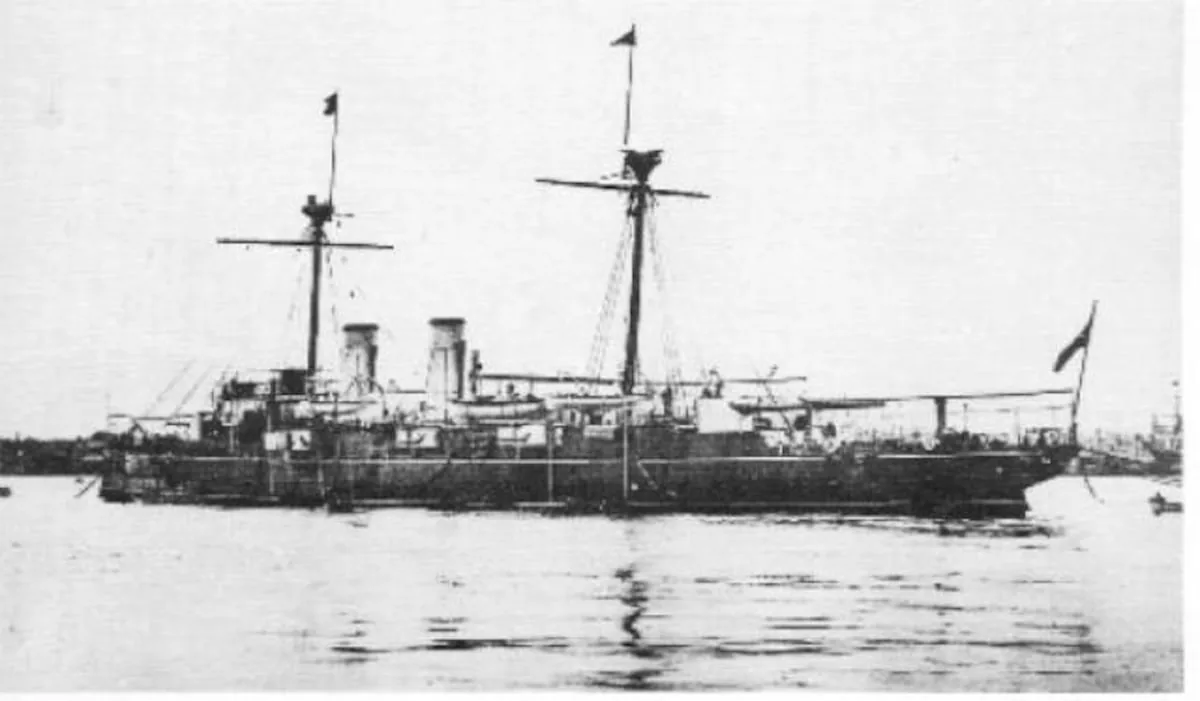
The Reina Regente was a cruiser of the Spanish Navy that entered service in 1888, but on March 10, 1895, it sank at some point in the Atlantic between Tangier and Cádiz. Its entire crew (412 sailors) perished and its remains were never found. The investigations opened at the time to locate it yielded hardly any results and the location of this great ship, modern and with great technical innovations, remains a mystery. But now, the study Disappearance of the Reina Regente: causes of its sinking and proposal for its location, signed by experts from the universities of Cádiz and Buenos Aires and the Spanish Navy, proposes, thanks to the use of a physical-mathematical model and the recovery of documentation from the time, its location not many miles from Tarifa, in Cádiz.
Read more And he tells it as if it were nothing
The experts —Óscar Santiago Ortega Pérez, Manuel Bethencourt Núñez, Nicolás C. Ciarlo and Tomás Fernández Montblanc— recall that the ship received the order to carry out a simple mission. It had to transport some Moroccan representatives from Cádiz to Tangier. As soon as it dropped them ashore, it had to head to the peninsula to be present at the launching ceremonies of the battleship Carlos V. The Reina Regente fulfilled the first part of the mission: it docked in the African city on March 9 and the next day began the return. But just on that day, a great storm broke out with winds of 56 to 63 knots and waves between 6 and 9 meters high.
After the tragedy, an investigation was opened, but it did not resolve the main questions. Nor could the subsequent numerous explorations, investigations, and actions undertaken afterwards. Therefore, the most important questions remain unanswered: Was the storm the main cause of the shipwreck? Did the ship have design and construction defects? Why did it go to sea despite adverse weather conditions? Was it in good condition to face the storm? And, perhaps the most fundamental, where do the remains of the Reina Regente and its crew rest?
The authors of the new investigation believe there was not a single cause for the sinking and mention various technical and even political reasons. Among the latter, they highlight “the continuous social and economic crises that Spain suffered throughout the 19th century and that prevented the development of a systematic program for the necessary regeneration and maintenance of the Navy (…). This situation led to seeking punctual and compromise solutions, mainly in the foreign naval industry, far from any coherent program and with future prospects.”
Initially, the Reina Regente was supposed to be similar to the Australia-class cruisers of the Royal British Navy, but it was finally decided that its displacement, length, beam, and draft would be smaller. In addition, an important modification of the initial design was made: the four main 203-millimeter guns were replaced by 240-millimeter ones. This change meant an increase in the high weights on the ship, which negatively affected its stability conditions.
The ship also presented “significant watertightness deficiencies in several compartments, as well as in the flooding and pumping systems. It also suffered electrical deficiencies in lighting and in the power supply of auxiliary systems. Furthermore, the living and hygiene conditions of most of the crew were far from acceptable minimum standards.” “Although these deficiencies could go practically unnoticed under optimal navigation conditions, in an emergency at sea, however, they drastically limited the crew’s capacity to react,” the report reads.
The specialists have also reconstructed the weather conditions on the day of the sinking thanks to a document about this storm found in the Historical Archive of the Royal Navy Observatory, the navigation logs of the ships sailing in the Strait of Gibraltar at that time, as well as the testimonies of their captains and other witnesses.
During the investigation, it was confirmed that the storm faced by the Reina Regente was very similar to the one that hit the Andalusian coasts in early March 2018, the storm Emma. “The meteorological and oceanographic conditions during the storm served as forcing for a Lagrangian dispersion model that has allowed narrowing down the search area,” they write.
The experts have also recovered the statements of direct witnesses of the ship’s first maneuvers after leaving the port of Tangier heading northwest towards Cádiz. “It is noteworthy that all stated, from these first moments, that the ship was rolling heavily and suffering sea blows that swept its deck, making its bow disappear under the waters at every moment.”
Read more Trump pollutes, the left revives
The captain of the English steamer Mayfield, who around 12:30 was about 12 miles from Cape Spartel (Tangier), declared that he sighted the Reina Regente with “strong rolling, but without noticing any damage.” This is the last news that was had of it.
The sea blows described by the British must have increased “the amounts of water taken on board, mainly through the forecastle and facilitated by the ship’s low freeboard. This would cause progressive flooding in the forward compartments, which could hardly be controlled by the crew due to the ship’s watertightness deficiencies and the pumping systems,” the Spanish-Argentine experts maintain.
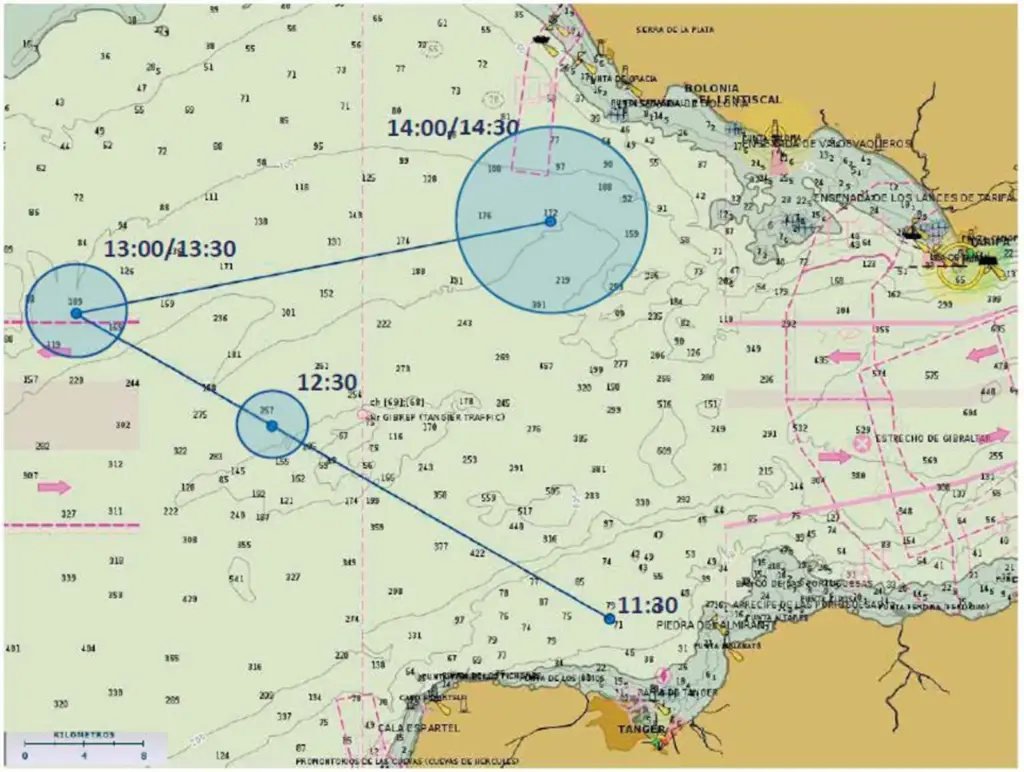
Thus, mathematical models show that the ship heeled about 30 degrees due to the wind. “Seeing his ship in danger, at some point after the Mayfield lost sight of it, the commander would have abandoned his course towards Cádiz and turned stern to the sea to weather the storm and seek shelter, possibly in the bay of Algeciras or lee of Punta Europa [Gibraltar].”
But when the Reina Regente was near Punta Camarinal (Tarifa), “a wave of the appropriate length [huge] probably struck the main frame and ended its already diminished stability conditions, causing it to capsize and sink practically instantly,” the experts say.
In April 1895, Frigate Captain Miguel Aguirre was ordered to investigate the testimony of two peasants who claimed to have seen the Reina Regente disappear near Bolonia beach (Cádiz). In his report, this senior officer gave credibility to these testimonies, located the sighting points, and even calculated, by triangulation, an ellipse within which the cruiser would theoretically be found. In the days and weeks following the ship’s disappearance, wreckage was found in different places along the Atlantic and Mediterranean coasts, in Spain and Africa.
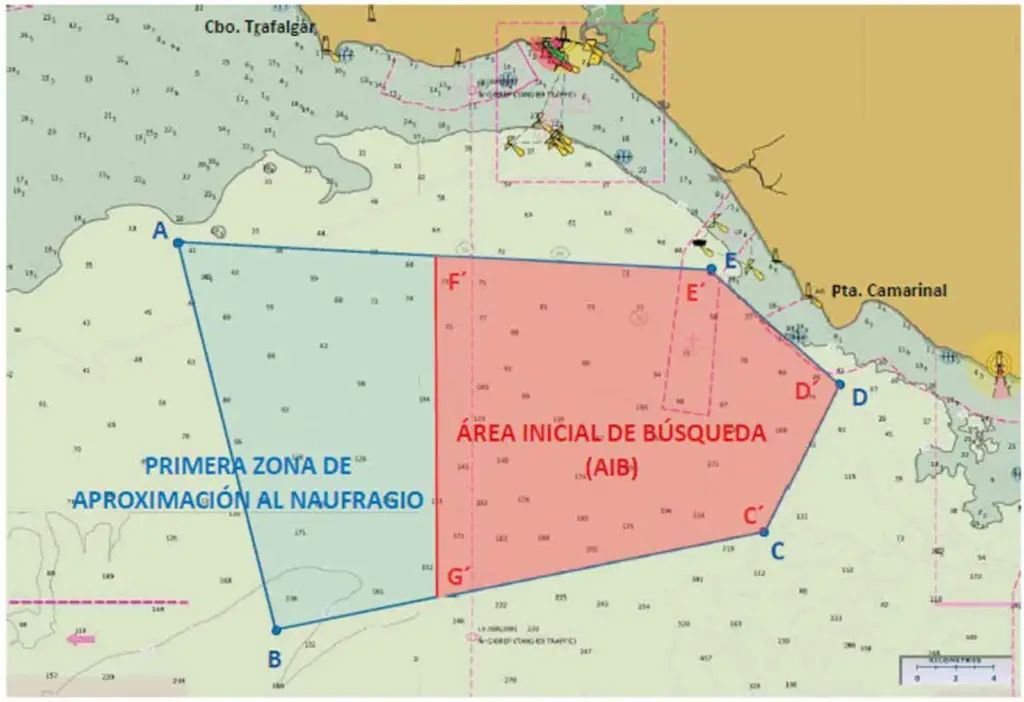
With this data, the experts have determined an Initial Search Area (ISA) in which they have established a grid with 460 points separated by one kilometer. “From each of these points, 100 combinations of virtual particles were released to simulate the wreckage. The trajectories of these particles have been obtained by implementing a physical-mathematical Lagrangian dispersion model and using the atmospheric and hydrodynamic data of the Emma storm.”
And they conclude: “The preliminary results obtained in the implementation of the model from the wreckage found at different points on the coast have allowed refining the hypothesis of the ISA [near Punta Caraminal, Tarifa] as the most probable location of the wreck.”
From this, they propose using “Navy resources and in synergy with other organizations and entities of the different State administrations with competencies in submerged cultural heritage to find and give rest to the 412 deceased sailors and pay them the honors and tribute they deserve.”
Read more Interview with Gustavo Petro, President of Colombia