








We have traveled the country with hundreds of approaches, from its millenary architecture to delving into the secrets of its pyramids. We have also done so in its best museums and at different times of the year. However, on this occasion, with EL PAÍS Viajes we propose to discover it beyond its classic postcards. You will start among the pharaonic treasures of Cairo and the colossi of Giza, but soon you will leave the big city behind to enter a little-traveled Egypt, made up of silent oases, mineral mountains, and deserts that seem not to belong to this world.
The journey combines archaeology, extreme landscapes, and local life. From the Fayum oasis and its forgotten temples to the Bahariya and Dakhla oases, each stage reveals a different chapter of a country that has coexisted with the desert for millennia. Haven’t you discovered the White Desert yet? There you will sleep under the stars. On this trip, you will also walk among chalk formations shaped by the wind and contemplate the Crystal Mountain at dawn. In short, you will live experiences that will transform the idea you had of Egypt until now. This trip culminates in Luxor, the great stage of Ancient Egypt, where temples, sacred avenues, and royal tombs take the traveler back to the time when the pharaohs ruled the Nile valley.
Egypt, The White Desert and the Crystal Mountain will last 12 days and will depart from Spain next November 18. Who will be guiding this impressive journey through the country? Iosu López, video journalist, documentarian, and visual narrator, whose knowledge of the country goes back 20 years, and who has an impeccable professional career: in 2014 he was nominated for the Goya Award for Best Documentary Short Film for The Red Carpet, a work selected in more than 120 international festivals. The short film portrays the life of Rubina Ali, the girl who rose to fame after Slumdog Millionaire, and reflects on the contrasts between celebrity and marginality, childhood and industry, dream and reality.
López has also worked for the EFE Agency in India, as a reporter on Backpackers TV, training new generations in audiovisual travel production and emerging narratives with video generation using artificial intelligence at the School of Travel Journalism; and, in addition, he directs Tsunami Digital, a communication and content strategy agency, and is the creator of Birratour, one of the largest gatherings of Spanish-speaking travel creators. His philosophy is summed up in one idea: traveling as a way to expand life, because — as he recalls quoting Martín Caparrós — “traveling is the best way to cheat time.”
Since his first and classic trip to Egypt, he has not stopped getting to know the country on different occasions, always interested in the lesser-known parts; that is how he discovered the White Desert, which, for those who do not know it, is located in the Farafra depression, about 45 kilometers north of the city of Qasr Al Farafra. The White Desert National Park has been considered a protected area since 2002.
“I was curious about this desert because of a photo I saw; it seemed like a remote place that was complicated to get to. From that moment I kept thinking about it and started researching it. I saw that there was a series of deserts and oases in southern Egypt that were totally unknown, not places where the more massive tourist routes go, let’s say. In the White Desert, there is some kind of excursion from Cairo, but they are fleeting trips. From there, I started designing a route that starts from Cairo and ends in Luxor, crossing several deserts and oases, and reaching the Nile, the greenest part of the trip,” explains Iosu López to EL PAÍS Viajes. And that is how the itinerary began to take shape, which is available to all travelers who want to enjoy it.
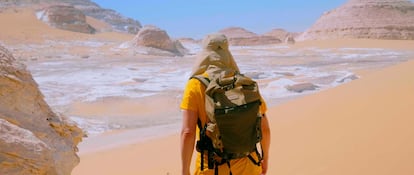
The White Desert of Egypt: an off-route journey into silence
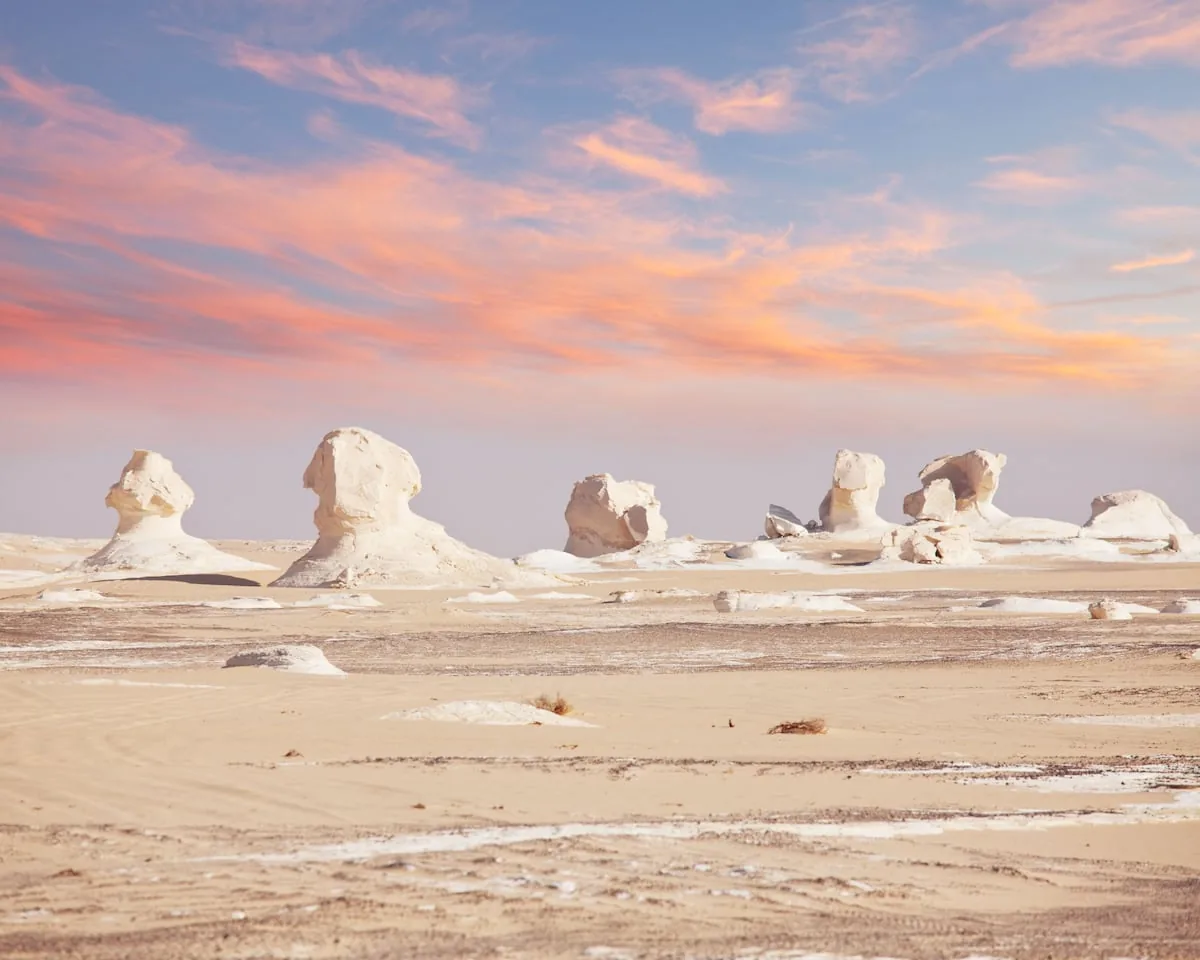
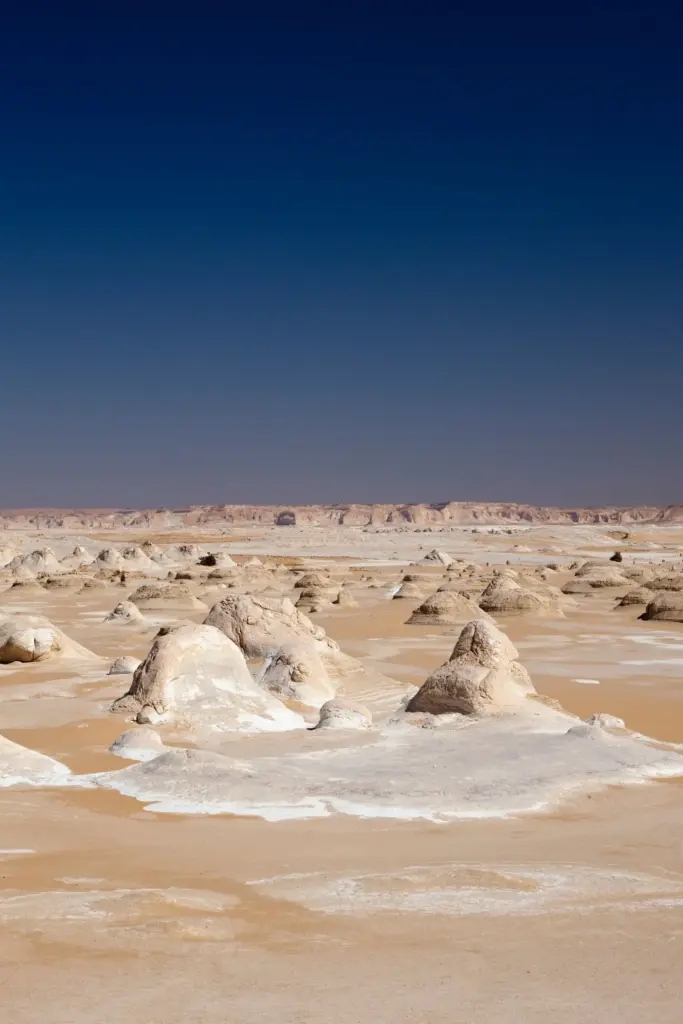
Egypt has two large deserts, the western one, which is located west of the Nile and reaches the border with Libya; and the eastern desert that extends from the east of the Nile to the Red Sea and the Gulf of Suez. It also has more desert areas in the east of the country. The White Desert and the Black Desert, the destination of this trip, are located in the western desert. The White Desert is special because it reveals to us — in an area of about 300 kilometers — a white landscape due to the white chalk rocks, created by wind and sand erosion, cliffs, dunes, and a starry sky like few in the world, thanks to the low light pollution.
“These are deserts you don’t expect to find in Egypt, with amazing contrasts, because, besides the desert and its dunes, we will see small valleys, areas where suddenly there are geological or mineral formations like the crystal mountain, which are totally unreal even within a desert, waterfalls, etc. But, without a doubt, the experience of camping under a starry sky in a place without light pollution is unforgettable,” emphasizes López.
This will happen on the seventh day of the trip, when the group of EL PAÍS travelers enters the beauty of the desert to first visit the New Highlighted Areas of the White Desert, famous for their chalk rock formations even more pristine and dramatic than the traditional areas; the Magic Spring and the Old White Desert, where the iconic “mushroom” and “animal” formations sculpted by the wind are found. Here they will spend the night by a campfire, an experience that will undoubtedly leave no one indifferent. “The experience of watching the sunset and sunrise from the top of a dune is fascinating. Also, the desert gives you the opportunity to disconnect from the world, a world overloaded with information and entertainment. Therefore, it is an opportunity for reconnection and silence,” explains the journalist.
The EL PAÍS Viajes itinerary: from Cairo to Luxor
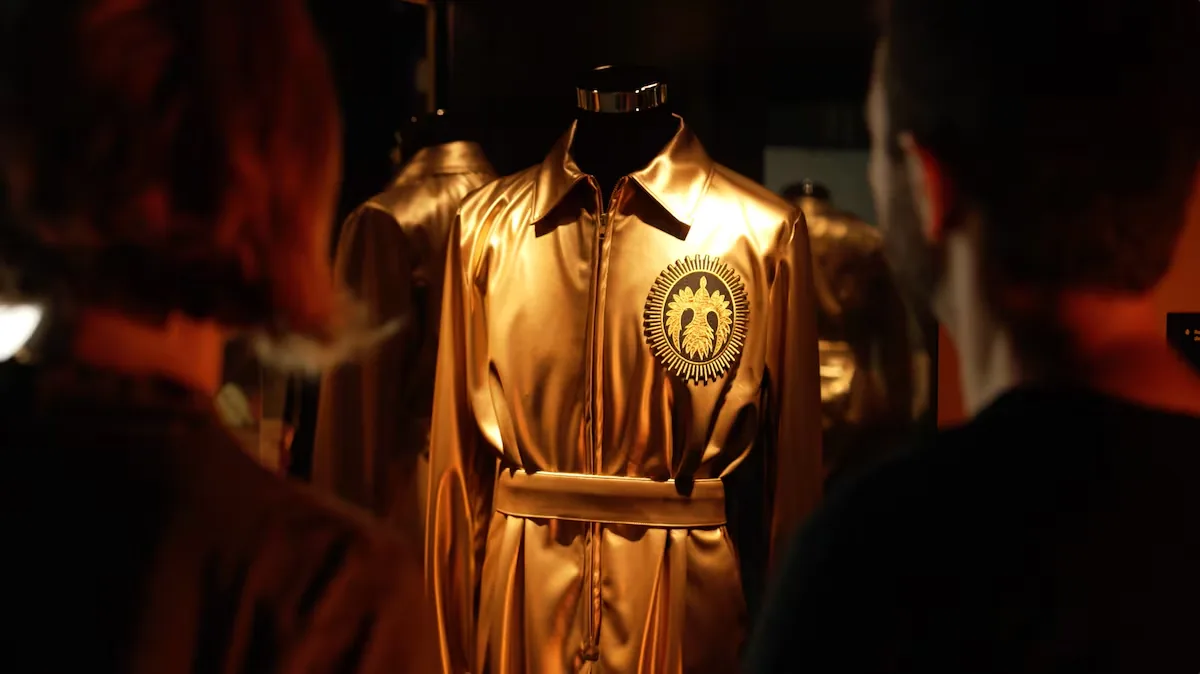
The trip begins in Cairo, where several stops will be made. First to the Grand Egyptian Museum (The GEM), a cultural milestone that promises to further enrich our understanding of Egyptian history and culture, and to the Citadel of Saladin, a medieval Islamic-era fortress in Cairo built by Salah ad-Din (Saladin) and developed by later Egyptian rulers. It was the seat of government in Egypt and the residence of its rulers for almost 700 years, from the 13th to the 19th century. Here is the Alabaster Mosque, a mosque located at the highest part of the city’s citadel.
From the city, a visit — always essential — will be made to the Giza necropolis with the famous pyramids of Khufu, Khafre, and Menkaure, the Great Sphinx, and the valley temple of Pharaoh Khafre. Also, on this third day of the trip, the pyramid complex of Saqqara is added, where the stepped pyramid of Pharaoh Djoser is located, and the Mastaba of Kagemni, one of the only mastabas that have scenes of daily life in pharaonic Egypt. Finally, the pyramid of Teti and the ancient city of Memphis.
From this point in the trip, the prelude to what will be the expedition through the White Desert begins. Where? In the Fayum oasis, located 100 kilometers southwest of Cairo. It is one of the largest and oldest oases in the country, whose main characteristic is its fertility, as it contains Lake Qarun, as well as, curiously, archaeological sites.
On the fifth day of the trip, they will reach Wadi Al-Hittan, an impressive UNESCO World Heritage site, famous for its fossils of prehistoric whales. Then, the sand dunes of the region will be explored before arriving at Wadi El Rayan, where an optional swim in its waters can be enjoyed. The Magic Lakes, known for their changing color and the beauty of the surrounding desert landscape, will also be visited. And finally, the journey will head to the Wahat Bahariya oasis (Bahariya oasis).
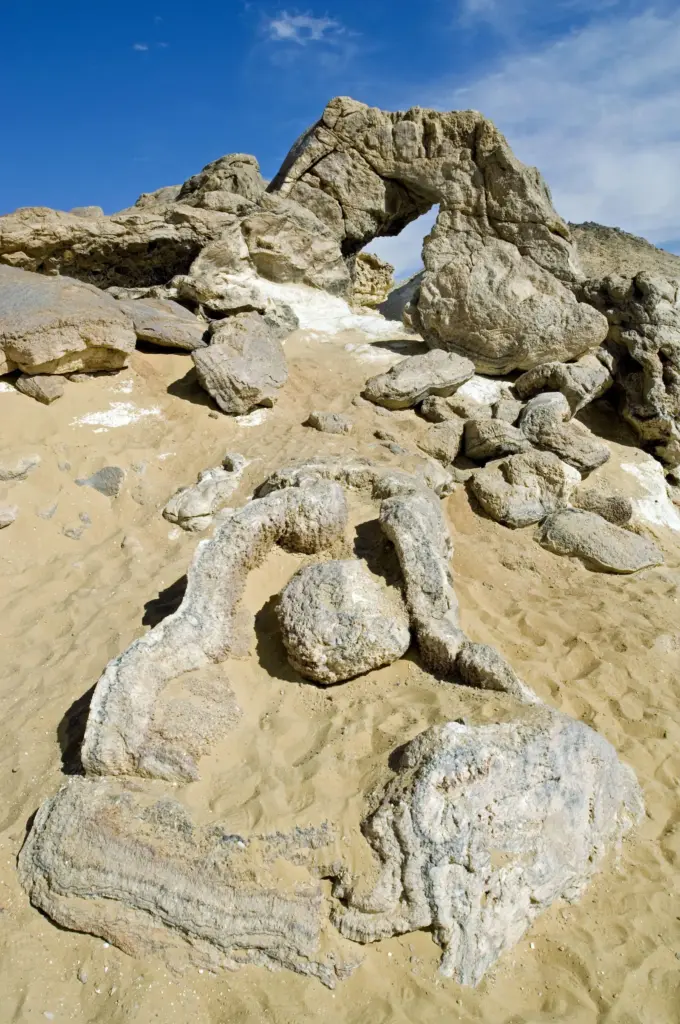
Before reaching the mentioned visit to the White Desert, the adventure makes a stop at the Crystal Mountain, a natural arch composed of bright quartzite crystals, then heads to Aqabat, known for its white rock formations that resemble mushrooms and animals, and finally to the Black Mountain, known for its summit covered with dark volcanic rocks.
After the night in the White Desert, the trip heads to the Dakhla oasis, one of the seven oases of Egypt in the western or Libyan desert, and to the spectacular Farafra oasis. Nearby is the Badr Museum, known for its fascinating clay sculptures inspired by local life and Bedouin culture, and the local market of Farafra.
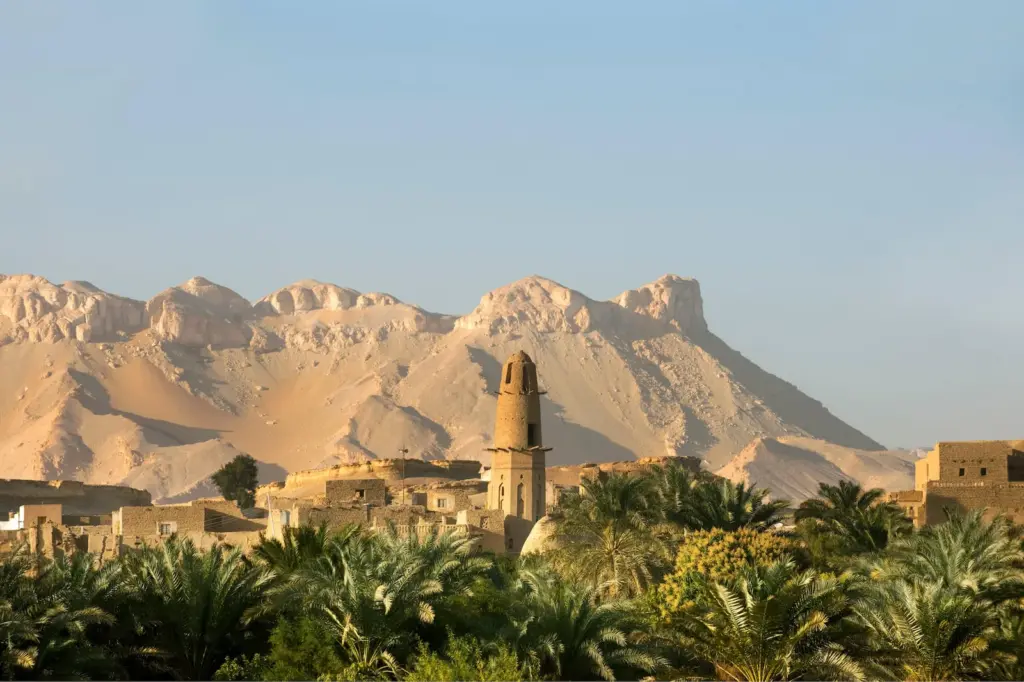
The route continues to the Dajla oasis, which shares space with the temple of Deir al-Hagar, a well-preserved Roman temple dedicated to the Theban Triad (Amun, Mut, and Khonsu), the tombs of Al-Muzzawaka, famous for their colorful frescoes and murals dating from the Roman era, the Qsar, an ancient medieval settlement with Islamic architecture and labyrinthine streets, and the village of Al-Qalamoun.
In the last part of the trip, before reaching the city of Luxor, there will be other fascinating visits, such as those to the oases of Dakhla and Kharga whose main attractions are the Hibis temple and the necropolis of El Bagawat.
Finally, the trip will focus on Luxor, where the great must-sees will not be missing: the Valley of the Kings, the necropolis of the pharaohs of the New Kingdom; the temple of Hatshepsut, the unique terraced funerary temple of the pharaoh Hatshepsut; the Colossi of Memnon; and the Luxor temple, famous for its beauty at sunset and its connection with the nearby Karnak temple through the Avenue of the Sphinxes. All this culminates in the Karnak temple complex, dedicated to the god Amun.
*If you want more information about this and other similar trips, check our website of EL PAÍS VIAJES.
You can follow EL PAÍS VIAJES on Facebook and Instagram, or subscribe here to the EL PAÍS Viajes newsletter.