









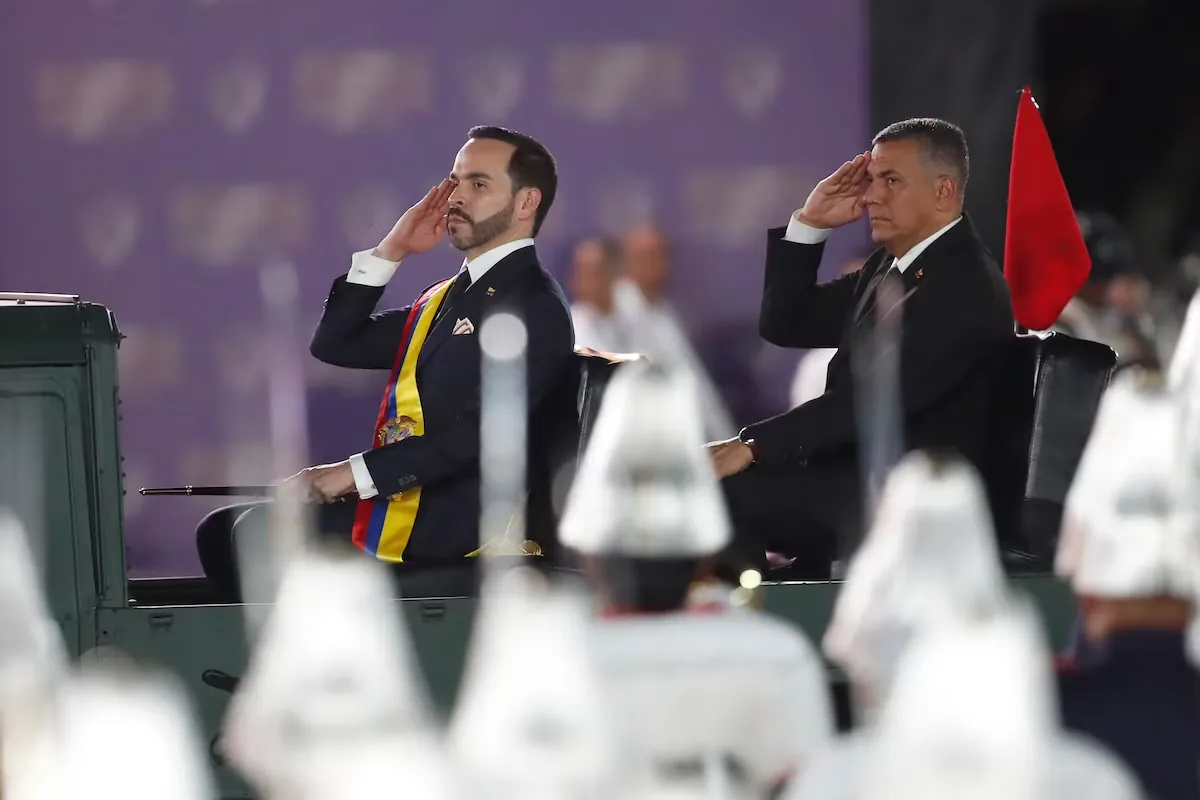
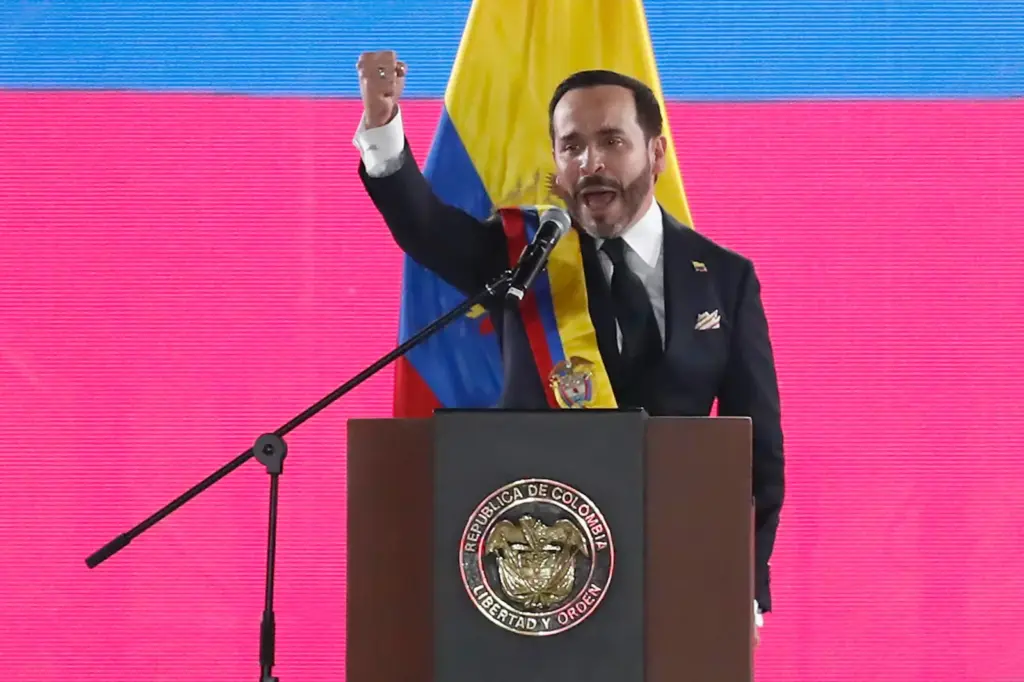
Cali woke up this Friday guarded by more than 11,000 uniformed officers and with the streets adorned with Colombian flags. The third most populous city in the country dressed up for the inauguration of Abelardo de la Espriella as president, an unprecedented milestone: for the first time, a president takes office outside Bogotá. “The time for the recovery of order, freedom, and authority has begun,” he announced in his first speech. The president gave the order to combat all criminal structures. “The Tiger has arrived and you will know how hard he bites when it comes to defending the Colombian people,” he shouted.
Read more The US Army’s ammunition shortage unleashes Trump’s anger
De la Espriella took his oath in an unusual setting, the auditorium of a university where concerts are usually held. The venue, with a capacity for more than 2,500 people, became the center of power in the country for a few hours. While the former president Gustavo Petro left the Casa de Nariño with a serious expression, international authorities and guests from the political, business, and social worlds walked the theater carpets in their finest attire.
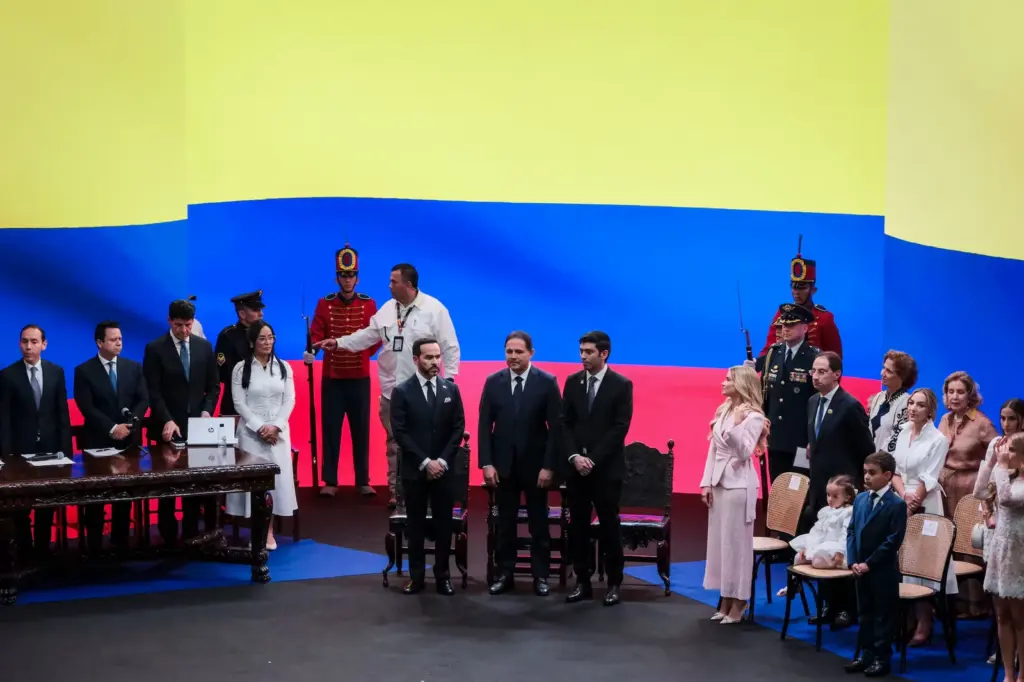
After the parade of heads of state — the Argentine Javier Milei was fervently cheered by a large group of accredited journalists — the new president appeared more than an hour late, dressed in a dark blue suit and white shirt, accompanied by his wife and four children, all protected by bodyguards, machine guns, and bulletproof shields.
Once in the auditorium, and without those protections, De la Espriella received the sash from the hands of the Senate president, Honorio Henríquez, and was brief: “Stand firm for the homeland!”. A 21-gun salute was broadcast in his honor, carried out in Bogotá, and he kissed his wife, Ana Lucía Pineda.
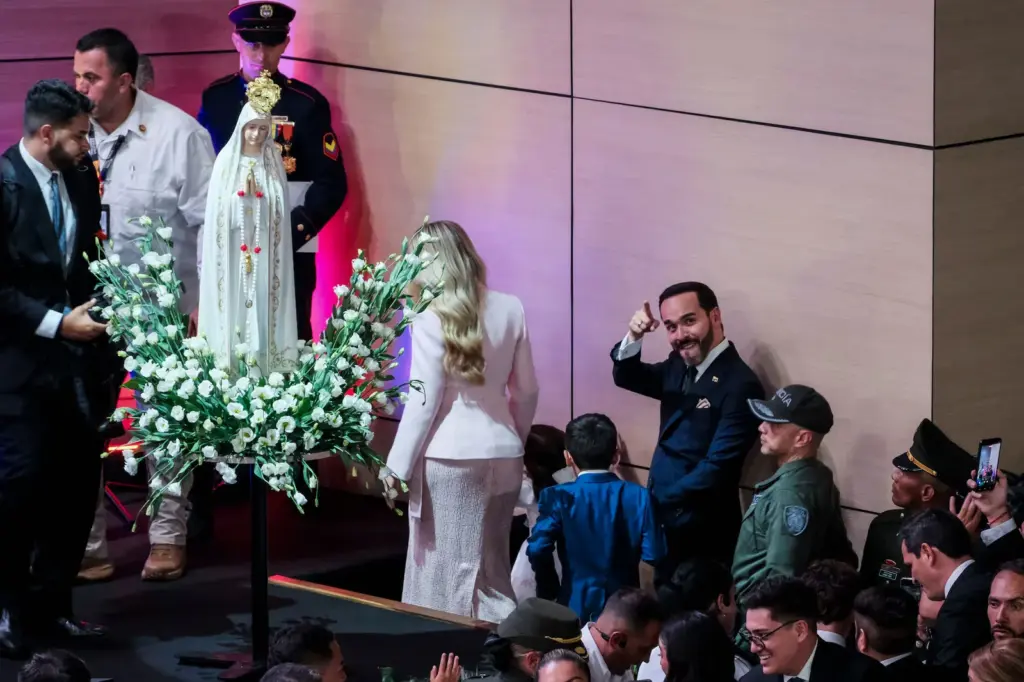
In a corner of the stage, a Virgin of Fatima surrounded by white carnations watched the ceremony. A rabbi pronounced almost a prayer and asked to put God first. “Long live Colombia and long live Israel!” he shouted. Then an evangelical pastor spoke, who got everyone to stand and pray. After that, a Catholic priest. And finally, a monsignor.
While those religious leaders spoke, before the protocol act ended, the president hurried out to reach a nearby military battalion. It was there, before dozens of uniformed soldiers formed in square and in dress uniforms, and not before the congressmen or other authorities, where he delivered his inauguration speech.
The first thing De la Espriella did was thank “Our Lord Jesus Christ” for sustaining Colombia “through a history marked by violence” and stated that he came “to close a long chapter of national resignation.” He highlighted the symbolism of giving his speech at the Pichincha military canton, declared himself president of all Colombians, and claimed that his victory was that of “Colombian democracy,” far from “the Bolivarian totalitarian models.” In the “Miracle Homeland no one will be persecuted for thinking differently,” assured the man who as a candidate did not grant interviews to critical media.
In front of dozens of soldiers formed in square and with impassive faces, the president reviewed the problems Colombia faces, attributed part of them to the “wrong decisions” of his predecessor, and promised measures in all areas. He announced a tax reform, the elimination of the wealth tax, the eradication of coca crops, and the pursuit of organized crime. He promised informal workers that he would strive to include them in the economy and credit systems, assured that he would strengthen the country’s energy sector, and committed to the prosperity of the countryside and its farmers. He swore to end the health crisis and improve education, which must never be “an instrument of ideological indoctrination.” The cultural battle is served, he warned.
The president of Colombia has arrived here by the narrowest margin left by a presidential runoff in 32 years: barely 250,830 votes, or less than one percentage point, ahead of Iván Cepeda, the leftist candidate, Gustavo Petro’s choice to continue his policies. The afternoon of June 21 experienced a heart-pounding count, with Petro live questioning the elections.
The government of The Tiger, as De la Espriella likes to call himself, inaugurates an unprecedented far-right experiment in Colombia: a lawyer without political background who sold himself as an outsider and promised to dismantle the establishment of which he himself is part. A man who challenged party machines with a marketing strategy. Colombia elected a president, but also bought a brand, his own.
Read more Defender Tim Payne enjoys unexpected star fame in Paraguay
His first decisions, however, do not correspond to an outsider. He handed over the state finances to an heir of one of the oldest conservative dynasties. In the foreign ministry, he bet on a MAGA trumpism militant who spent two decades at the UN, an organization he now accuses of being hijacked by “globalism.” And in health, he chose the president of the subcontracted companies’ guild to sustain a system in crisis, which she herself will have to regulate.
Support and absences
The ceremony gathered 10 heads of state, two vice presidents, and 15 foreign ministers, many regional right-wing allies who share his conservative values and cultural battle against the left. In the morning, De la Espriella held bilateral meetings with Milei, the Chilean José Antonio Kast, the Ecuadorian Daniel Noboa, the US delegation, and King Felipe VI.
But some gaps in the guest list drew attention. Nayib Bukele, whose aesthetics and hardline discourse inspired De la Espriella’s campaign; Keiko Fujimori, president of Peru; and the leftist presidents Lula da Silva, Claudia Sheinbaum, and Yamandú Orsi.
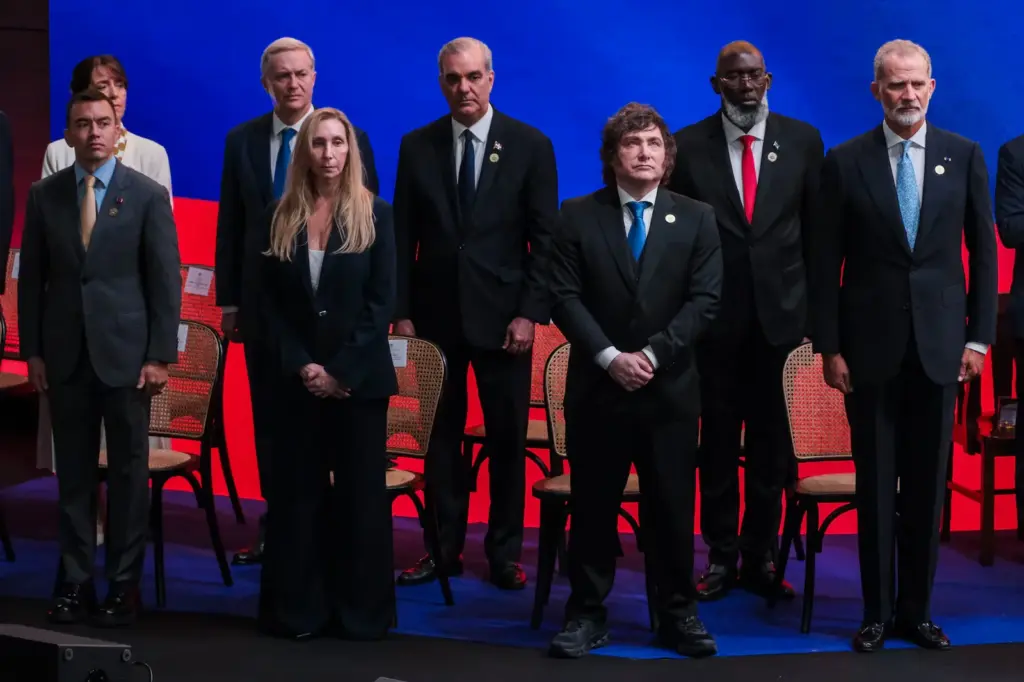
The low rank of the US delegation also stood out. Neither Donald Trump, JD Vance, nor Marco Rubio traveled to Cali. Trump sent a delegation led by the acting attorney general, Todd Blanche, along with the director of the Office of National Drug Control Policy, Sara Carter, and the National Security Advisor to the vice president, Cliff Sims: a judicial, anti-drug, and security profile, without officials of head of state or government rank.
Petro also did not attend, as he still does not recognize the election result, nor did the congressmen of the Historic Pact, who preferred to lead marches in Bogotá, Barranquilla, and Cali. Former presidents Juan Manuel Santos and Ernesto Samper were also absent, explicitly excluded from the list. Álvaro Uribe, leader of the Colombian right, had doubts about his attendance but finally appeared.
The choice of Cali reinforces one of the central campaign messages: governing from the regions and not only from Bogotá. His circle insists that the choice of the southwest is not only symbolic but the point from which the new government will challenge the drug trafficking territory, the great battle of all Colombian presidents.
In the circle of the president-elect, it has been insisted that the choice of the country’s southwest is more than pure symbolism; it is the point from which the new government will begin to challenge drug trafficking territory, the great battle of all Colombian presidents.
The location of the event was, until the last moment, a matter of dispute. De la Espriella wanted to be sworn in at a military garrison to reinforce his hardline message alongside the uniformed. The outgoing president prevented it and ordered that no military or police facility carry out preparations, relying on the fact that until the last second of his term, he remained the supreme commander of the Armed Forces. He argued that a civilian must be sworn in before the people and not before the arms. But De la Espriella found the loophole to get his way.