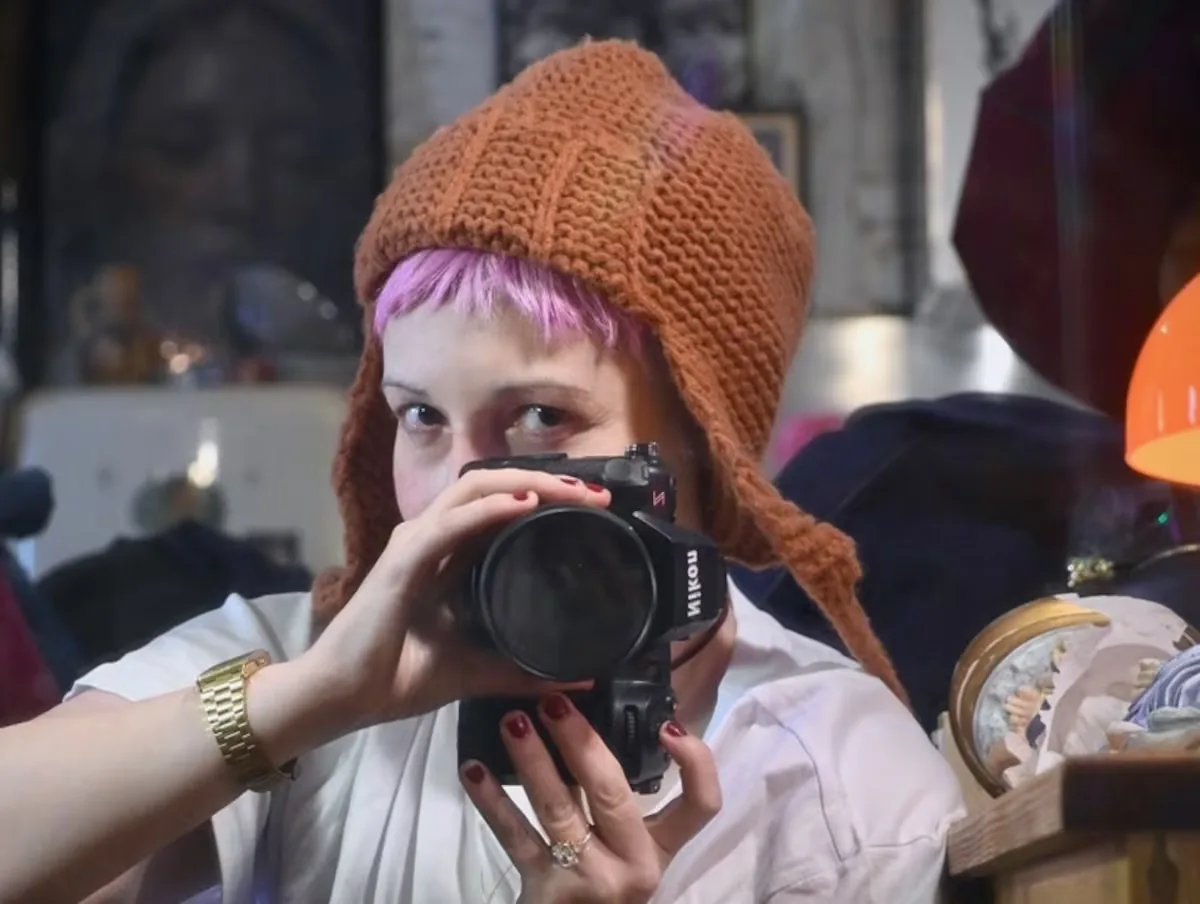
She wears pink hair, giant glasses, golden jewelry, and her cheekbones are well defined with blush. She says “beautiful,” blows kisses, is shy, warm, and smiling. At first glance, it’s hard to find that woman who shouted: “Devil came to me, he said ‘I know what you need,” but the truth is we never had time to know who she really was. Those who knew her in the nineties, with short hair, a gray t-shirt, and baggy pants, will say she was a reference, a pioneer, a leader of something that only happens once every many years. Those who reached the African and electronic phase of Dover: that she got lost, that she was a fraud, “a continuous delirium” they wrote about her penultimate album.
Cristina Llanos (Madrid, 50 years old), co-founder and voice of Dover, has been hidden from the world for 10 years and, if she has ever been able to say anything, she has always done so through the voice of her sister Amparo. She has never wanted to answer journalists, nor will she this time, but now Cristina has decided to speak and write. On September 2, she publishes The night fell and no one could save me (La esfera de los libros, 2026), memoirs in which she tells, among other things, what happened for Dover to cease to exist.
A few weeks before Kurt Cobain took his own life, Cristina Llanos, 18 years old, was returning to her home in Majadahonda on a Saturday night. When ringing the bell to get off the bus, a man stood up and got off at the same stop. She knew him by sight; he had even smiled at her once. She remembers him clearly. Once on the street, he tried to convince her to go for a walk together, first kindly; shortly after, with violence. That man pressed her from behind with what seemed to be a sharp object and said it was a knife. Cristina, unable to react, cried, followed him, let herself be led. He, impatient, called her a slut, stupid, fat. She felt a tingling all over her body and then came the pain.
“From there, I entered a state I can neither describe nor want to,” Cristina writes in her diaries, “thus came the end of the world as I had known it until that night. I lost all connection with it in one fell swoop. And I have never recovered it (…) The Devil took her away.”
After the assault, a silence settled in Cristina that eventually turned into a wound. And then into a sore. She even developed some aversion to Nirvana and, by extension, to Dover whenever someone compared them to Kurt Cobain’s band. Heart-shaped Box, the single from In Utero, became the soundtrack of a hell, and her whole life turned into “The Stagnation,” the word Cristina uses to name the years when the pain spread throughout her body like a sticky mass. On one side were the illness, binge eating and donuts, anorexia, Zaldiar, Robaxin, Enanplus, Tryptizol, and Cymbalta, vodka, tobacco, and depression as a personality. On the other side, “The Miracle,” as she defines the years of Dover, her personal shield, her refuge, a way to keep going.
The night fell and no one could save me is a review of that. A confessional written in bursts of vomiting, in which Cristina talks about the problems she and her siblings experienced at home with their father, various grudges and stomach-turning passions (“I hate Bertín Osborne”), small moments during Dover’s tours, and sleepless nights in her Malasaña home. She talks about some fleeting loves and the love of her life: Samu, Sami, Samuel Titos, bassist who later joined Dover: “the only man who has loved me and whom I have loved and love unconditionally.” The one she once asked to leave.

She also opines. She opines fiercely: against the trans law, in favor of the state of Israel, against the “bastard aliade” ex-deputy Íñigo Errejón. Everything boils in this grumbling current of thought in which Cristina has no interest in appearing lukewarm or politically correct. There is no will to be liked.
Beneath all this purge is the depression that has accompanied her since she was 16. The situation at home was not easy. Her father “threw tantrums nonstop,” had a heavy hand, sometimes, not always, “but often.” “We were all afraid of him,” she says. Sometimes she thinks she hears his voice in hers, and that terrifies her. There was also Mariano, her brother, addicted to drugs for years. Cristina writes about the time she decided not to look at the chaos in which her father, mother, and he lived.
Mariano smoked cocaine base since his twenties and ended up in La Cañada Real, the huge informal settlement located in the southeast of Madrid, under the orders of one of the families controlling drug trafficking in the area. He died on November 18, 2023. The police believed that although the respiratory collapse caused by years of inhaling cocaine base would have come sooner or later, Mariano’s death at 54 was precipitated by a beating, “there, in the damn Cañada Real, the hell he called home.”
In 1994, at 18 years old, the assault happened. Cristina tried to commit suicide and convinced her father to send her to London, where she spent the best seven months of her life. And although eating disorders had been present long before, that night condemned them to accompany her forever. A year later, Dover released Sister, their first album, with which they only sold about 500 copies. But the Llanos sisters did not give up and in 1997 released Devil Came to Me, the album that began “The Miracle,” with nearly 800,000 copies sold, gold and platinum records, an Ondas Award, all from an independent label with “a fax, three people, and a cat,” Subterfuge Records. In 1998, from the wall phone at their parents’ house, Amparo whispered the song DJ to her sister for the first time. Cristina remembers those days with nostalgia: “What a joy, huh?”
During the years of success, Cristina writes in her diaries that she had to deal with vans, sleepers, and tours and, in addition, an irritable colon: “I was shitting all over the world.” In 2000 they took part in the Vans Warped Tour, “the dream of any punkrocker, I imagine, or whatever that meant to me at the time, but by no means the ideal stage to control such a susceptible and treacherous colon as mine.” They shared a bus with the seven members of Flogging Molly, plus their respective stage technicians. Then came I Was Dead for 7 Weeks in the City of Angels (2001), recorded in the United States; The Flame (2003), with which they began to move away from the sound of the early years; and Follow the City Lights (2006), the turn towards danceable pop and electronic music. In 2008 they extended that tour. Cristina was then 33 years old. The miracle was about to disappear.
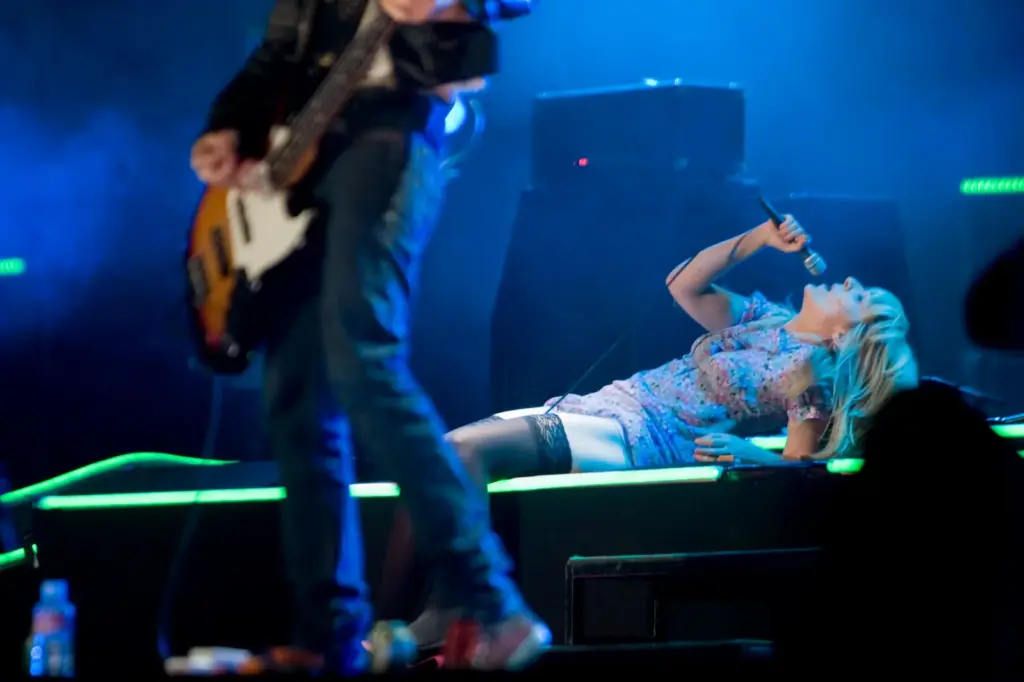
Fibromyalgia —“and traumas, and melancholy”— suffered by the Llanos sisters began to show worrying signs, affecting Cristina’s vocal cords. This disease can affect the voice and cause problems controlling the muscles used to speak and sing. She felt she had lost her only value. “I hadn’t known how to keep it.” On April 8 she writes: “And that’s how, finally, even dead of fear and sorrow, I let go of the Miracle.” Cristina held on a few more years until the I Ka Kené phase. In 2010 Dover released the so-called “African album” and embarked on a much smaller tour than before. Their drummer, Jesús Antúnez, remembers it as the band’s lowest moment, with practically empty concerts. Six years later, in 2016, Dover officially disbanded.
The mere notion of suffering while doing what was once my only refuge breaks my soul badlyCristina Llanos
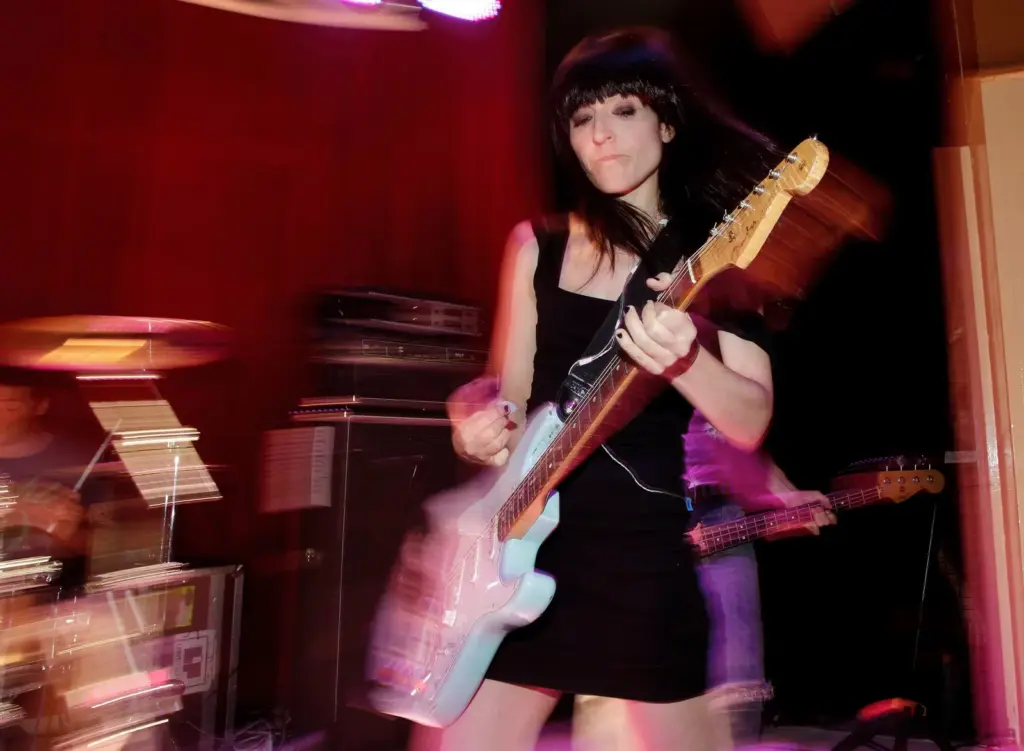
All who lived it will remember what it was like to see the Llanos sisters on stage. All who are too young to have lived it can try to replicate it through a video uploaded to YouTube of the band’s live performance in 2000 at Sala Riviera in Madrid. Cristina Llanos appears in the middle of the stage, practically immobile with a sky-blue Fender Stratocaster in her hands, dark hair, very short, combed forward and to one side, a clean face, and cheeks flushed from the heat. Her sister Amparo wears a black cap pulled down to her eyes, a white tank top, and that huge tattoo that still covers half of her right arm. “The Miracle was Amparo and me, and Amparo was and is the love of my life,” Cristina writes in her book.

Cristina says she does not remember what it was like to live in a healthy body, without ailments. When she dreams that she is asked if she would sing again, she answers that she would rather slit her trachea: “The mere notion of suffering while doing what was once my only refuge breaks my soul badly.” In recent years, while the band went through one of its most exciting but also most complicated phases in terms of audience and acceptance, Cristina fought against herself: “Dyed first redhead, then blonde, and finally my natural dark color. My time wanting to please everyone, anyone (…) my unbridled desire to be what I was not, I am not and will never be naturally, spoiled it, much as I regret remembering it now.”
Many wanting to be her while she wanted to be someone else. These things happen all the time before our eyes. The miracle, like almost everything that later seems miraculous, had started much earlier, in the middle of a stagnation. She had shouted it: “They say I’m dry but I’m just sick” (They say I’m dry, but I’m just sick).