









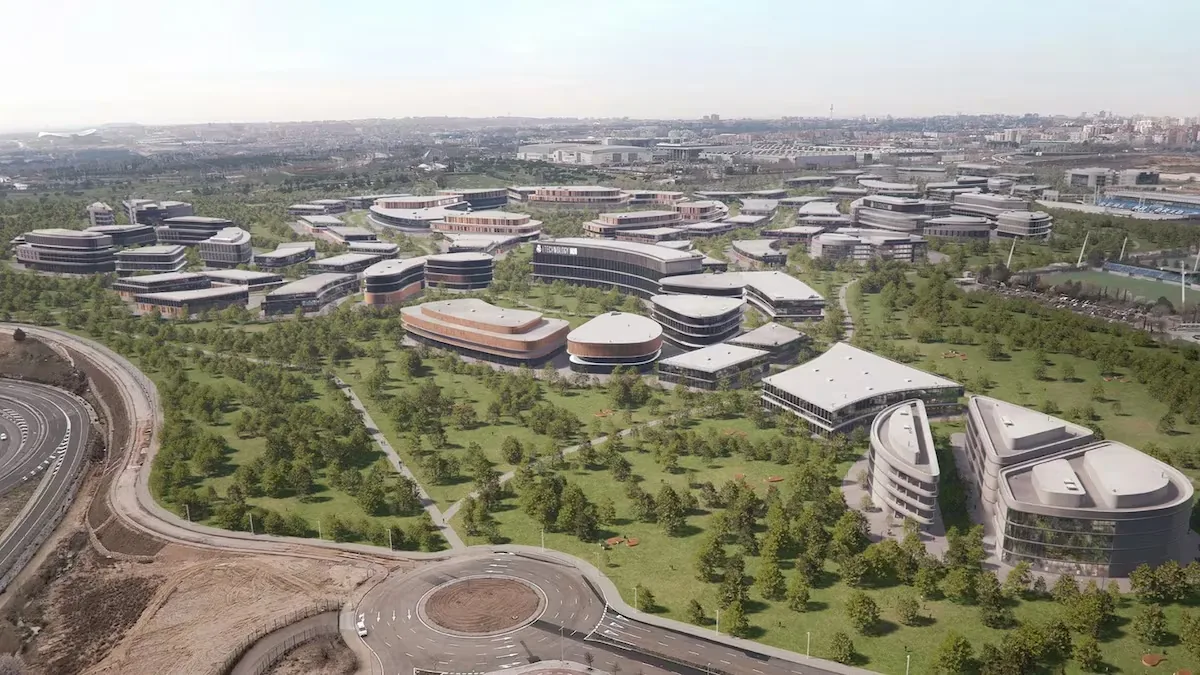
Florentino Pérez, president of Real Madrid, will once again obtain from the Madrid City Council the reclassification of the land of the white club’s sports city. 25 years ago, he achieved it with the land on Paseo de la Castellana, and now he expects the same to happen with the current land in the Valdebebas neighborhood. The council led by José Luis Martínez-Almeida (PP) reclassifies the buildable area of 448,000 square meters of the Real Madrid plot where it plans to give a lucrative use – for offices, a hospital and private university, hotels, and shops. For sports endowment use, it only maintains 89,000 square meters of buildable area, compared to the 360,000 meters of the current regulations, according to the documentation of the urban plan modification.
In May of last year, Pérez, along with Isabel Díaz Ayuso, president of the Community of Madrid, and Martínez-Almeida, presented the Madrid Innovation District project, to give an alternative use to the unused land in the Valdebebas sports city. At the end of July this year, the municipal Government Board initially approved the project, in which it was announced that the total buildable area of the land would become 532,000 square meters, which represents an increase of 172,000 compared to current regulations.
As of this Wednesday, the general plan modification project is available for public information, revealing the details of the urban changes proposed by the city council and which has Real Madrid as the private promoter, being the sole owner of a 1.2 million hectare plot of land currently designated for private sports endowment use. Of these, the white club has used 350,000 meters to build 60,000 of its current facilities, and the rest, 850,000 square meters, are unused.
The relevant aspect of the project is the modification in the buildable area. While current regulations allowed for 360,000 meters for sports endowment use (of which Real Madrid has built 60,000, including the Alfredo Di Stéfano stadium), the project reduces it to a quarter, to 89,000 square meters.
Up to the new 532,000 square meters of buildable area, the rest becomes private equipment (276,000) and tertiary services such as offices or hotels (172,550).
The consequence of the reclassification of uses implies a higher value for the land, which goes from having a residual valuation as sports endowment to having a valuation of 360.1 million euros, according to an attached report from the real estate consultancy Savills. In that document, the sports land is valued at 40.7 million, the private endowment at 133.9 million, and the tertiary at 185.5 million.
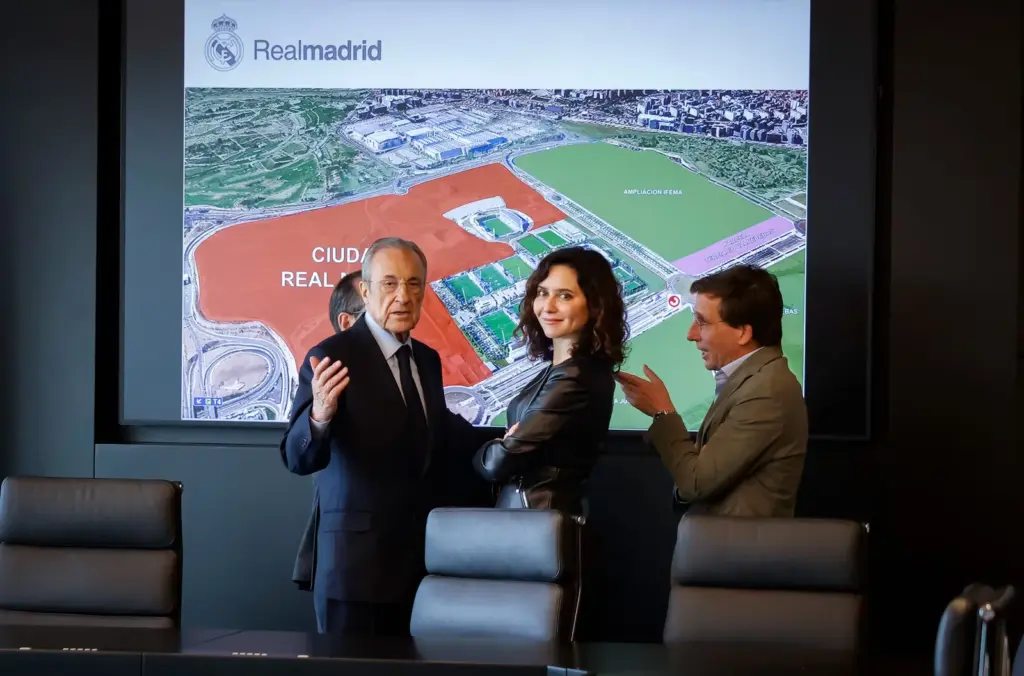
Although Real Madrid is the project promoter, being the owner of the plot, nothing prevents it from selling that land if it deems it necessary to gain liquidity. This is the model it used in the reclassification of the Castellana sports city, where the well-known Cuatro Torres, the tallest buildings in Spain, which house offices, currently stand. It could also choose to develop the project alone or with partners to receive recurring rental income from future buildings.
The project’s economic report indicates a cost of 1.2 billion for building the entire project. The city council’s forecast is that urbanization can begin in 2028 – after final approval from both the council and the Community of Madrid – and construction from 2029. The documents indicate that the development would be stabilized in 40 years and the first revenues for the promoters would arrive in 2031.
Offices and private hospital
The economic report further details the project’s uses. For sports use, Real Madrid will add new football fields and related services (10,000 square meters) and what it calls a sports club (9,993 meters). With these two facilities, it would exhaust the sports buildable area.
For the new tertiary buildable area of 172,550 meters, approximately 100,000 will go to office buildings and the rest to other uses such as lodging (compatible with hotels or medium-stay residential solutions like flex-living), local retail (a shopping center is excluded), and recreational.
In the case of private equipment, approximately 110,000 square meters are planned for healthcare, for example a private hospital, and the same magnitude for education, with preference for a private university. The rest of the buildable area will be used for an auditorium and cultural facilities.
Project justification
The municipal modification justifies in the document that currently only 17% of the maximum buildable area permitted for the Real Madrid plot has been executed, which represents an underutilization of consolidated urban land.
This development of the Madrid Innovation District clashes with the reality of the Valdebebas neighborhood, where since its origin in the nineties, 1.2 million square meters of offices were contemplated on plots that are almost entirely empty of that use for businesses. The Urban Planning department’s document acknowledges that these lands have had a slow pace of occupation – unlike the success of residential areas. But it posits that, being plots of “much smaller dimension” than that of the sports city, they do not have the conditions for the implementation of a technological innovation center like the one Real Madrid is planning.
The Real Madrid plot is located in this neighborhood, northeast of the city, and very close to Barajas airport. In Valdebebas, next to the Real Madrid plot, the Madring urban circuit has also been built, which will host the return of F1 to the region next month.
Read more The robe is in fashion: luxury frivolity or feminist claim?