








We find ourselves at a unique moment for business education: the first artificial intelligence (AI) native generation in history is just around the corner. But we are also in a “situation where human intelligence is under attack.” The echo belongs to Matthew Connelly, Vice Dean of AI at Columbia University (New York). Strong words. “The battle between robots and brains has already begun, and educators can glimpse its end. Young people are becoming so dependent on AI that they lose the ability to think for themselves. And instead of opposing it, academic administrators are facilitating the hostile takeover of higher education.” Connelly is a reference. A Columbia student —he recounts—, Roy Lee, boasted of having developed an AI tool to cheat in online interviews for the tech sector. Venture capital firm Andreessen Horowitz expressed admiration for the “bold” approach and helped him raise 15 million dollars to launch Lee’s company, who stated, without hesitation, that he wants to help users “cheat at everything.”
This is part of the attack. It doesn’t stop. The ubiquitous ChatGPT developed a technology that detected, with 99.9% accuracy, works generated with its tools. It added a kind of watermark. The initiative was shot down by its executives because it could lead some users to switch to a competitor’s product. Is it a war or not? And increasingly, tech companies want to conquer more educational ground. OpenAI intends for an army of bots to become part of the central infrastructure of education. That is, to control academic advising from access decisions to the core. And furthermore, universities are enthusiastically linking up with AI companies, despite decades of evidence on the need to test educational technology first, which often fails to achieve quantifiable improvements in student learning. The German Frankfurt School of Finance & Management signed a collaboration with OpenAI in 2025 to integrate ChatGPT Edu into its teaching, administration, and research. “With the arrival of new generations, […] practical learning and interaction with others will consolidate as key teaching methods,” explains Christian Landau, Vice President of the German center’s Bachelor’s program, via email. And he adds a new derivative: “A school’s network of contacts and the opportunities it offers students during their training, and later as alumni, will be a key differentiating factor.” Now there is a war between those who have an “agenda” and those who lack one.
Similarly, the French business school NEOMA sealed an alliance with Mistral, a pioneering French AI company, which provides each new student with a license for Le Chat LLM —an alternative to ChatGPT—, which they can use to analyze course content, simulate learning experiences, and plan their workload. Professors could, in their offices, use Le Chat to generate teaching materials such as syllabi.
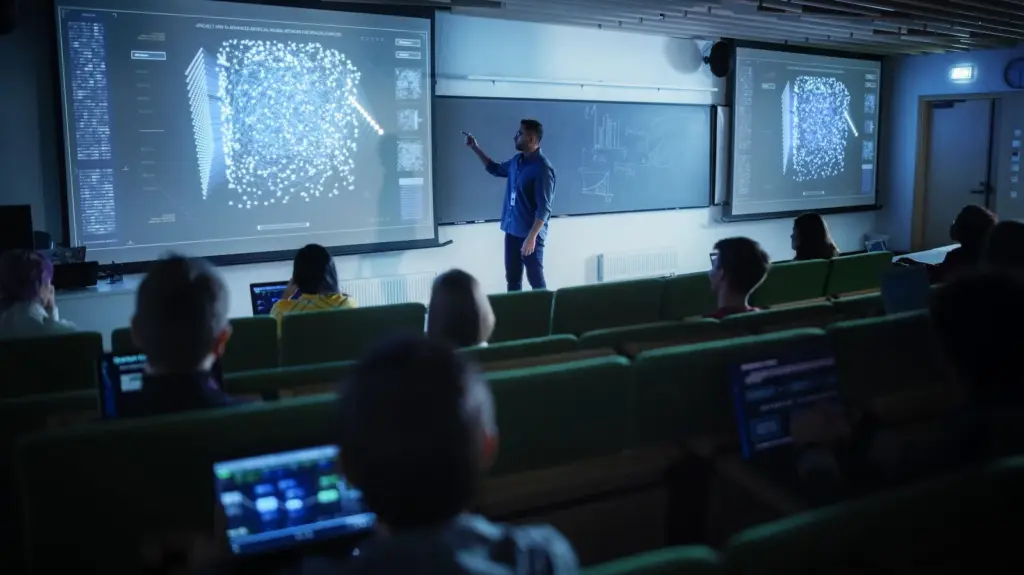
Keeping up with the times
An era of uncertainty where impunity reaches even the elite of the classrooms. Few now deny the friction. Graham Hastie is Associate Dean of Education at London Business School (LBS), one of the best business schools in the world. “The value of a top-tier institution like ours must go beyond transmitting information,” he observes. “It lies in fostering creativity, innovation, and critical thinking; in developing the ability to formulate the right questions, not just the answers, and cultivating the interpersonal, ethical, and leadership skills that are essential for success in a world shaped by AI,” he adds. One might ask what LBS understands by success. For now, the conversation turns to other horizons. “We focus on helping our students develop uniquely human capabilities that AI cannot replace: empathy, resilience, judgment, and the ability to inspire and lead diverse teams.” You will have heard it a thousand times: leaders who generate value for society and businesses. But there is something that reads like one of the many business management manuals for sale. “AI-based recruitment processes imply that trust and credibility are a crucial factor,” admits Hastie. No Roy Lee-style cheating. And to protect themselves, curricula and teaching methods will change. “Content will cease to be the focus and capabilities will become the focus: critical thinking, analysis, decision-making in uncertain environments, and understanding AI as a tool. This implies teaching oriented towards real problems, where the humanistic gains weight over the purely technical,” ventures David López, Dean of the MBA at Esade.
Back to the grammar of war, the war is already laid out and its strategists have clear moves. In a recent conversation with the Financial Times newspaper, Mustafa Suleyman, CEO of Microsoft AI, predicted that in 18 months, law and MBA graduates —and many other less qualified professionals— will be out of work. The transformation will be more drastic —the executive admitted— than that experienced before the pandemic. Semantics offers other options. Instead of war, it can be called a fracture. How to overcome it? “The goal is to train professionals capable of orchestrating work in hybrid teams of humans and AI, generating impact in the new world of work,” comments, also by e-mail, Lee Newman, Dean of IE Business School at IE University. The professor still trusts in human beings. In 600 BC, the philosopher Anaximenes asked his teacher Pythagoras: “Why should I bother seeking the secrets of the stars if I constantly have death and slavery before my eyes?” Asking ourselves questions like these reminds us of the species we are and the way to advance as a global society. “Our approach combines technological innovation with humanism,” says Newman. “We have integrated OpenAI tools into our educational ecosystem from the beginning and are focused on how AI can support teachers in personalizing teaching.”
A challenge, just like Anaximenes’ question. The studies cited by Columbia University suggest that students using AI do not read with the same attention when researching and write with less precision and originality. They ignore what they are missing; reading carefully, thinking critically, and writing logically are the skills needed to harness the true potential of AI.
However, the future depends a lot on who you ask. “It is possible that teachers can be replaced for certain tasks, such as office hours, some virtual programs, and the preparation and grading of exams,” predicts Mauro Guillén, Vice Dean at The Wharton School of the University of Pennsylvania (USA). The center has incorporated AI courses into MBA programs. If we listen to the Graduate Management Admission Council (GMAC), a firm specializing in the sector, 46% of business schools consider AI to be fundamental in an ideal curriculum.
Read more Iran prevails in the propaganda battle against Trump
Traveling to Belgium, where there are countless current institutions affecting Old Europe, students can stop at the Vlerick Business School; it holds a mid-range position in the rankings, but it enters the club of prestige. They use AI to leap (that’s the verb they use). “From creating your own company to accessing a new international position,” summarizes Steve Muylle, Associate Dean of Digital Learning at the center. Leap. On such a technological planet, verbs rarely mattered so much. The attack is as evident as if the front page of every newspaper caught fire simultaneously. The way to put out the fire changes. “The value no longer lies in accessing knowledge, but in interpreting it, questioning it, and using it with discernment,” emphasizes Carlos López, Dean of Esic Business & Marketing School in Madrid. “The differentiating value of a school cannot be to compete with AI, but to teach how to think with it,” he clarifies. Avoid confusing “assistance with substitution.”
These cutting-edge technologies pose the challenge of the red line. Where to set the limit. In the course AI Essentials for Business —translatable as Basic Artificial Intelligence for Business—, taught online by Harvard University, one of the appeals to attract students is that mastery of those two letters brings in an extra 20,000 dollars (17,300 euros) to an average salary. Not long ago, a business school in Madrid proposed billboards with the English slogan: Business and only business. “AI is a technical competence and they can be natives, but understanding it in depth requires learning, and professors are not very enthusiastic because they think students abuse it to save work,” says Franc Ponti, Professor of Innovation at EADA (Barcelona). “We give very practical and participatory classes: mobile phones are prohibited and computers are turned off,” he adds. His purpose is to incorporate AI into creative processes.
Less prepared students
Pessimists persist in every sense. We have seen it with Mustafa Suleyman, head of Microsoft AI, but also Tyler Cowen, professor at George Mason University (Virginia, USA), who insists from the Business Insider platform that universities are “producing a generation of students who will enter the job market very ill-prepared for what is expected of them,” as AI transforms the world of work. Economic prophets have always existed, and there have always been those who failed and those who succeeded in their predictions. If in any country in the world a Catholic analogy takes its place, that is Italy. “Because students can get answers instantly, our job is to help them formulate better questions,” advises Dirk Hovy, Dean of Digital Transformation and AI at Bocconi University (Milan). “This implies strengthening critical thinking, the ability to detect biases, and questioning the assumptions of machines and people.” Teachers change their narrative, moving from being the sole authority in the classroom to acting as guides, provocateurs, and companions in intellectual debate.
Something that brings us back to the confrontation between man and machine. An already declared conflict that does not use blank ammunition, it is real. “History shows that wars can be lost even before they are declared if defenders cede strategic ground without a fight. For universities, that ground is the highest possible exponent: human intelligence itself. If we don’t fight for it now, those who come after will face an even more unequal fight,” warns Matthew Connelly in The New York Times. Higher education needs to incorporate the dialogue between Anaximenes and Pythagoras into the learning of cutting-edge technologies, just as it did 2,626 years ago.
Equitable access, a key subject
These are the times of a new Library of Alexandria or its new destruction. The binding is centuries old and the prologue is as expected. “Our task is to ensure that all students have equitable access to high-quality tools and a deep understanding of how they work,” says Cloda Jenkins, Associate Dean for Pedagogical Education and Innovation at Imperial Business School (United Kingdom), one of Europe’s top institutions according to the rankings. “And that they can use these tools ethically to help solve problems,” she adds. Critical thinking, diversity of ideas, and collaboration with new technologies share a shelf in this technological Alexandria. Some experts are carried away by a neogrammar. “Tomorrow’s leaders must become orchestrators of artificial intelligence (AI), capable of defining intentions, guiding intelligent agents, questioning results, and translating distributed intelligence into purposeful actions,” enumerates José Esteves, Dean of Porto Business School. The professor is clear: ethics, creativity, and discernment —even as AI increases its impact— will continue to be very human. The persistence of memory.
Read more In Caracas without Maduro, «right now everything is a priority»