


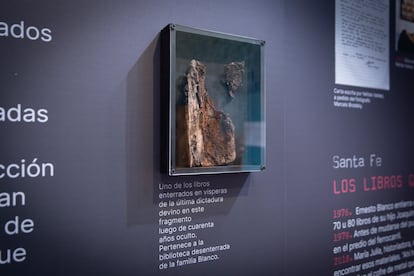
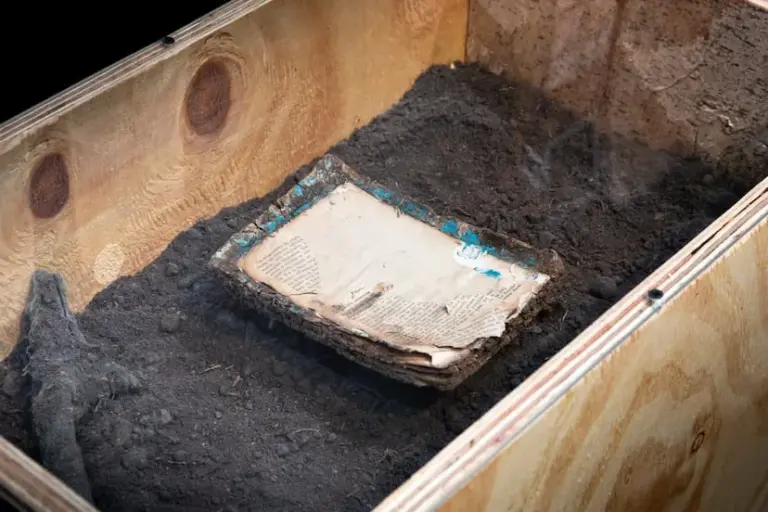
A fossil-book—covered in bark, almost camouflaged with a trunk—was exhibited at the 50th edition of the Buenos Aires Book Fair, which closes this Monday with great public success. It belonged to the library that Ernesto Blanco’s family buried in 1976 in the yard of their house in San Gregorio, in the Argentine province of Santa Fe, out of fear of the military who had taken power on March 24 of that year. The books belonged to Joaquín, a student and socialist activist. They spent 42 years underground. When unearthed, they could not be read, but they were unique objects, memories of a past in which books and songs were banned and thousands of Argentines were persecuted for their political ideas. Those who did not manage to escape in time were kidnapped, tortured, and disappeared.
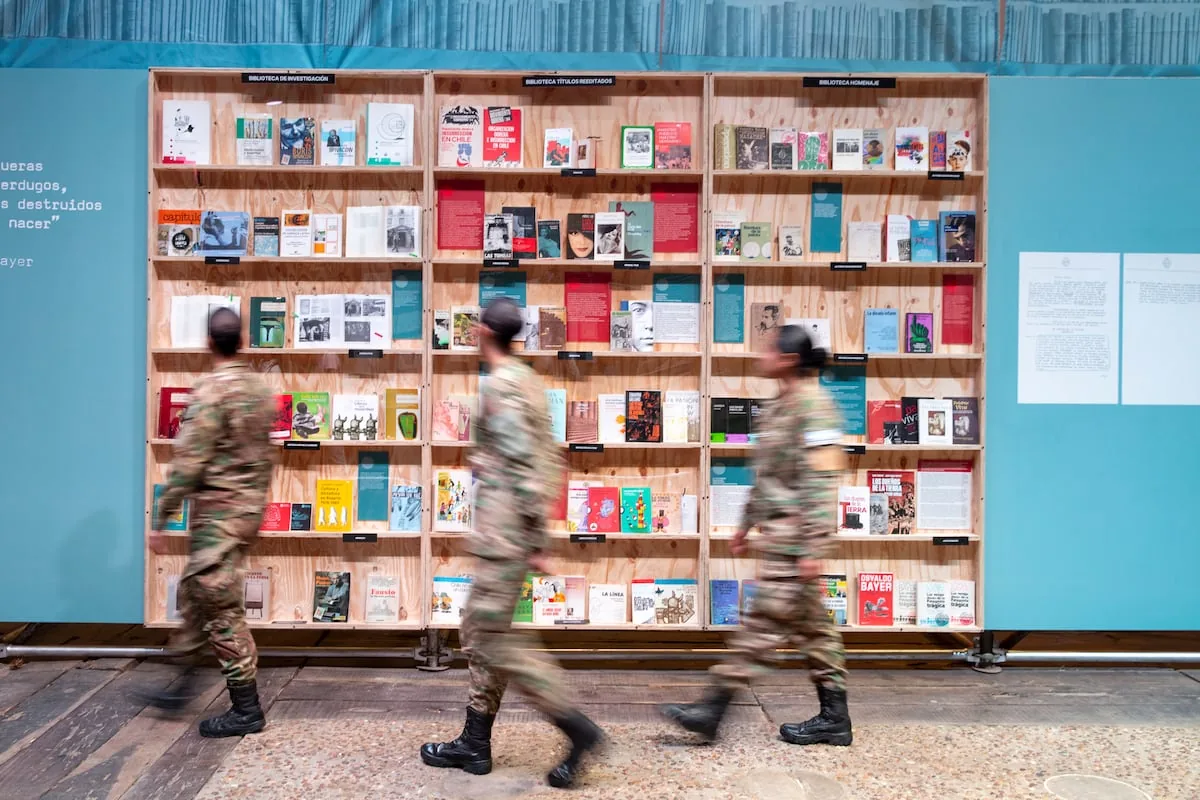
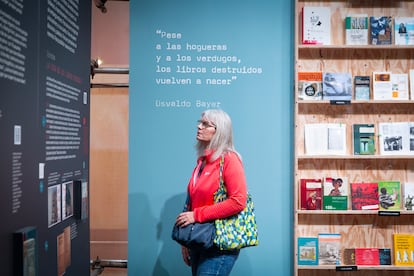
The exhibition Planned Censorship. Books in the Crosshairs of the Dictatorship showed the ways in which the military regime attacked culture between 1976 and 1983. The military raided several publishers—such as Eudeba, the Latin American Publishing Center, and Ediciones La Flor—ordered their closure, and seized everything they deemed subversive. On June 26, 1980, 24 tons of books—the equivalent of one and a half million copies—were burned to ashes.
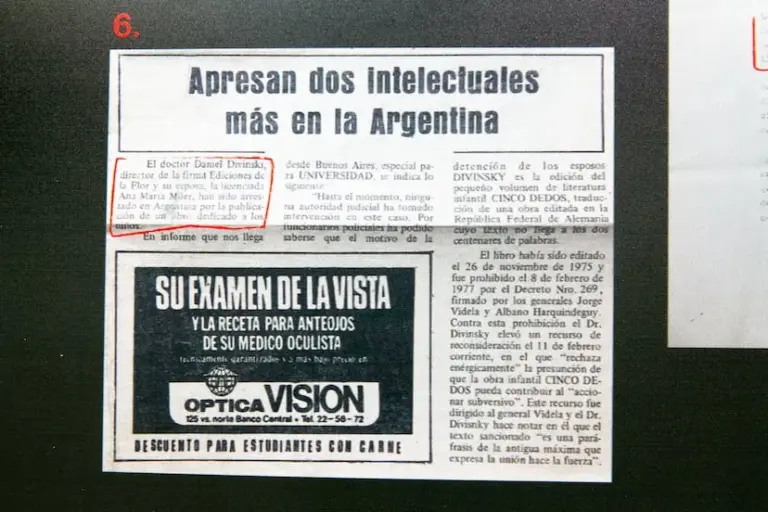
The couple behind Ediciones La Flor, Daniel Divinsky and Ana María Kuki Miler, were imprisoned because a general’s wife interpreted that one of the books they had published was a mockery of the army. They spent 127 days in prison. They gained their freedom thanks to the solidarity of national writers and foreign publishers. They went into exile until democracy returned.
In those years, there were also books stripped of pages, guillotined, and thrown in the trash. “They were personal and human reactions of self-defense against fear,” says the exhibition text. “Those who went through those dilemmas remember them with pain and shame,” it continues.
The fear was so fierce that some writers do not even remember how they got rid of their libraries. This is the case of María Negroni, the author of The Heart of Damage. Negroni was 24 years old, a law student and political activist when the dictatorship began. “We read Marta Harnecker, Mao, Malraux, Mariátegui, José Martí, Abelardo Ramos, Hernández Arregui, Juan Gelman, John William Cooke. And we listened to the records of Víctor Jara, Violeta Parra, Mercedes Sosa; we watched Pino Solanas’ films. That was the world I moved in, and when the military coup came, I can say I had a disappeared library: I don’t remember how I got rid of those books, those magazines, those records,” she recalled in one of the round tables of the cycle 50 Years of Writings and Readings in Argentina, coordinated by writer and journalist Verónica Abdala. “I went into exile in a house in the southern area of Buenos Aires province, and in that house, there were no books. I have no memories as a reader because I was very busy trying not to be killed,” she said.
Writer Clara Obligado barely escaped. She said that in 1976 she was a literature student and was about to become an assistant in French literature when she saw everything around her becoming tense and decided to go into exile in Spain, where she still lives today. Within 24 hours of leaving the country, the military came looking for her. Vicente Battista had already crossed the Atlantic before the military regime began, but he was not spared from persecution and looting. Two weeks after the coup, members of the Navy surrounded his parents’ house, broke down the door, and stole everything they wanted. “They took all my photos, my writings, my love letters, they left me nothing, not even a photo from my childhood,” Battista recalled at the table he shared with Negroni.
The fair’s exhibition displayed dozens of books censored by the regime. The selection included political essays but also novels—Earn Death, by Griselda Gambaro, The Little Bottle, by Luis Gusmán, among others—and children’s stories, such as An Elephant Takes Up a Lot of Space, by Elsa Bornemann and The Tower of Cubes, by Laura Devetach. The copies in circulation were seized and destroyed one way or another.
Also on that list were the works of chronicler Tomás Eloy Martínez, whose son, Ezequiel Martínez, now presides over the Book Fair. “My father was on all the highest danger lists of the dictatorship, including the last one in 1983, when only 46 names remained,” Martínez emphasized when inaugurating a marathon of reading banned books. He recalled that in the prologue of The Passion According to Trelew he left a message that resonated during that dark page of Argentine history and remains relevant today: “The memory of the people will always be longer than the cunning of those who repress it.”
Writers and editors invited to the Fair recalled the fear they had to overcome in those years and warned against current attempts at censorship, such as the unprecedented ten-day closure of the Casa Rosada to journalists ordered by the Javier Milei government or the witch hunt launched against alleged pornographic books in schools last year.
Some authors, like Luisa Valenzuela, decided to go into exile in the late seventies because they did not dare to show anyone what they wrote for fear of putting them in danger. Others decided to stay and face threats and job dismissals imposed from above, like Juan Sasturain and Liliana Heker. They could no longer meet in bars or cafes, but they did not stop writing, inventing ways to circumvent censorship, or sharing culture. One of the cracks was workshops, turned into refuges to talk about literature, writing, or philosophy, like the one given by thinker Santiago Kovadloff at his house. “They came one by one because many were suspects and some never returned,” Kovadloff recalled.
The activities related to the 50th anniversary of the coup were one of the central axes of a fair that also celebrated its half-century of life. The public supported the celebrations of the most massive literary event in Buenos Aires, with 1.3 million visitors, almost 10% more than the previous year.